
Creases in foldable displays have long been considered a challenge for foldable phones. For the panels used in the Galaxy Z Fold 8 series, Samsung Display replaced the existing plastic backing film with a titanium alloy film—which is approximately 20 times stiffer—and added a reinforced titanium plate to create a dual-titanium structure, reducing the display thickness by 12% compared to the previous generation. The reinforced titanium plate allowed for the fabrication of smaller micro-holes in the folding area, enabling a denser application of the adhesive layer; this improved both the impact dispersion effect and the visibility of the crease. The crease is now being treated not as a mechanical byproduct of hinge movement, but as a matter of material properties controlled through a layered design.
A foldable OLED module consists of a single integrated system comprising a hard coating, a protective film, an UTG (ultra-thin glass) cover window, multiple OCA layers, an OLED panel with an integrated TFE touch layer and COE structure, and a metal backplate. The technological competition in 2026 hinges not on the performance of individual layers, but on how interlayer stiffness is distributed and where the neutral plane is positioned.
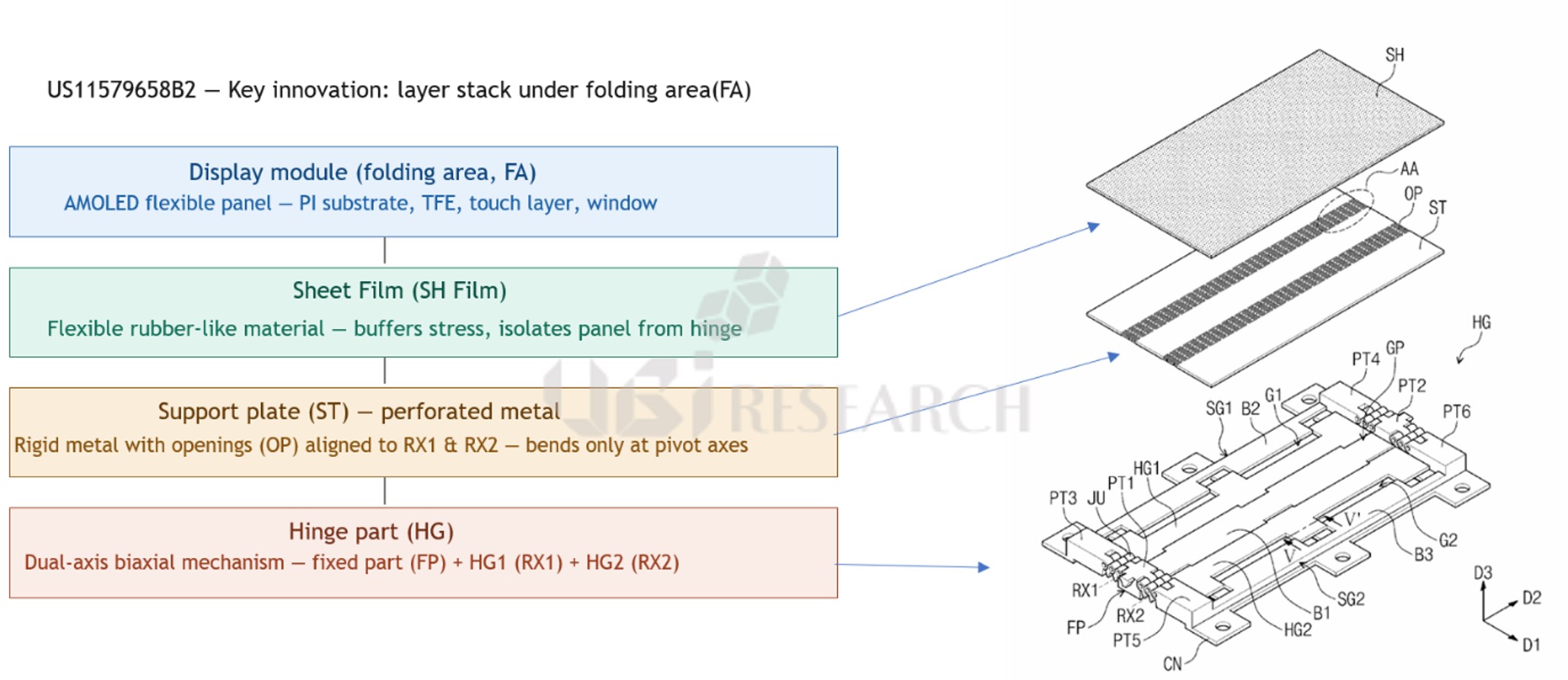
Samsung Display’s folding-area stack structure and crease reduction technology example (Source: UBI Research)
- Four Pillars of Crease Reduction Technology
Crease control in foldable displays has long been regarded as a task for the hinge mechanism, but in 2026 the center of gravity is shifting toward controlling the layered structure inside the panel. The cover window, adhesive layers, metal support plate, and hinge materials are no longer improved independently of one another; they have entered a stage where they are optimized together within a single structural design.
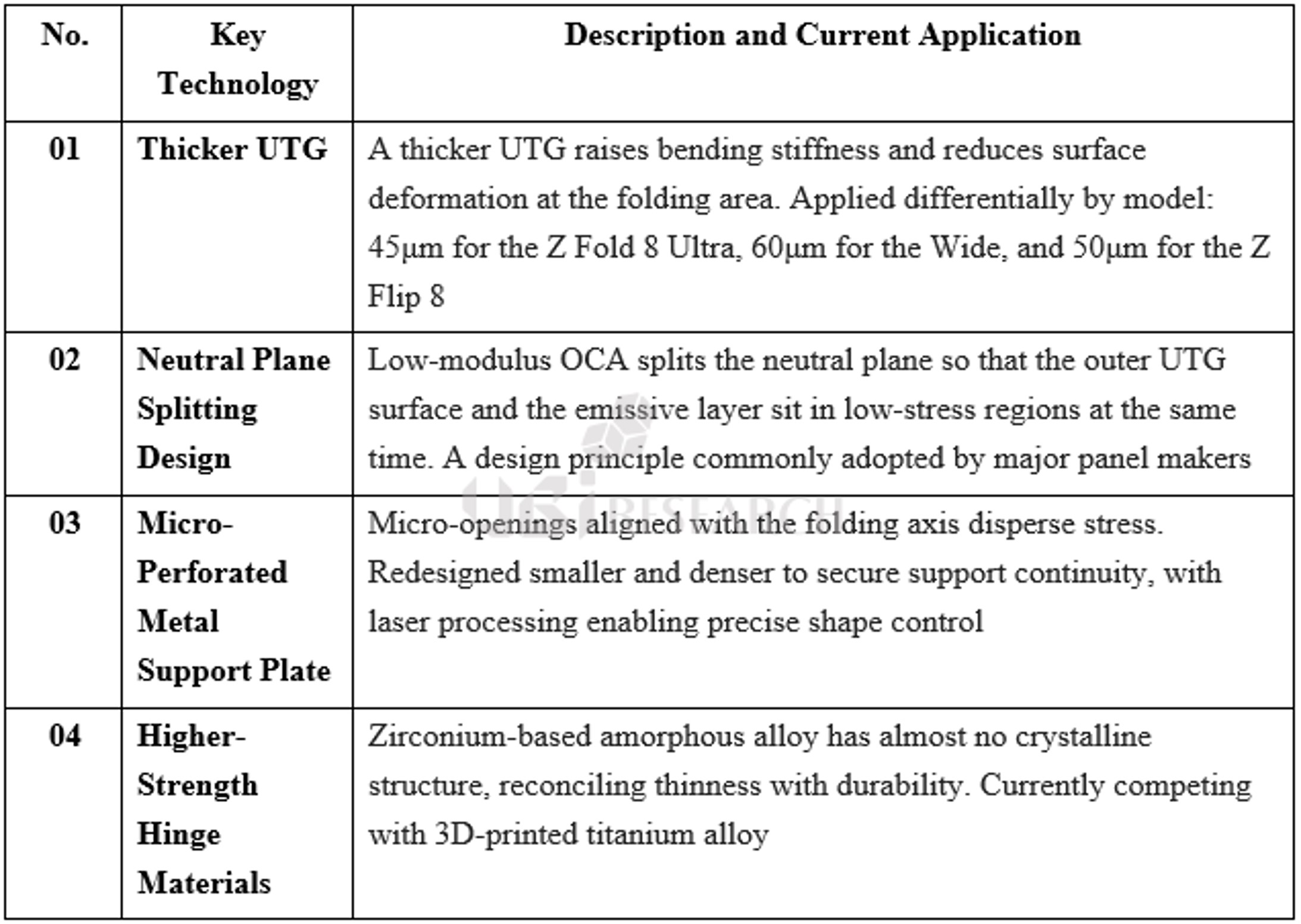
Summary of key crease reduction technologies for foldable displays in 2026 (Source: UBI Research)
Meanwhile, dual UTG—placing UTG not only as the cover window but also as a support layer beneath the panel—known as GMF (Glass Mid Frame), is discussed as a next-generation structure that distributes folding stress symmetrically above and below. It has not been applied to the Galaxy Z Fold 8 series, however, and remains under review primarily for Apple’s foldable and for foldable IT devices.
- Material Technologies Supporting a Thinner Stack
Crease reduction and stack thinning ultimately point in the same direction. The COE (Color filter on Encapsulation) structure, which removes the polarizer, lowers both stack thickness and bending stiffness, with Black PDL taking the place of the black matrix. The issue is the cost burden created by the additional photomask steps. The halftone Black PDL (HT-BPDL) under review at Samsung Display is an approach that forms the PDL and the spacer together in a single photo step, reducing the number of mask steps from six to five.
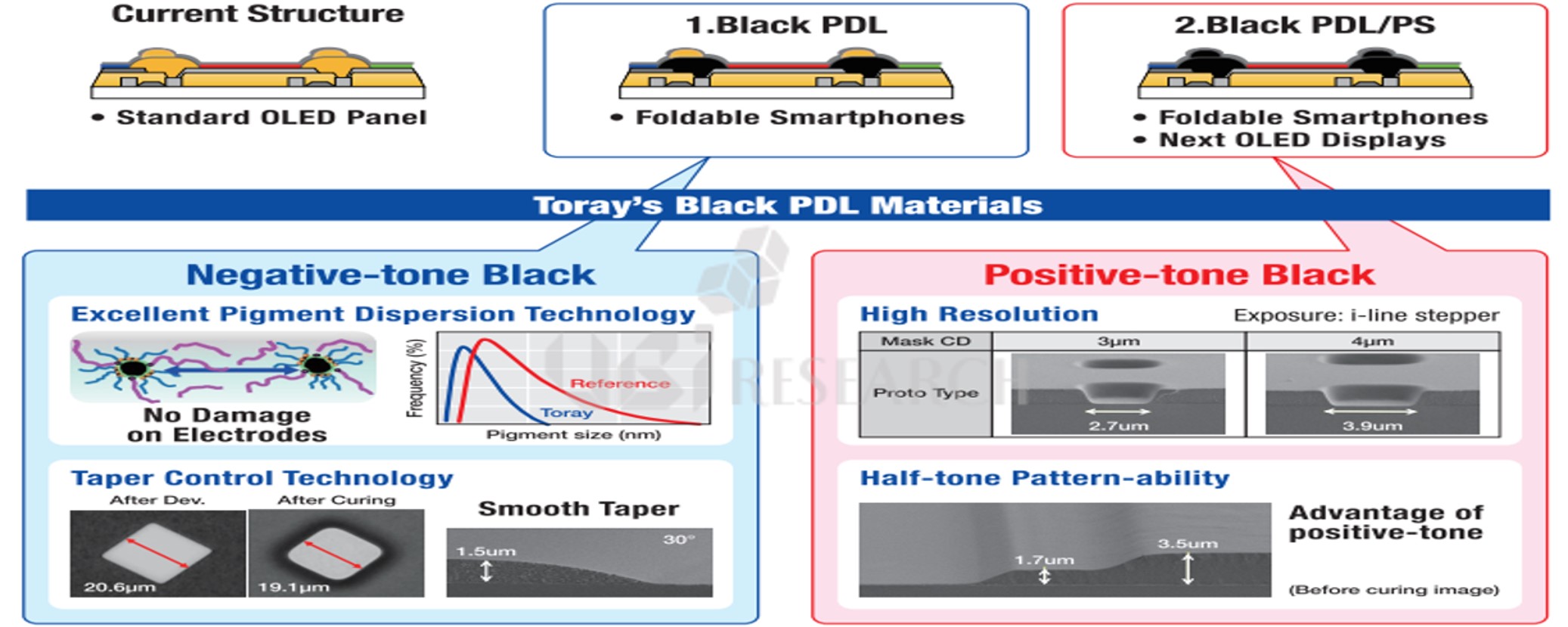
Toray’s half-tone Black PDL development case (Source: UBI Research)
OCA is likewise not a simple adhesive but a structural material that determines the position of the neutral plane. It must deliver a low modulus for interlayer decoupling, a high elastic recovery rate to suppress buckling, and the creep resistance that governs static folding reliability. These requirements conflict with one another, yet each can be controlled independently, so they can be reconciled at the molecular design stage. Silicone-based OCA already entered mass production with the Galaxy Z Fold 7 and is stable across a wide temperature range, while reworkability remains a challenge.
- Material Roadmap Leading to Next-Generation Form Factors
Next-generation form factors each carry a different set of challenges. Tri-fold devices have already reached mass production, but the three folding sections are not uniform in thickness, and how to handle the interaction stress between the two hinges remains an open question. OCA with a different modulus for each folding zone is cited as a promising solution, but it still requires validation for mass-production use. Rollables face continuous curvature across the entire screen rather than at a discrete folding section and must withstand multiple winding turns, so the requirements for the cover material differ fundamentally from those of foldables. This is why Samsung Display presented an elastomer protective film at SID 2025 with elastic recovery performance far exceeding that of polyimide. The neutral plane design and interlayer stiffness distribution principles established in foldables remain valid for next-generation form factors, but the question of which materials will realize them must be answered anew for each form factor.
Changho Noh, Senior Analyst at UBI Research (chnoh@ubiresearch.com)
▶2026 In-Depth Technical Report on Foldable Displays
▶Display Korea 2027: Where Global Display Business Connects
※ This article is produced by UBIResearchNet.
Unauthorized reproduction or citation without source attribution is prohibited.
When quoting, please clearly indicate the source (UBIResearchNet) and provide a link.