
The foldable smartphone market is rapidly restructuring around the wide (landscape-oriented) form factor. Unlike conventional foldables that open into a vertically elongated display, wide foldables unfold into a broad screen closer to a compact tablet, offering a clear advantage in document editing, multitasking, and video consumption. Following Huawei’s initial foray into the category, Samsung Electronics and Apple are both slated to launch new models with a 4:3 aspect ratio in the second half of 2026, positioning the wide foldable as the new centerpiece of the premium market.
Huawei officially launched the wide foldable Pura X Max in China on April 20. The device features a 7.7-inch inner OLED and a 5.4-inch outer OLED, with an inner resolution of 2584 × 1828 at a 14.1:10 aspect ratio — wider than the conventional 16:10. When unfolded, it measures 5.2 mm thin and weighs 229 g, powered by Huawei’s in-house Kirin 9030 Pro chipset and a 5,300 mAh battery. Priced from CNY 10,999 (approximately KRW 1.52 million), the device sold over 200,000 cumulative units within its first 10 days on sale.
Samsung Electronics is expected to unveil the Galaxy Z Fold 8, Galaxy Z Flip 8, and a new wide model — the Galaxy Z Fold 8W (Wide) — simultaneously at its Galaxy Unpacked event in July. The wide model is projected to feature a 7.6-inch inner display and a 5.4-inch cover display at a 4:3 aspect ratio, dimensions comparable to those of the Pura X Max, with an unfolded thickness of 4.3 mm, a 4,800 mAh battery, and a dual-camera system.
The single largest variable in the 2026 foldable market is Apple’s debut in the category. A foldable iPhone is expected to launch alongside the iPhone 18 Pro in September, featuring a 7.8-inch inner OLED, a 4:3 aspect ratio, and an ultra-thin titanium frame at 4.5 mm when unfolded.
Meanwhile, Samsung is reported to have revised its annual foldable shipment target down from 6.5 million to 6.0 million units in consideration of rising memory prices and Apple’s forthcoming entry, while simultaneously increasing the panel shipment allocation for the Galaxy Z Fold 8W (7.6-inch).
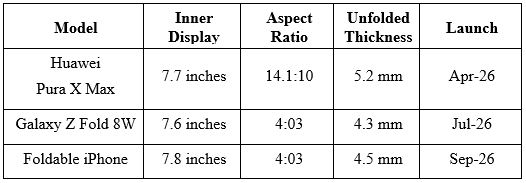
Comparison of major wide foldable phone specifications in 2026 (Source: UBI Research)
UBI Research characterizes the rise of wide foldables as a structural shift in foldable OLED design philosophy. As the industry’s center of gravity moves from maximizing screen size toward optimizing the width-to-height ratio, the simultaneous optimization of the display stack and hinge design is emerging as a core competitive differentiator.
The sequential launch of the Huawei Pura X Max, Galaxy Z Fold 8W, and the foldable iPhone through 2026 will mark an inflection point at which wide foldables transition from niche to mainstream, and panel-level crease suppression technology along with ultra-thin hinge materials are expected to remain central axes of competition through 2027.
Changho Noh, Senior Analyst at UBI Research (chnoh@ubiresearch.com)
▶2026 Analysis Report on China’s OLED Supply Chain Management
▶2026 Small OLED Display Annual Report
※ This article is produced by UBIResearchNet.
Unauthorized reproduction or citation without source attribution is prohibited.
When quoting, please clearly indicate the source (UBIResearchNet) and provide a link.