
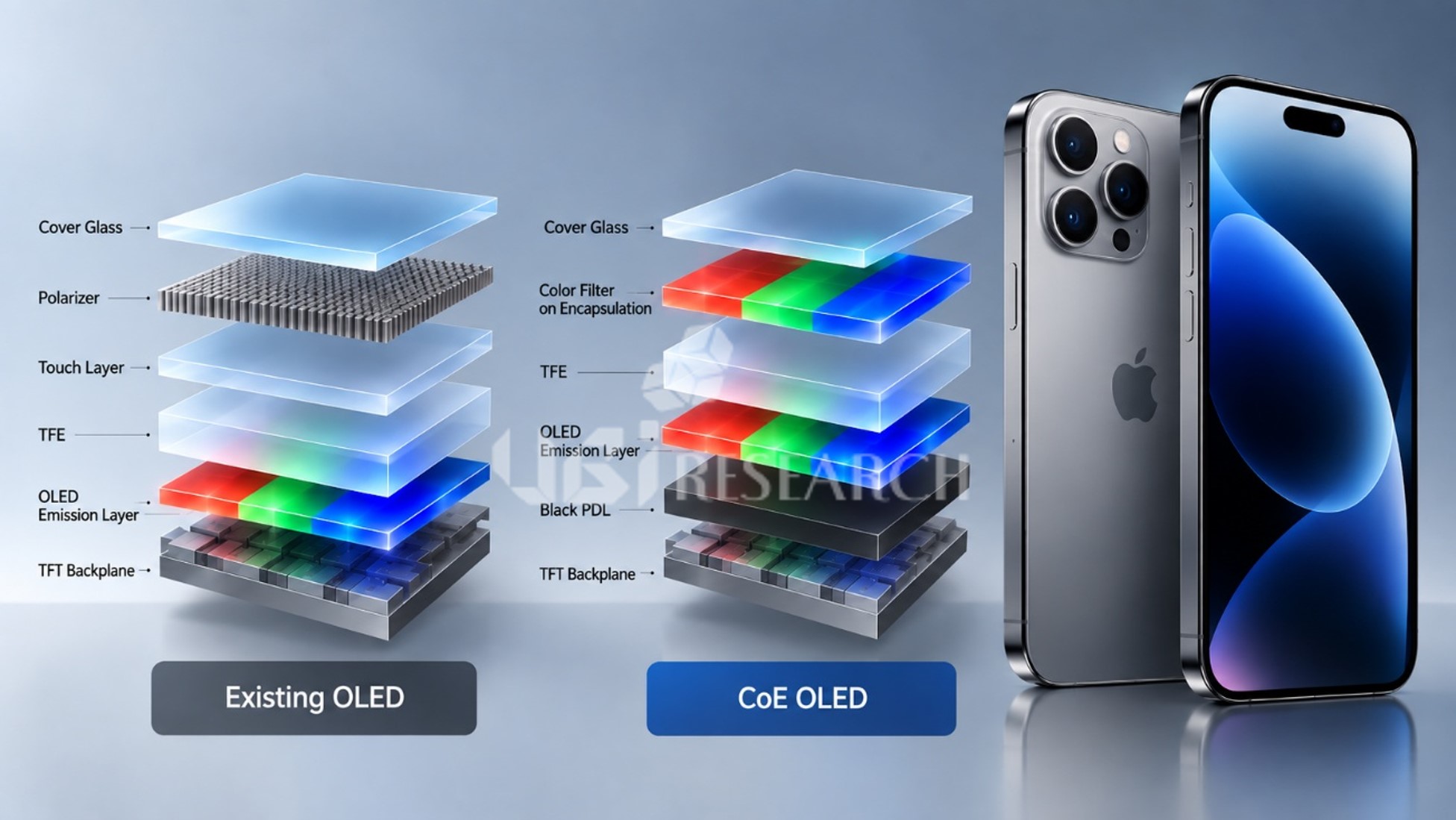
Comparison of conventional OLED and polarizer-free CoE OLED structures (AI-generated by UBI Research)
Apple is expected to apply CoE(Color Filter on Encapsulation) technology to its bar-type iPhone Pro and Pro Max lineup scheduled for release in the second half of 2029. CoE is a polarizer-free OLED technology that removes the conventional polarizer from the OLED panel and forms a color filter on top of the encapsulation layer. Considering that the polarizer absorbs a significant portion of the light generated inside the OLED, CoE offers structural advantages by enabling higher brightness at the same power consumption or lower power consumption at the same brightness. By eliminating the polarizer, CoE can also reduce panel thickness, making it advantageous for thinner and lighter premium smartphones.
CoE was first commercialized in foldable OLED. Samsung Display commercialized polarizer-free OLED by applying Eco² OLED to the Galaxy Z Fold3, and has since expanded the application of this technology from foldable devices to bar-type smartphones. Samsung Display explains that the technology can improve transmittance and reduce power consumption. Recently, polarizer-free OLED technology, known as CoE or OCF(On-Cell Film), has been expanding beyond foldable OLED into bar-type flagship smartphones and IT products.
CoE Expected to Expand from Foldable to Bar-Type iPhone
Apple is likely to introduce CoE in stages. Its first foldable iPhone, expected in 2026, is anticipated to serve as the starting point for CoE adoption, followed by expansion to the bar-type iPhone Pro lineup. Apple has typically adopted new technologies first in premium or new form-factor products before expanding them to higher-volume mainstream models. CoE is likely to follow a similar path.
If CoE is applied to the bar-type iPhone Pro and Pro Max in 2029, its impact on the OLED supply chain is expected to be much greater than that of the foldable iPhone. Although the foldable iPhone carries strong technological significance, its initial volume is likely to be limited. In contrast, the bar-type iPhone Pro and Pro Max are Apple’s core sales models, and panel supply for the new Pro lineup released every second half is expected to remain at approximately 90 million to 100 million units per year.
The high-end iPhone OLED supply chain for Apple is currently dominated by Samsung Display and LG Display. Since the Pro and Pro Max lineups require high-performance LTPO-based OLED, quality, yield, mass-production stability, and supply responsiveness are key competitive factors. The OLED panels for the 2026 iPhone 18 Pro and Pro Max are reportedly supplied entirely by Samsung Display and LG Display, while BOE remains in a limited position in high-end models due to quality and yield issues. Based on this trend, Samsung Display and LG Display are likely to maintain leadership during the early stage of CoE adoption for bar-type iPhones in 2029.
Samsung Display and LG Display Likely to Lead Initial Supply
Samsung Display has the most extensive commercialization experience in CoE. It has already verified the technology in foldable OLED and has expanded polarizer-free OLED adoption to bar-type smartphones, including the Galaxy S26 Ultra. If Apple applies CoE to the bar-type iPhone Pro lineup in 2029, Samsung Display is likely to be in the most favorable position to secure early volume based on its existing mass-production experience and technological reliability. CoE is not merely a process of removing the polarizer. It is a complex technology that requires the optimization of color filters, black PDL, low-reflection design, thin-film encapsulation, touch structure, and optical compensation. In this respect, prior mass-production experience becomes an important entry barrier.
LG Display’s role is also likely to expand. In 2025, LG Display decided to make a large-scale investment in OLED new technologies and infrastructure, with the investment period set to run through June 2027. The industry interprets this investment as being related to Apple’s next-generation OLED requirements. There is also a view that a supply system for CoE panels for bar-type iPhones could begin operating in earnest after 2028. For LG Display, CoE adoption in 2029 could become an opportunity to improve profitability in its small and mid-sized OLED business for Apple. If LG Display adds CoE process capability to its existing LTPO OLED supply capability, it could maintain the two-supplier structure with Samsung Display or expand its share in certain models.
BOE’s additional entry cannot be ruled out. BOE has been expanding low-power OLED technology platforms such as LTPO, Tandem, and CoE for Chinese smartphone customers, while emphasizing the competitiveness of its high-end smartphone OLEDs through its f-OLED technology brand. However, CoE panels for Apple’s bar-type iPhones have different requirements from OLED panels supplied to the Chinese domestic market. Apple demands very high standards in color uniformity, low-gray performance, power consumption, outdoor visibility, yield, long-term reliability, and mass-volume supply. For BOE to enter the supply chain in 2029, it must prove not only CoE technology itself but also Apple-standard LTPO+ backplane performance, CoE process uniformity, low-reflection performance, and mass-production yield.
In particular, BOE’s OLED business for Apple has recently shown weaker-than-expected momentum. BOE has sought to expand its share in iPhone OLED supply under Apple’s supply chain diversification strategy, but repeated LTPO panel quality and yield issues have limited its position in high-end models. Apple is likely to continue reviewing BOE’s entry to strengthen price negotiation power and supply stability. However, it remains uncertain whether BOE will be able to secure a meaningful share of the initial 2029 CoE volume. Since the Pro and Pro Max models adopting CoE are Apple’s top-tier products, the initial supply structure is more likely to be centered on verified Korean panel makers.
Low Power, Thinness, and Low-Reflection Design to Define iPhone OLED Competition After 2029
After 2029, the core competitive technologies for iPhone OLED are expected to be concentrated in three areas. The first is low power consumption. As smartphones increasingly incorporate AI functions, high-brightness displays, high-refresh-rate driving, and on-device processing, battery efficiency is becoming even more important. Since CoE can improve panel optical efficiency, Apple may use it as a means to improve both battery life and outdoor visibility in the Pro lineup.
The second is thinness and internal space optimization. Although bar-type iPhones offer less room for structural change than foldable devices, the space requirements for camera modules, batteries, thermal management structures, antennas, and AI processing components continue to increase. The reduction in panel thickness achieved by removing the polarizer may appear modest on its own, but it can become a meaningful space asset in Apple’s product design. This is especially valuable for the Pro Max, which must accommodate a large display, high-performance camera system, large-capacity battery, and high-performance AP.
The third is front-side design evolution. For iPhones in 2027 and 2028, next-generation front display technologies such as four-sided bending, minimized bezels, transparent electrodes, and low-reflection structures are reportedly under consideration. CoE is likely to be combined with these changes. Once the polarizer is removed, reflection control becomes more difficult, requiring improvements in color filters, black PDL, low-reflection coating, and electrode transmittance. Ultimately, CoE adoption in the 2029 bar-type iPhone is not simply a material change, but could be connected to Apple’s transition toward a next-generation front display structure.
From a supply chain perspective, the importance of CoE equipment and materials is also expected to grow. CoE processes require color filter formation equipment, exposure equipment, black PDL-related materials, low-reflection optical materials, and technologies for stabilizing the interface between thin-film encapsulation and color filters. While this could be negative for conventional polarizer suppliers, it may create new demand for color filter materials, low-reflection materials, black matrix-related materials, and CoE exposure and inspection equipment. Once Apple-related volume begins in earnest, investment in CoE-dedicated equipment within small and mid-sized OLED production is likely to expand.
However, CoE does not offer only advantages. The polarizer is a highly effective component for reducing external light reflection. Once it is removed, controlling internal panel reflection and outdoor visibility becomes more difficult. CoE compensates for this through color filters and black PDL, but it must simultaneously satisfy requirements for reflectance, color coordinate shift, viewing-angle characteristics, and dark-room contrast under high-brightness outdoor conditions. This may be one reason Apple is expected to wait until 2029 before applying CoE to bar-type iPhones. Verifying the technology first in foldable or limited-volume models before applying it to the high-volume Pro and Pro Max lineup would help reduce both technology and supply risks.
The adoption of CoE in the 2029 bar-type iPhone is expected to mark an important turning point in Apple’s OLED strategy. If CoE adoption begins with the foldable iPhone and expands to the bar-type Pro lineup, CoE could become a core specification for premium smartphone OLED rather than an optional feature. Initial supply is likely to remain centered on the Samsung Display and LG Display duopoly, while BOE may have an opportunity to enter but must first overcome technology verification and yield stabilization challenges. After 2029, the iPhone OLED market is expected to evolve around CoE-based low power consumption, thinner panel structures, low-reflection optical design, and next-generation front display architecture.
Junho Kim, Analyst at UBI Research (alertriot@ubiresearch.com)
▶2026 In-Depth Technical Report on Foldable Displays
▶Display Korea 2027: Where Global Display Business Connects
※ This article is produced by UBIResearchNet.
Unauthorized reproduction or citation without source attribution is prohibited.
When quoting, please clearly indicate the source (UBIResearchNet) and provide a link.