
From high-brightness and high-resolution competition to a race for “effective visual information” per unit of power, volume, and weight—and for mass-production capability
Written by Dr. Namdeog Kim, Senior Analyst | Edited by Choong Hoon Yi, Chief Analyst
As AR glasses rapidly move toward commercialization, the performance requirements for microdisplay technologies continue to rise. In the early stage, the primary concern was whether the technology could be implemented at all. As AR glasses increasingly target lighter weight, extended wear, and a more natural visual experience, however, display development has begun to seek a better balance among size, brightness, resolution, and full-color capability. Accordingly, the basis of competition in microdisplay technology is also changing. In the past, individual specifications such as brightness, resolution, and pixel pitch were regarded as representative indicators of technological capability. Going forward, the key metric is expected to be how efficiently a display can deliver the visual information users actually need within strict power, space, weight, and thermal budgets. This means that the display in AR glasses is evolving from a simple image-output component into a core element that simultaneously determines battery life, wearing comfort, computing performance, and product design.
Commercializing AR Glasses: “Lighter, Brighter, and Longer-Lasting” Is the Key
The differentiation of AR glasses does not lie in simply placing a smartphone screen in front of the user’s eyes. The core value is to provide only the information needed at the moment it is needed—such as real-time translation captions, navigation directions, meeting notifications, and fitness information—directly within the field of view. To achieve this, cameras and sensors, AI processing, communications, audio, batteries, and the display system all need to be integrated into a form factor and weight close to those of ordinary glasses. The challenge is that all of these functions compete for the same system resources. Higher display power consumption leaves less power available for AI processing and battery life, while a larger optical module reduces the space available for the frame and battery design. Therefore, the value of a microdisplay for AR glasses needs to be assessed by how much effective visual information it can deliver per unit of power, volume, and weight. From this perspective, the demand for products that are “lighter, brighter, and longer-lasting” ultimately converges on efficiency. Brightness must be high enough to ensure sufficient visibility outdoors, but simply increasing power consumption raises the burden on the battery and thermal management. Increasing battery capacity to extend operating time likewise adds weight and thickness to the glasses. This is why improving the efficiency of both the display and optical system—either by generating higher optical output at the same power or achieving the same brightness at lower power—is critical.
Micro LED Leads the System-Efficiency Race for AR-Glasses Microdisplays
At a CIOE 2026 forum presentation in September, Hongshi Intelligence introduced its next-generation Yunjin (云锦) Micro-LED display platform from the perspective of system efficiency. According to the presentation, the pixel pitch of its 0.08-inch VGA Micro LED was reduced from 3.75 μm to 2.4 μm, increasing pixel density by approximately 148% to 10,583 PPI. Representative power consumption at 32 PPD was 90 mW. The company also exhibited an ultra-compact 0.07 cc monochrome optical engine and a 0.15 cc full-color XC7-series solution. The significance of these figures goes beyond simple miniaturization. In AR-glasses design, the saved system resources can be reallocated to other product values, such as a larger battery, additional sensors, greater AI computing performance, or thinner temples.
In display-equipped AI glasses now entering full-scale mass production, monochrome green Micro-LED is emerging as a practical option. For early use cases centered on translation, navigation, prompts, and notifications, high visibility, low power consumption, compact optics, and reasonable cost take priority over full-color video. Color displays, meanwhile, are likely to expand over the longer term. However, because color implementation requires additional optical components, power, volume, and cost, adoption is expected to begin with product categories in which the added user value can justify those burdens.
The competitiveness of Micro-LED should be evaluated not only by its high-brightness potential and miniaturization, but also by the efficiency of the entire system, including the microdisplay and optical module. At the same time, other microdisplay technologies such as OLEDoS and LCoS each retain advantages in resolution, color reproduction, process maturity, and supply-chain readiness. Rather than rapidly converging on a single technology, the AR-glasses market is therefore likely to differentiate its technology choices according to product purpose, price segment, and optical architecture. In lightweight information-display products, efficiency and module size may be the more important criteria, while image quality and integration density may carry greater weight in products requiring richer color content and higher resolution.
Mass-Production Readiness and Co-Development Matter More Than Prototype Performance
For AR glasses to expand into mainstream consumer products, repeatable mass-production capability is more important than a prototype with the highest specifications. The presentation summarized this requirement in three elements: Consistency, Reliability, and Deliverability. End-device brands can adopt a technology in actual products only when brightness, power consumption, uniformity, and display quality can be maintained consistently across tens of thousands of units or more. Hongshi Intelligence stated that its Micro-LED products have been adopted by more than ten domestic and overseas brands. It also said that XC6 has reached the mass-production and delivery stage, while the XC7 three-color combined-light product has entered pilot production for selected customer projects.
The industry structure is also likely to shift from supplying standardized modules toward a model based on joint product definition. Each AR-glasses brand has different targets for weight, temple thickness, resolution, color, the amount of displayed information, and display power consumption, making it necessary for microdisplay and optical-module suppliers to participate from the early stages of product planning. This means that the competitiveness of microdisplay suppliers will extend beyond panel performance itself to optical design, driving, packaging, thermal management, yield, and customer-specific engineering. In this process, the central competitive axis of the microdisplay industry—including Micro LED—is expected to move rapidly away from a race for the highest specifications and toward system efficiency, mass-production capability, and the ability to co-design products with device brands.
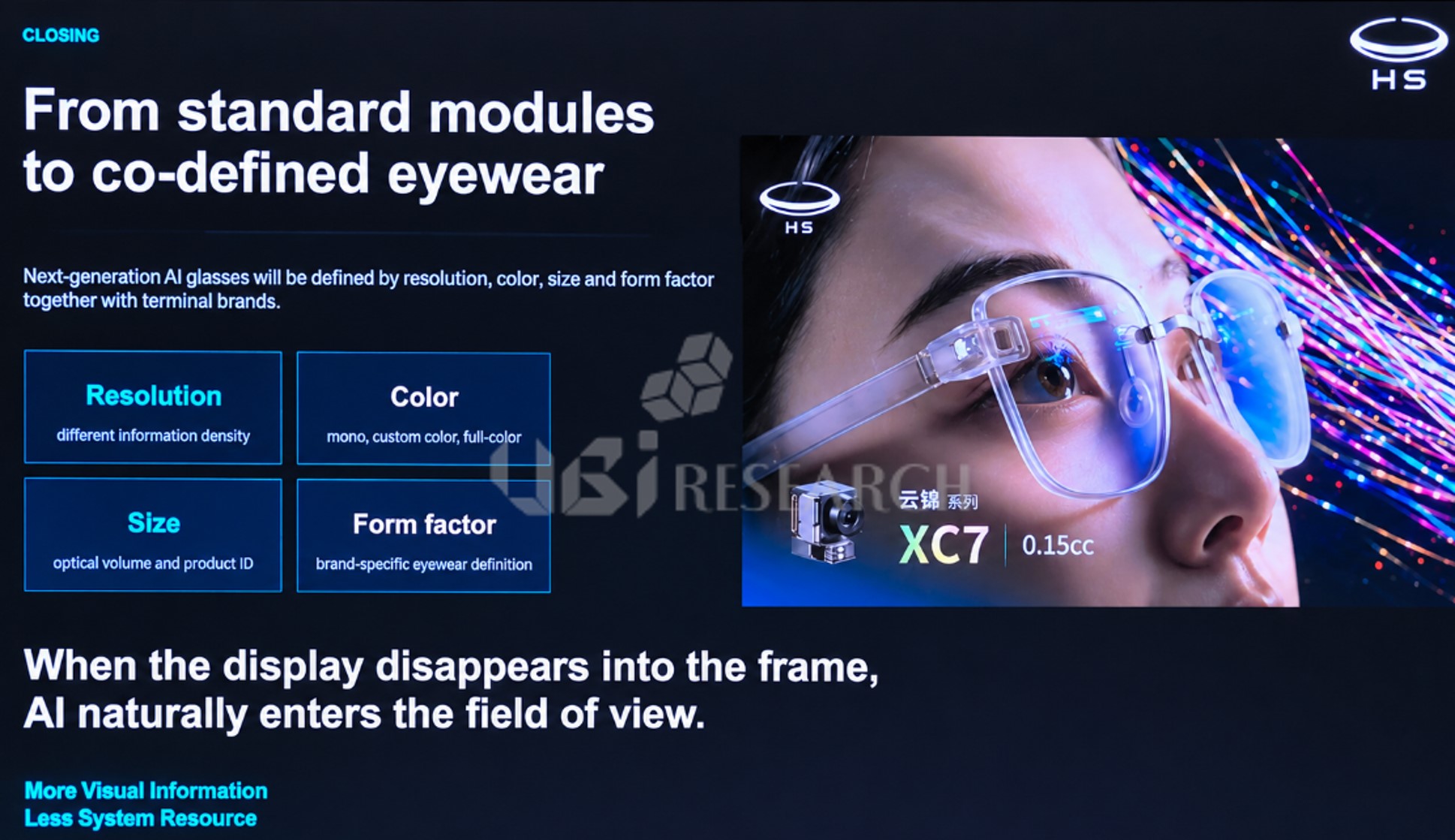
Source: Hongshi Intelligence presentation. Photo by UBI Research