
Color conversion and vertical stacking are two representative approaches to implementing full-color Micro-LEDs for AR glasses on a single panel. Both technologies are being developed by multiple companies and can contribute to optical-engine miniaturization by reducing the need for the combining prism and panel-alignment structure used in X-cube architectures that combine three monochrome RGB panels. Recent joint research by Raontech and SN Display, and a stacked-device prototype from Inlighten and StarkSemi, illustrate the development direction of each approach.
Raontech and SN Display signed a memorandum of understanding on October 15 to conduct preliminary research on applying perovskite color conversion to Micro-LED and Micro-OLED displays. According to SN Display, its technology can deliver high color-conversion efficiency in layers thinner than 0.5 μm and supports fine patterning using semiconductor processes. The collaboration will verify whether the technology can be applied to Micro-LED pixels of 4 μm or smaller.
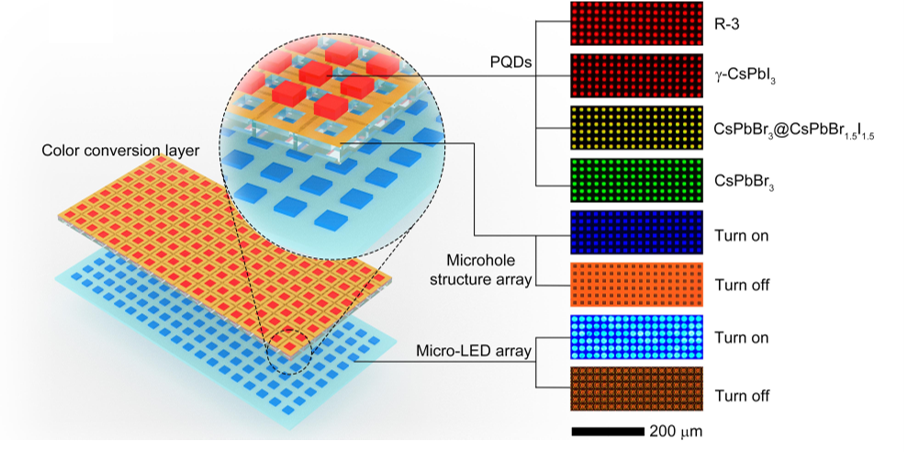
Full-Color Micro-LED Structure Using a Perovskite Color-Conversion Layer (Source: Xiamen University Research Team)
Conventional blue-light-based color conversion generates red and green in the conversion layer, thereby avoiding the direct-emission efficiency challenge of ultrafine red LEDs. The high absorption coefficient of perovskites can also enable thinner conversion layers, reducing the process burden associated with narrow, high-aspect-ratio patterns. However, converting blue light into lower-energy red and green light inevitably introduces Stokes loss. In an actual panel, key issues are whether light absorption and conversion efficiency can be maintained after patterning and encapsulation, and how stably brightness and color can be sustained under intense optical excitation and heat.
Inlighten privately demonstrated a red-green two-color stacked microdisplay developed in collaboration with StarkSemi at MicroLED-Connect 2026 in Eindhoven. StarkSemi is pursuing a structure in which RGB emission layers are vertically integrated within each pixel using hybrid bonding. Because the emission layers for the three colors share the same pixel area, the approach can reduce the area constraints associated with arranging RGB subpixels side by side on a plane.
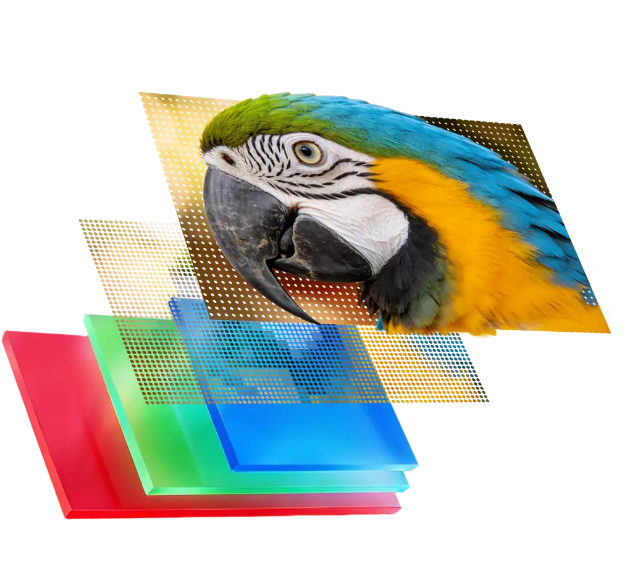
StarkSemi Vertically Stacked RGB Micro-LED Concept (Source: StarkSemi)
Vertical stacking avoids the losses associated with color conversion, but it still faces the challenge of securing high emission efficiency from ultrafine red devices. StarkSemi is developing both InGaN- and AlGaInP-based red LEDs. AlGaInP becomes particularly susceptible to sidewall non-radiative recombination as device dimensions shrink, while InGaN red LEDs face challenges in lattice mismatch and crystal-quality control due to their high indium content. Additional process requirements include alignment between the emission layers and CMOS, electrical interconnection, and management of interlayer optical loss. Because bonding defects introduced while combining multiple layers affect final yield, the ability to maintain uniform device performance after stacking is a major factor in manufacturing cost.
In color-conversion architectures, the efficiency of the blue light source and conversion losses affect final power consumption, while vertically stacked architectures are influenced by the emission efficiency of each color and optical losses introduced during integration. The practical competitiveness of the two approaches is therefore likely to emerge from comparisons of power consumption, long-term operating stability, and manufacturing cost per good unit at the same white luminance and color gamut. For AR glasses, a key issue will be how effectively power consumption and heat generation can be controlled while retaining the optical-engine miniaturization benefits of integrating full-color functionality into the panel.