
At the 2026 Paris Motor Show held in October, Peugeot unveiled the “RCZ Vision,” an electric concept car equipped with transparent Micro LED displays. The 12.4-inch transparent Micro LED human-machine interface (HMI) technology, developed by AUO in collaboration with the Peugeot design team, was incorporated into the driver information display above the Hypersquare steering wheel and the central floating display. The design presents a new cockpit configuration that provides essential driving information while preserving an open view through the transparent displays.
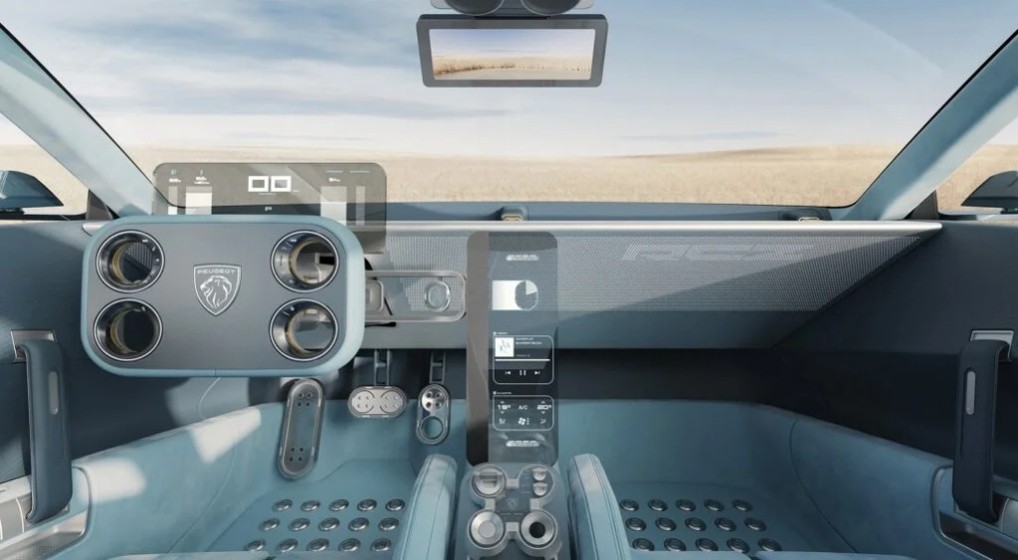
Driver information display and central floating display in the Peugeot RCZ Vision concept (Source: Peugeot)
Transparent displays for automotive applications are being developed primarily using OLED and Micro LED technologies. LG Display, AUO, and other companies have showcased cockpit concepts incorporating these technologies. What makes the Peugeot example noteworthy is that transparent Micro LED has moved beyond demonstrations by display manufacturers and has been integrated into the interior design and driver interface of an automotive brand.
A key technical advantage of transparent Micro LED is its ability to combine high pixel density, transmittance, and brightness. Micro LED chips can be miniaturized to dimensions of several tens of micrometers, making it easier to secure a larger transparent area within each pixel than with OLED. In 2023, AUO demonstrated a 13.5-inch transparent Micro LED display with a pixel density of 163 PPI, 55% transmittance, and 5,000 nit brightness. By comparison, LG Display’s 55-inch Full HD transparent OLED offers approximately 40 PPI and 45% transmittance. Although the products differ in size, the comparison illustrates Micro LED’s ability to achieve high transmittance even at high pixel densities.
These characteristics offer value in automotive cockpits, where clear driving information must be presented without obstructing the view beyond the display. In particular, they can enable driver information displays and open interior designs to coexist, moving beyond conventional instrument clusters that occupy dedicated cabin space. However, transparent displays must address changes in readability depending on the background, as well as driver visibility and safety.
This example shows that automotive display development is expanding beyond changes in screen size and form factor toward deeper integration with vehicle interior structures. Rather than simply replacing conventional displays, transparent Micro LED may broaden its applications as a technology that enables new cockpit designs through high transmittance and effective information display.