
At the 1st Automotive Display Industry Development Forum held on June 16, the industry’s response to the changing mobility paradigm and flexible cover window material technologies were discussed. The Korea Automotive Technology Institute presented on the topic of “Mobility Paradigm Shift and Display Industry Response Strategy,” analyzing that automotive displays are transitioning from simple information display devices into core HMI components that connect vehicles and occupants.
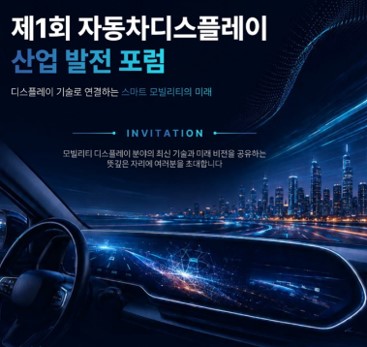
The 1st Automotive Display Industry Development Forum hosted by the Korean Society of Automotive Engineers
The presentation forecast that the spread of SDVs, on-device AI, V2X, and MaaS is changing the role of vehicle interior spaces. As a result, automotive displays are expected to go beyond providing driving information and take on additional functions such as safety alerts, occupant status monitoring, content consumption, and communication with the outside environment. In particular, as autonomous driving advances, displays are likely to expand beyond fixed screens into seamless displays integrated with interior materials, window displays, and exterior displays.
The Korea Automotive Technology Institute also emphasized the difference in development perspectives between the automotive industry and the IT display industry. IT products evolve rapidly around image quality and user experience, whereas automobiles prioritize safety and reliability, requiring much stricter development cycles and validation standards. Therefore, future automotive displays must secure not only optical performance but also mechanical properties as automotive components, including allowable strain, coefficient of thermal expansion, tensile characteristics, and repeated operation lifetime.
The Korea Institute of Industrial Technology presented on the topic of “Recent Research Trends in Flexible Hard Coatings,” introducing cover window and protective material technologies required to realize large-area, curved, and variable-form automotive displays. Because the interior space available for storing or deploying displays is limited by safety devices and structural components, durability, wrinkle suppression, and impact resistance were presented as key requirements for rollable, slidable, and foldable displays.
The presentation explained that UTG and CPI are being used as flexible cover window materials, and that high- and low-temperature reliability, repeated folding durability, breakage prevention, and scratch resistance are especially important in automotive environments. UTG, in particular, offers excellent surface feel and optical properties, but it requires a protective film to prevent scattering in the event of breakage, which can lead to reduced hardness or wrinkle issues. As technologies to address these challenges, the presentation introduced high-hardness coating materials that can be applied directly to the glass surface without a protective film, as well as an RSR structure that controls the physical properties of the folding area.
UBI Research analyzes that the automotive display market is unlikely to shift rapidly toward OLED in the short term. Instead, adoption is expected to expand gradually after technologies are first validated in premium vehicles. Future competitiveness is likely to be determined not only by the performance of the panel itself, but also by the level of integration with cover windows, coatings, sensors, and interior materials. The automotive display industry is expected to evolve beyond a simple panel supply market into a convergence market that combines components, materials, HMI, and sensor technologies.
Changwook Han, Executive Vice President/Analyst at UBI Research (cwhan@ubiresearch.com)
▶2025-2026 Automotive Display Technology and Industry Trends Analysis Report
※ This article is produced by UBIResearchNet.
Unauthorized reproduction or citation without source attribution is prohibited.
When quoting, please clearly indicate the source (UBIResearchNet) and provide a link.