
At the 1st Automotive Display Industry Development Forum held on June 16, LG Display gave a presentation titled “Development Trends in Automotive Displays,” highlighting the changing role of automotive displays and future technology directions.
According to the presentation, since 2020, the expansion of ADAS (Advanced Driver Assistance Systems) and the advancement toward autonomous driving technologies have gradually reduced the driving burden on drivers. As a result, demand for in-vehicle displays is growing beyond simple driving information delivery, expanding into entertainment, passenger experience, and integration with interior design.
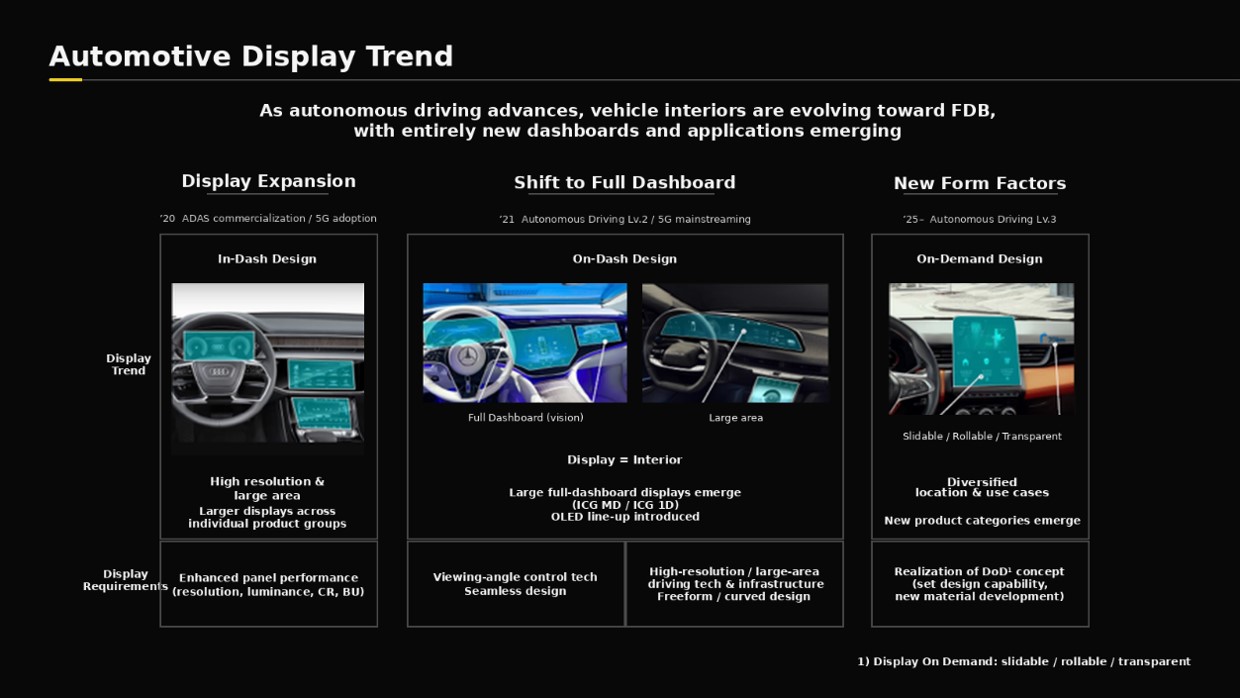
Automotive Display Trends Presented by LG Display (Image Source: LG Display)
In the past, automotive displays were mainly rectangular panels centered on navigation systems and instrument clusters, with contrast ratio, brightness, resolution, reliability, and durability serving as the key performance requirements.
Recently, however, displays have become a core element of vehicle interior design. A wide range of form factors is emerging, including circular, hexagonal, curved, slidable, and transparent displays, while display sizes that were once centered around 7 to 8 inches are expanding to 12 inches or larger. Development is also increasing for multi-purpose displays that integrate the cluster, CID, and PID areas into a single large panel, as well as large-area P2P (Pillar-to-Pillar) displays.
Application areas are expanding beyond the cluster and CID to include passenger-side PID or CDD (Co-driver Display), rear-seat entertainment displays, control pads, and e-Mirrors. In particular, demand for entertainment functions for front passengers and rear-seat occupants is growing, mainly in premium vehicles.
From a technology perspective, SPM (Switchable Privacy Mode), which prevents images on the passenger display from entering the driver’s field of view, is attracting attention. Conventional LCF (Light Control Film) can block light in specific directions but cannot be switched on and off. As a result, active privacy technologies such as backlight control, PDLC, electrophoretic methods, and dual-cell structures are being developed.
Dual-view technology, which allows the driver and passenger to view different content on a single panel, is also being explored, particularly in the CID area. This enables the driver to check driving and control information while the passenger uses the same panel to enjoy video content, thereby expanding the in-vehicle entertainment experience.
In terms of safety functions, UDIR (Under Display IR) technology is also under development. This technology places IR sensors and light sources beneath the display to detect driver drowsiness, gaze deviation, or inattentiveness, and is expected to be linked with driver monitoring systems in the future.
Transparent displays have also been presented as a major development direction. Combined with the DOD (Display on Demand) concept, which shows information only when needed, transparent displays can be applied to various parts of the vehicle interior, such as windows, doors, and control boxes. This is expected to enable both information delivery and emotional design while maintaining a sense of openness.
UBI Research analyzes that the advancement of ADAS and the expansion of connectivity are shifting the automotive display market from simple panel competition toward technology competition centered on user experience, safety, and interior integration. In particular, large-area displays, privacy control, dual-view technology, transparent displays, and under-display sensing technologies are expected to become key differentiating factors for premium automotive displays.
Changwook Han, Executive Vice President/Analyst at UBI Research (cwhan@ubiresearch.com)
▶2025-2026 Automotive Display Technology and Industry Trends Analysis Report
※ This article is produced by UBIResearchNet.
Unauthorized reproduction or citation without source attribution is prohibited.
When quoting, please clearly indicate the source (UBIResearchNet) and provide a link.