
The Competition for ‘AI Glasses’ Is Officially Underway
Historically, transformations in computing platforms have given rise to new industrial ecosystems and dominant companies. The history of computing—which evolved from PCs to smartphones—is now moving toward a new frontier: “AI glasses (smart wearables).” With major Big Tech companies such as Meta, Snap, Apple, and Samsung set to launch their next-generation hardware in 2026, this year is expected to mark the beginning of an intensifying competition among XR device manufacturers vying for market dominance.
Drawing lessons from past failures, global set manufacturers are competing fiercely on features such as “weight, immersion, and ecosystem connectivity” as part of their strategies to capture market share.
- Meta: “Penetrating Everyday Life, Leading the Way in the Popularization of AI Glasses” By incorporating a lightweight display and integrating the Llama AI model into the ultra-lightweight form factor of its Ray-Ban smart glasses—which weigh just about 49g—Meta is reinforcing its pragmatic approach to penetrating the public’s daily lives as quickly and extensively as possible.
- Samsung & Google: Participating in “AWE USA” held on the 16th (local time), the companies set their sights on next-generation XR glasses based on OLED-centric display technology. Of particular note is their display hardware strategy. At this year’s “AWE USA,” they showcased a 1.3-inch RGB OLEDoS with a brightness of 40,000 nits. By proactively presenting ultra-high-definition, high-brightness solutions optimized for MR headsets and smart glasses, they are firmly solidifying their hardware leadership within the Android ecosystem. Samsung and Google are mounting a counteroffensive by forming an Android XR alliance. At AWE USA 2026, Google introduced devices such as Project Aura, which will lead the Android XR platform and ecosystem.
- Snap: “As a pioneer in fully standalone AR, we are targeting the ‘middle ground’ of the market. Snap officially unveiled ‘SPECS,’ its fully standalone augmented reality glasses, at this year’s ‘AWE USA.’ Scheduled for release in 2026, ‘SPECS’ is a fully standalone AR device that requires no connection to a smartphone or external device. Combining a weight of around 130g with an LCoS display, it achieves an ideal ‘always-on form factor’ that bridges the gap between simple functional glasses and heavy headsets.
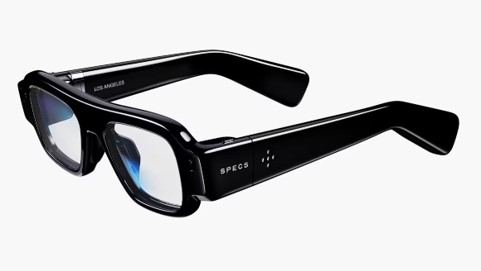
Snap’s SPECS AR glasses (Image Source: Snap)
- Apple: Drawing on the painful lessons from the first-generation “Vision Pro”—which failed to achieve widespread success due to its heavy weight (approximately 600g) and extremely high price—the company is shifting its strategy away from embedding heavy computational hardware directly into the device and toward using the iPhone as the main processor. The company is focusing on securing mass appeal by positioning the product as “smart AI glasses” that integrate with its proprietary AI, “Apple Intelligence.”
The competitive strategies of these set manufacturers are ultimately directly linked to the competition over microdisplay technology, which is the core component responsible for projecting images onto the screen.
- OLEDoS (OLED on Silicon): Samsung unveiled a 1.3-inch panel with a brightness of 40,000 nits at “AWE USA 2026.” This technology is primarily being adopted by the high-end mixed reality (MR) device sector and the premium smart glasses market, where a high level of immersion is essential.
- LCoS (Liquid Crystal on Silicon): This is the panel technology adopted by SPECS. It offers excellent mass-production capabilities and a low unit cost, making it the preferred choice among the pragmatic AR glasses sector. Meta’s Ray-Ban Display glasses also utilize LCoS technology.
- LEDoS (Micro-LED on Silicon): With its overwhelming brightness, it allows users to see a clear display even in bright sunlight, and is gaining attention as a powerful display technology of the future for creating the ultimate “outdoor AR glasses.” Chinese companies are adopting it as their flagship technology.
According to an analysis by UBI Research, the competition in the XR device market is a battle to find the optimal balance between hardware performance (weight and immersion), price, and practicality. Samsung’s “ultra-lead” strategy—which targets the smart glasses market with its top-brightness OLEDoS lineup based on OLED technology—Snap’s push for a standalone ecosystem, Apple’s pivot to ultra-lightweight AI glasses, and cost reductions in optical components are all intertwined on a massive scale. Starting with AWE USA 2026, the battle for supremacy in the XR device market will hinge on how clearly and naturally powerful XR devices can be realized in the form of eyewear.
Namdeog Kim, Senior Analyst at UBI Research (ndkim@ubiresearch.com)
▶Industry Trends and Technology of Micro-LED Displays for XR Report
▶XR Industry Trends and OLEDoS Display Technology & Industry Analysis Report
※ This article is produced by UBIResearchNet.
Unauthorized reproduction or citation without source attribution is prohibited.
When quoting, please clearly indicate the source (UBIResearchNet) and provide a link.