
BOE is stepping up its expansion into the mid-sized OLED market, including notebooks and tablets, based on its Gen 8.6 AMOLED production line.
Yinglong Huang, Director of BOE’s Technology Development Center, delivered a presentation titled “Leading Mid-size Displays, Empowering a New Vision” at DIC FORUM 2026 in Shanghai, China. Huang explained that with the rapid adoption of AI, displays are evolving beyond simple content-viewing devices to become a key interface connecting users with AI.
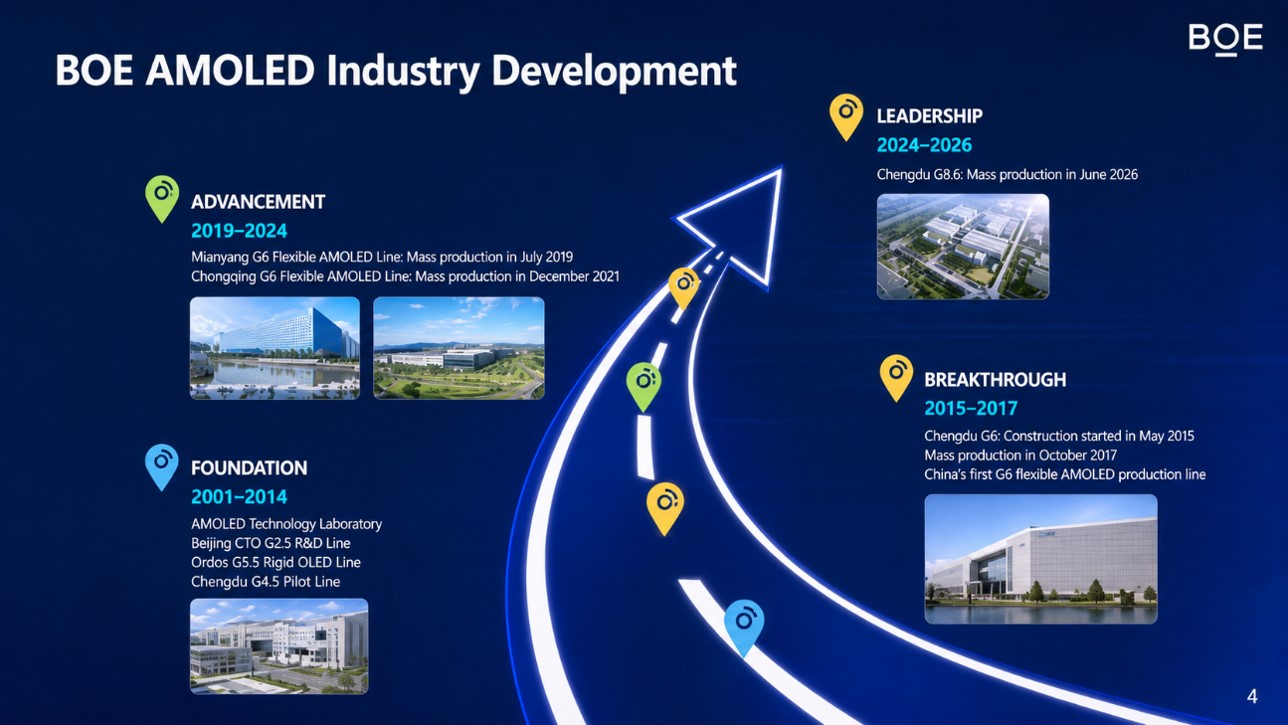
BOE AMOLED industry development roadmap and Chengdu Gen 8.6 AMOLED mass-production line (Source: BOE)
BOE stated that while the smartphone OLED market has entered a relatively stable phase, the mid-sized OLED market, including notebooks, tablets, and automotive displays, still holds significant growth potential. In response, the company established a Gen 8.6 AMOLED production line in Chengdu and announced that mass production and customer shipments began in June 2026. BOE also said that the product lighting-up schedule was brought forward by five months compared with the original plan.
The line is primarily designed to produce premium OLED panels for notebooks and tablets and supports both flexible OLED and hybrid OLED processes. A key focus is the combination of an LTPO backplane and tandem OLED architecture to achieve high refresh rates, low power consumption, and long lifetime. BOE said it plans to address demand for AI PCs and high-performance IT products with refresh rates of up to 240Hz and variable refresh rate technology.
For mid-sized OLED technology development, BOE identified high image quality, low power consumption, lightweight and thin designs, and diverse form factors as key directions. The company explained that it is developing technologies to improve low-gray-level image quality and uniformity while expanding the color gamut from DCI-P3 toward BT.2020. BOE also introduced approaches to improve luminance and lifetime by increasing the pixel aperture ratio and to reduce bezel width from approximately 2.5 mm to around 1.6 mm.
To reduce power consumption, BOE said it is also developing COE (Color Filter on Encapsulation) technology, which eliminates the polarizer, along with improvements in panel structures and driving algorithms. According to BOE, the adoption of COE can reduce power consumption by approximately 35%, while additional structural innovations could increase power savings to as much as 40%. The company also announced that it is developing technology to integrate touch functionality directly into the panel, reducing the number of components as well as display thickness and weight.
In terms of form factors, foldable, slidable, and bidirectionally expandable displays were presented as major development targets. However, BOE assessed that large-area foldable OLEDs still face significant technical challenges involving driving circuits, materials, crease reduction, and mechanical reliability.
BOE’s Gen 8.6 AMOLED line can be viewed as a strategy aimed not merely at expanding production capacity, but at simultaneously improving the cost competitiveness and performance of mid-sized OLEDs. The key is to combine LTPO, tandem OLED, COE, and integrated touch technologies to deliver the high refresh rates, low power consumption, and lightweight designs required for AI PCs. Going forward, BOE’s competitiveness is expected to depend less on the initial scale of mass production and more on the speed of yield stabilization and customer qualification, as well as the extent to which tandem OLED costs can be reduced.
Changwook Han, Executive Vice President/Analyst at UBI Research (cwhan@ubiresearch.com)
▶Display Korea 2027: Where Global Display Business Connects
※ This article is produced by UBIResearchNet.
Unauthorized reproduction or citation without source attribution is prohibited.
When quoting, please clearly indicate the source (UBIResearchNet) and provide a link.