
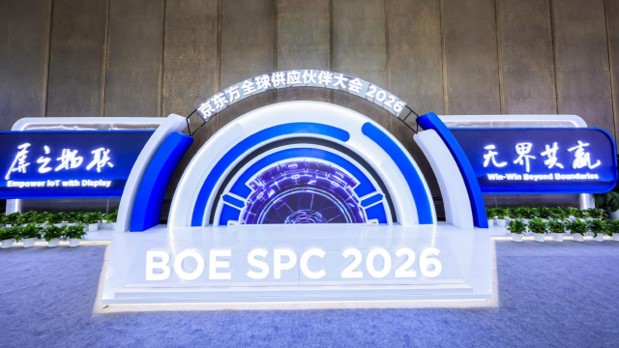
BOE SPC 2026 venue image (Source: BOE)
BOE unveiled its next-generation growth strategy at the “BOE Global Supply Partner Conference 2026 (BOE SPC 2026),” held in Chongqing, China on June 9. Building on the capabilities it has accumulated in its display business, BOE presented a new set of growth businesses.
The eighth edition of BOE SPC brought together more than 600 partner companies and over 1,000 guests from 10 countries. BOE Chairman Chen Yanshun stated that, in response to surging AI-driven demand, the company is pursuing glass substrate packaging, co-packaged optics, and short-range optical interconnects as key directions for industrial advancement. He added, “Based on the ‘Nth Curve’ development theory introduced in 2024, we are continuously pursuing new businesses in next-generation display, glass substrate processing, and large-scale integrated intelligent manufacturing.”
BOE CEO Peng Qiang stated that, guided by the “Nth Curve” theory, the company will pursue three key priorities: high-quality growth under the “1+4+N+Ecosystem Chain” framework, strengthening global capabilities, and an “AI+” transformation. BOE’s “1+4+N+Ecosystem Chain” refers to a business expansion structure centered on its core display business (“1”), four major growth tracks—Mini LED, sensors, smart medical engineering, and IoT innovation (“4”)—from which increasingly specialized application scenarios (“N”) are continuously identified, all woven together with external partners into an ecosystem chain.
BOE Senior Vice President and Chief Technology Officer Liu Zhiqiang said the company has achieved numerous industry-first technological breakthroughs in key tracks including flexible OLED, glass substrate packaging, and perovskite photovoltaic devices.
Quantifying ecosystem collaboration was also a notable feature of this year’s conference. BOE Senior Vice President and Chief Procurement Officer Zhang Xuezhi introduced an “Ecosystem Efficacy” index that comprehensively reflects five foundational capabilities—technology, quality, delivery, cost, and environmental sustainability—along with collaboration efficiency and AI capability. He explained that BOE has already implemented AI-powered supply chain applications such as intelligent Q&A and automated ordering. At the conference, Applied Materials, DNP, and Guangzhou CVTE (广州视源) received the top honor, the Diamond Award, while more than 30 partner companies signed strategic cooperation agreements with BOE.
Separately, BOE disclosed on June 12, shortly after the conference, that it had completed automation of its pilot production line for glass substrate semiconductor packaging, with a designed production capacity of approximately 1,000 panels per month. Samples of high-density glass substrates with a 20-layer structure produced on this pilot line were sent to domestic customers for testing, and some customers have passed initial validation and moved on to formal technical qualification. However, BOE noted that the business has not yet generated mass-production revenue.
BOE is also pursuing solar cells based on perovskite, a next-generation photovoltaic material, as a new growth business, continuing to accelerate technology development and the transition to mass production under its “Nth Curve” strategy.
According to UBI Research, BOE’s “Nth Curve” strategy represents an attempt to transfer its glass processing and precision manufacturing capabilities—amid slowing growth in its panel business—into adjacent, high-value-added industries such as AI semiconductor packaging and perovskite photovoltaic devices, offering a meaningful reference point for Korean display companies as they formulate their own business diversification strategies.
Changho Noh, Senior Analyst at UBI Research (chnoh@ubiresearch.com)
▶2026 OLED Emitting Materials Report
※ This article is produced by UBIResearchNet.
Unauthorized reproduction or citation without source attribution is prohibited.
When quoting, please clearly indicate the source (UBIResearchNet) and provide a link.