
Top-emission OLEDs using Mg/Ag cathodes deliver superior color purity and efficiency through strong microcavity effects, but inherently trade off against angular blue-shift, corner luminance distortion, and brightness loss. The integrated IZO transparent cathode + COE design — which fundamentally resolves these issues while simultaneously compensating for color purity and luminous efficiency degradation — is rapidly emerging as a focal point of industry interest.
At SID 2026 (Digest 75-3), BOE presented a COE (Color Filter-on-Encapsulation) design framework addressing the optical challenges associated with the use of transparent cathodes in OLED displays. Through ray-tracing simulation, BOE researchers precisely analyzed regional differences in reflectance and color shift between conventional Mg/Ag cathode-based COE structures and transparent cathode (IZO, etc.)-based COE structures, and derived the design conditions under which off-state optical performance equivalent to the conventional structure can be achieved with a transparent cathode architecture.
The Mg/Ag semitransparent cathode forms a strong microcavity with the underlying metal anode, enhancing frontal luminous efficiency and color purity. However, this structure produces angular blue-shift at oblique viewing angles, presenting a structural limitation for applications such as automotive HUDs that require color stability across the full viewing angle range. A transparent cathode reduces upper reflectance from 40% to 20%, weakening the microcavity and enabling wide-angle color stability — but at the cost of reduced color purity and luminous efficiency. BOE researchers addressed this challenge through an integrated design optimization methodology that leverages COE’s high transmittance and color reproducibility to compensate.
The results revealed that regional reflectance changes within the COE structure upon transparent cathode adoption act in opposing directions. In the PDL (Pixel Definition Layer) aperture region, microcavity weakening raises reflectance by approximately 0.33 percentage points, while in the BM-out region, the cathode’s own reflectance decreases by 44% (~39% → ~22%), lowering reflectance by 0.53 percentage points. The cancellation of these two effects results in a total COE module reflectance of 6.60% actually 0.2 percentage points lower than the conventional Mg/Ag structure (6.80%).
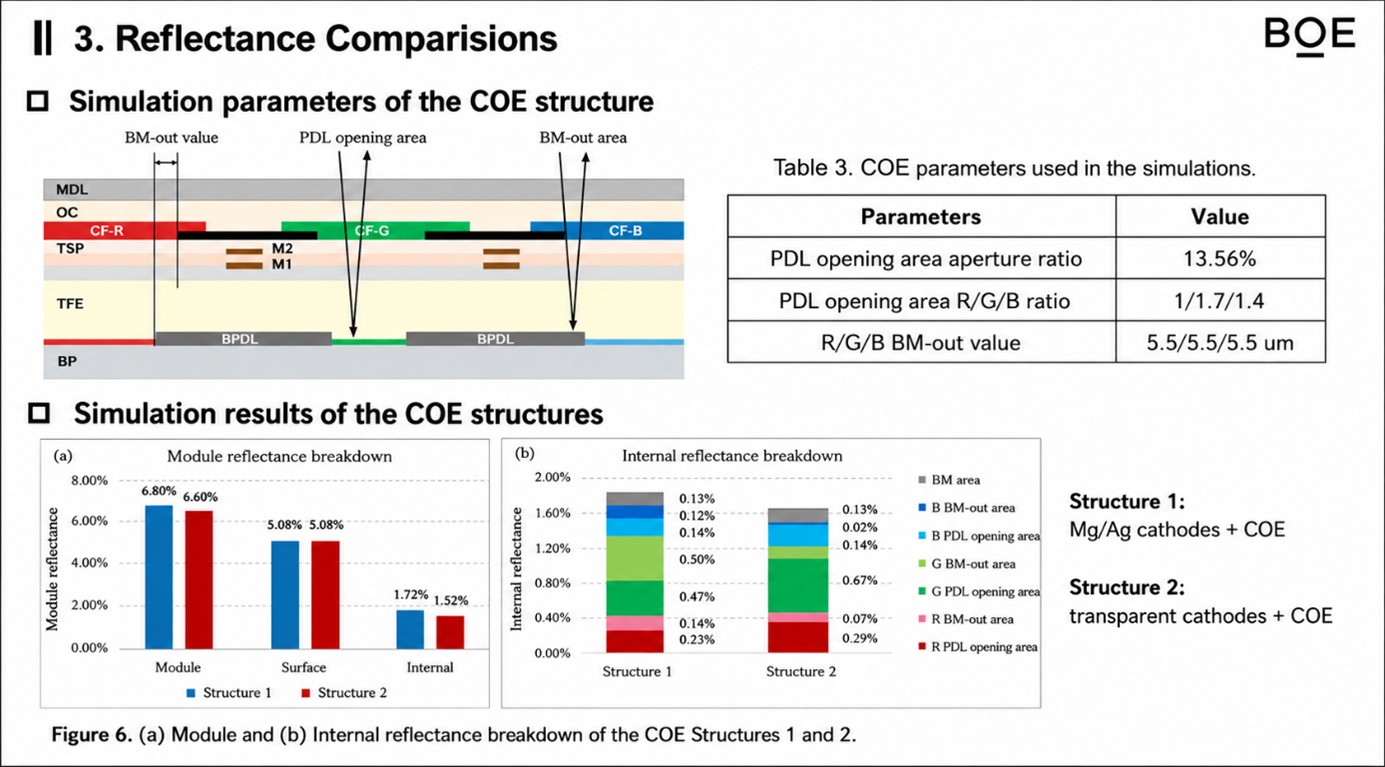
BOE IZO transparent cathode + COE reflectance comparison. Source: BOE, SID 2026 Digest 75-3
Building on these findings, BOE researchers derived a transparent cathode + COE design that achieves off-state optical performance equivalent to the conventional Mg/Ag+COE structure (6.80%), while further improving power consumption reduction versus a circular polarizer architecture from 37% (Mg/Ag cathode) to 42%.
UBI Research regards this BOE presentation as significant for being the first to systematically establish the theoretical foundation for transparent cathode-based OLED design optimization. With IZO transparent cathode adoption in mainstream smartphone panels projected to accelerate from 2028, the COE design parameter combinations presented in this study carry sufficient specificity to serve directly as reference values for mass production design. It should be noted, however, that this research remains a simulation-based preliminary study; experimental validation through actual sample fabrication remains a future task requiring additional confirmation.
Changho Noh, Senior Analyst at UBI Research (chnoh@ubiresearch.com)
▶2026 Analysis Report on China’s OLED Supply Chain Management
▶2026 Small OLED Display Annual Report
▶2026 Medium & Large Size OLED Display Annual Report
※ This article is produced by UBIResearchNet.
Unauthorized reproduction or citation without source attribution is prohibited.
When quoting, please clearly indicate the source (UBIResearchNet) and provide a link.