
Written by Changwook Han, Principal Analyst
BOE and OnePlus unveiled their fourth-generation Oriental Screen on October 9. The display, which will debut in the OnePlus 16, supports 165Hz operation across its hardware architecture and up to 185Hz in certain gaming scenarios. BOE stated that it has improved image clarity and responsiveness by optimizing emissive materials, driving circuits, and a 22nm display driver IC (DDIC).
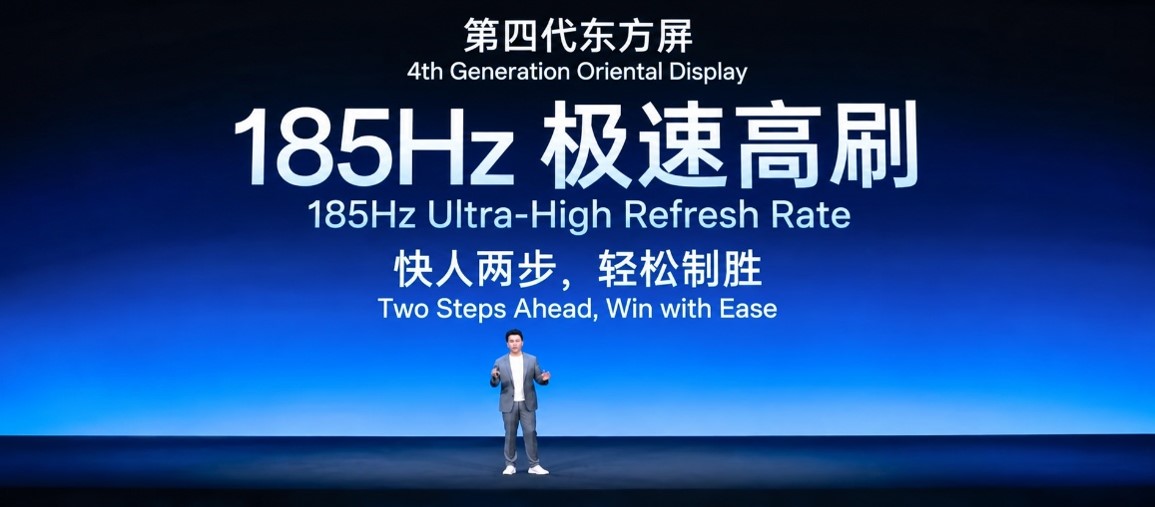
Unveiling of the fourth-generation Oriental Screen jointly developed by BOE and OnePlus (Source: BOE)
Several smartphone brands have already introduced models supporting refresh rates of 165Hz or higher. The OnePlus 15 supports up to 165Hz in gaming, while the realme Neo8 and iQOO 16 have also adopted 165Hz displays. The iQOO 16 features a 2K 165Hz display jointly developed with Samsung Display. The ASUS ROG Phone 9 Pro supports up to 185Hz in a dedicated gaming mode, while the HONOR WIN series also offers refresh rates of up to 185Hz.
However, the growing number of models featuring higher refresh rates should not yet be interpreted as a market-wide transition. The Galaxy S26 Ultra and iPhone 18 Pro, as well as China’s OPPO Find X9 Pro, continue to use displays with maximum refresh rates of 120Hz. This indicates that the adoption of higher refresh rates depends on target customers and product positioning.
It is also important to distinguish between a display’s maximum refresh rate and its benefits in actual use. Even if a panel supports 185Hz, the game must consistently deliver a corresponding frame rate to fully utilize that capability. Power consumption and heat generation when sustaining high frame rates must also be considered. BOE’s claim of a 15% reduction in power consumption needs to be evaluated against the specific comparison conditions, including brightness and refresh rate, before its benefits in actual gaming environments can be assessed.
UBI Research expects refresh rates of 165Hz or higher to expand selectively as a differentiation feature in performance-oriented smartphones for the time being. Adoption of higher maximum refresh rates could increase if variable refresh rate technology allows devices to operate at lower refresh rates during normal use and switch to higher rates only in supported games. However, there is still insufficient evidence to suggest that 165Hz or higher will replace 120Hz across mainstream flagship smartphones.
BOE’s latest announcement should therefore be viewed less as a signal of high-refresh-rate displays becoming mainstream and more as an example of intensifying competition in performance-oriented smartphones. UBI Research believes that 120Hz will remain the standard for mainstream models, while adoption of 165Hz and higher refresh rates will depend on supported content and tangible consumer benefits. The potential for broader adoption should be assessed based on perceived benefits relative to additional costs, battery life, and actual sales performance, rather than maximum refresh rate alone.