
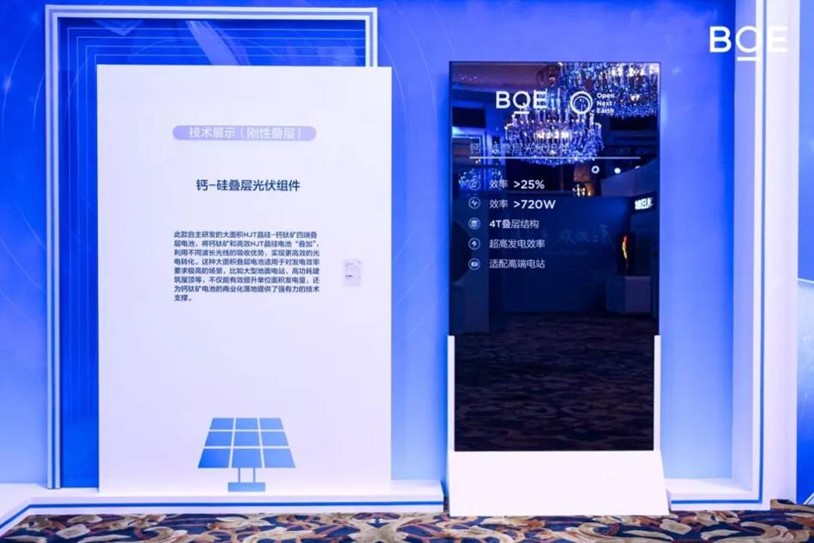
Perovskite Solar Cells at the 2026 BOE Investor Day (Source: BOE)
China’s 15th Five-Year Plan (2026–2030), finalized in March, explicitly names intelligent driving, new-type solar cells, and new-type energy storage as key technology innovation tasks under strategic emerging industries. The term “new-type solar cells” is interpreted as encompassing perovskite. Wang Gang, Chairman of Jinjing Science & Technology and a delegate to the National People’s Congress, has for two consecutive years (2025 and 2026) proposed that the perovskite photovoltaic industry chain be explicitly incorporated into national and provincial-level five-year plans.
Bolstered by this policy support, BOE unveiled its perovskite business achievements at the BOE Supply Partner Conference 2026 (BOE SPC 2026) on June 10, and then, at the “2026 BOE Investor Day” held in Shanghai on July 2, formally designated perovskite—alongside glass-based packaging substrates and optical interconnects—as one of the company’s new core businesses.
BOE’s perovskite business began in earnest with the establishment of its subsidiary Hefei BOE Technology Co., Ltd. (registered capital of RMB 599 million) in March 2024. A 500MW-scale module production line, part of a pilot-line project with total investment of RMB 871 million, went into operation in December 2024—regarded as one of the earliest instances of large-scale mass production achieved in the industry. The production base at Hefei Xinzhan High-Tech Industrial Zone is also reported to have succeeded in manufacturing the world’s largest rigid perovskite module, measuring 1.2m × 2.4m.
On the technology side, BOE has pursued three parallel development paths—rigid, flexible, and tandem—building out a full three-stage platform process spanning glovebox scale (2.5×2.5cm), pilot line scale (30×30cm), and mid-scale test line (120×240cm). As of December 2025, the company achieved a stabilized glovebox efficiency of 27.61%, a flexible-device pilot-line efficiency of 21.39%, and mid-scale test-line efficiencies of 20.11% (rigid) and 16.6% (flexible), respectively—setting four world records for perovskite module efficiency as certified by third-party accredited testing institutions.
Applications are also rapidly expanding from consumer electronics into buildings and ground-based power plants. BOE built the world’s first perovskite building-integrated photovoltaic (BIPV) project, the “Zero-Carbon House,” and reportedly obtained China’s first-batch and only Photovoltaic Building Evaluation Certification Mark using perovskite technology, as well as a “PV-Storage Application Award” from the Asia Photovoltaic Industry Association. The company also stated it built a 100kWh-scale demonstration power plant last November. Industry observers suggest BOE will progressively extend its application scope from consumer electronics and automotive products through BIPV to ground-based power plants and eventually space-based solar cells. In fact, BOE reportedly joined the founding of the Beijing Space Computing Industry Innovation Center on June 1, agreeing to supply space-grade perovskite solar technology—marking an initial step toward space applications.
In May, BOE signed a memorandum of understanding with global materials company Corning, agreeing to collaborate in areas including glass-based packaging substrates, foldable glass, perovskite glass substrates, and optical interconnect applications. Zeng Chongkai, President of Corning Display Technologies China, stated: “Building on more than 20 years of collaboration, we look forward to jointly opening up a new RMB 100 billion-scale growth space.”
UBI Research notes that, in step with the Chinese government’s move to treat perovskite as effectively a national-level strategic growth technology, startup-driven companies such as GCL Perovskite, Jidian Guangneng (极电光能), and Xianna Guangdian (纤纳光电) are also ramping up GW-scale production lines, intensifying scale-up competition. Amid this, BOE is positioning itself as a leading group within the perovskite industry by leveraging the glass-substrate processing, precision manufacturing, and automated mass-production capabilities it has accumulated in the display industry. Whether perovskite is explicitly designated in the detailed implementation measures of the five-year plan going forward, along with the utilization rate of BOE’s 500MW line and the pace at which its Corning partnership is concretized, are expected to be key indicators for gauging the business’s performance.
Changho Noh, Senior Analyst at UBI Research (chnoh@ubiresearch.com)
▶2026 Analysis Report on China’s OLED Supply Chain Management
※ This article is produced by UBIResearchNet.
Unauthorized reproduction or citation without source attribution is prohibited.
When quoting, please clearly indicate the source (UBIResearchNet) and provide a link.