
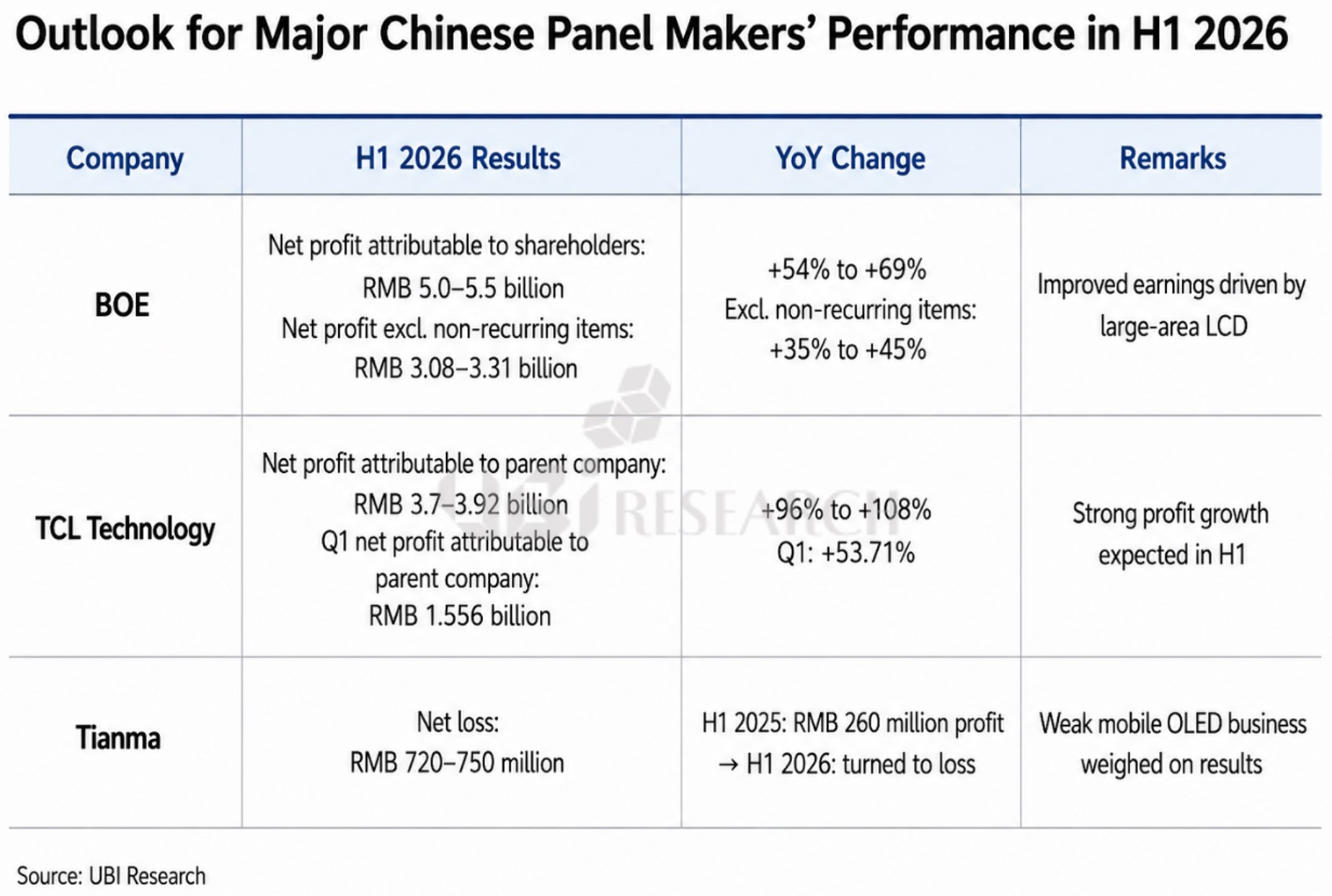
H1 2026 earnings outlook for major Chinese display panel makers. (Source: UBI Research)
The financial performance of China’s major display panel manufacturers is expected to diverge in the first half of 2026, reflecting differences in their business structures and product portfolios. BOE and TCL Technology forecast substantial year-on-year profit growth, supported by improved profitability in the large-area LCD business, while Tianma is expected to swing to a net loss amid continued pressure from its mobile OLED operations.
BOE estimated that its net profit attributable to shareholders of the listed company would reach between RMB 5.0 billion and RMB 5.5 billion in the first half of 2026, representing a year-on-year increase of 54% to 69%. Net profit excluding non-recurring gains and losses is projected at RMB 3.08 billion to RMB 3.31 billion, up 35% to 45% from the same period a year earlier.
BOE’s earnings improvement appears to have been driven by a recovery in the profitability of its large-area LCD business and an increased share of high-value-added products. Its diversified business structure, covering applications such as TVs, monitors, notebook PCs, and automotive displays, also appears to have helped the company respond more effectively to market fluctuations.
However, as the growth rate of net profit excluding non-recurring items is lower than that of total net profit, it is necessary to distinguish the contribution of one-off factors from the improvement in the profitability of the company’s core operations.
TCL Technology is expected to record an even higher profit growth rate than BOE. Its net profit attributable to shareholders of the parent company is forecast to reach between RMB 3.70 billion and RMB 3.92 billion in the first half of 2026, representing a year-on-year increase of 96% to 108%.
TCL Technology had already reported net profit attributable to shareholders of the parent company of RMB 1.556 billion in the first quarter, up 53.71% year on year. Earnings continued to improve in the second quarter, further widening the company’s profit growth for the first half.
Stable utilization of its large-area LCD production lines and improvements in its product mix are believed to have contributed to stronger profitability. The expansion of non-TV businesses, including IT and automotive displays, is also expected to enhance the company’s medium- to long-term earnings stability.
In contrast, Tianma is expected to post a net loss of between RMB 720 million and RMB 750 million in the first half of 2026. The company recorded a net profit of approximately RMB 260 million in the first half of 2025, meaning that it is expected to return to the red this year.
Tianma’s weak performance appears to have been affected by slowing demand in the smartphone OLED market and intensified price competition among Chinese panel manufacturers. In particular, rising prices for key components such as memory and application processors have increased cost pressure on smartphone manufacturers, leading them to adopt a more conservative approach to panel procurement prices and production plans.
Mobile OLED production lines have a cost structure in which the fixed-cost burden increases significantly when utilization falls below a certain level. As a result, profitability can deteriorate rapidly when lower shipment volumes and panel price pressure occur simultaneously.
Although Tianma has established relatively stable businesses in automotive, industrial, and professional displays, these segments appear to have been insufficient to offset the losses generated by its mobile OLED operations. The company’s earnings recovery in the second half will therefore depend heavily on improvements in smartphone OLED shipments and production-line utilization.
Demand and Utilization Management to Be Critical in the Second Half
The earnings performance of Chinese panel manufacturers is expected to remain differentiated in the second half of 2026, depending on market conditions in the LCD and OLED sectors. BOE and TCL Technology are likely to maintain relatively stable profitability, supported by economies of scale and diversified product portfolios in the large-area LCD business.
However, if first-half demand brought forward from later periods subsides and demand for TVs and IT products undergoes an adjustment, panel prices and production-line utilization could place pressure on second-half profitability. BOE and TCL Technology are therefore expected to place greater emphasis on profitability-oriented product mixes and disciplined utilization management rather than simply expanding shipment volumes.
In the smartphone OLED market, memory prices and smartphone manufacturers’ production plans are expected to become major variables. If cost pressure from key components persists, handset manufacturers may slow the adoption of OLED panels in mid-range and entry-level models or demand further reductions in panel procurement prices.
Such developments could weigh not only on shipment volumes for Chinese OLED panel manufacturers but also on average selling prices and production-line utilization.
BOE is expected to continue expanding its mobile and IT OLED businesses based on the profitability of its large-area LCD operations. TCL Technology is also likely to maintain an LCD-centered earnings base while strengthening its competitiveness in small- and medium-sized OLED panels and IT displays.
Tianma, meanwhile, will need to achieve growth in its automotive and professional display businesses while reducing costs, improving its product mix, and restoring utilization at its mobile OLED production lines.
Overall, the Chinese panel industry in the first half of 2026 was characterized by strong earnings improvement at BOE and TCL Technology, both of which have substantial large-area LCD operations. Tianma, with its relatively high exposure to mobile OLED, was more heavily affected by weak market demand and price competition.
Junho Kim, Analyst at UBI Research (alertriot@ubiresearch.com)
▶2026 Analysis Report on China’s OLED Supply Chain Management
▶China Display Industry Trends Report
※ This article is produced by UBIResearchNet.
Unauthorized reproduction or citation without source attribution is prohibited.
When quoting, please clearly indicate the source (UBIResearchNet) and provide a link.