
While the realization of BT.2020 green color coordinates — a central challenge in OLED wide color gamut competition — has to date been pursued primarily through PSF (Phosphorescent Sensitized Fluorescence) architectures, new research has demonstrated that pure phosphorescent (PHOLED) materials alone can reach BT.2020 green. A research team at Zhejiang University of Technology (ZJUT) in China combined a tetradentate Pt(II) phosphorescent complex with a microcavity structure to simultaneously achieve a CIE coordinate of (0.22, 0.75) and a narrow FWHM of 14.8 nm. The associated paper was published on June 10 in the international journal Science Advances.
To date, the industry has broadly regarded PSF architectures — combining MR-TADF narrowband fluorescent dopants with phosphorescent sensitizers — as virtually essential for achieving high color purity green at BT.2020 levels (CIEy ≥ 0.73). The PSF-based approaches presented by Samsung Display at SID 2026 and adopted by Visionox and Tianma are representative of this direction. The difficulty lay in the fact that narrowband phosphors alone exhibited FWHM values exceeding 20 nm, making sufficient color purity difficult to secure.
The research team overcame this limitation through a novel molecular design. The PtN5N2 compound achieved an FWHM of 16.4 nm in toluene solution, and the microcavity of the top-emission (TE) device introduced destructive interference into the vibrational sidebands, further narrowing the FWHM to 14.8 nm — a value narrower than current MicroLED and QD-LED linewidths.
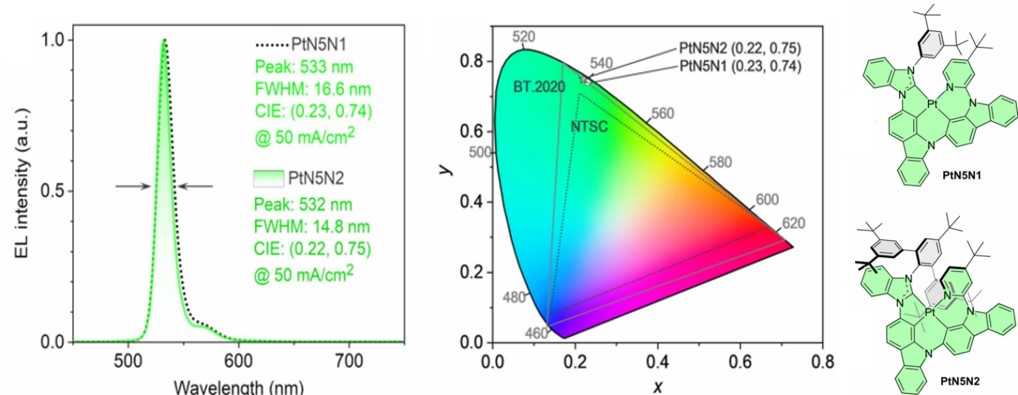
EL spectrum, CIE color coordinates, and molecular structures of PtN5N1 and PtN5N2 phosphorescent emitting materials. (Source: Science Advances)
Device performance is equally noteworthy. The PtN5N2-based TE-OLED recorded a maximum current efficiency of 174 cd/A and power efficiency of 202 lm/W at an emission peak of 532 nm, with CIE coordinates of (0.22, 0.75) approaching the BT.2020 green standard. In terms of lifetime, the PtN5N1 device achieved an extrapolated LT90 of approximately 540,000 hours at 1,000 cd/m² based on an accelerated degradation model.
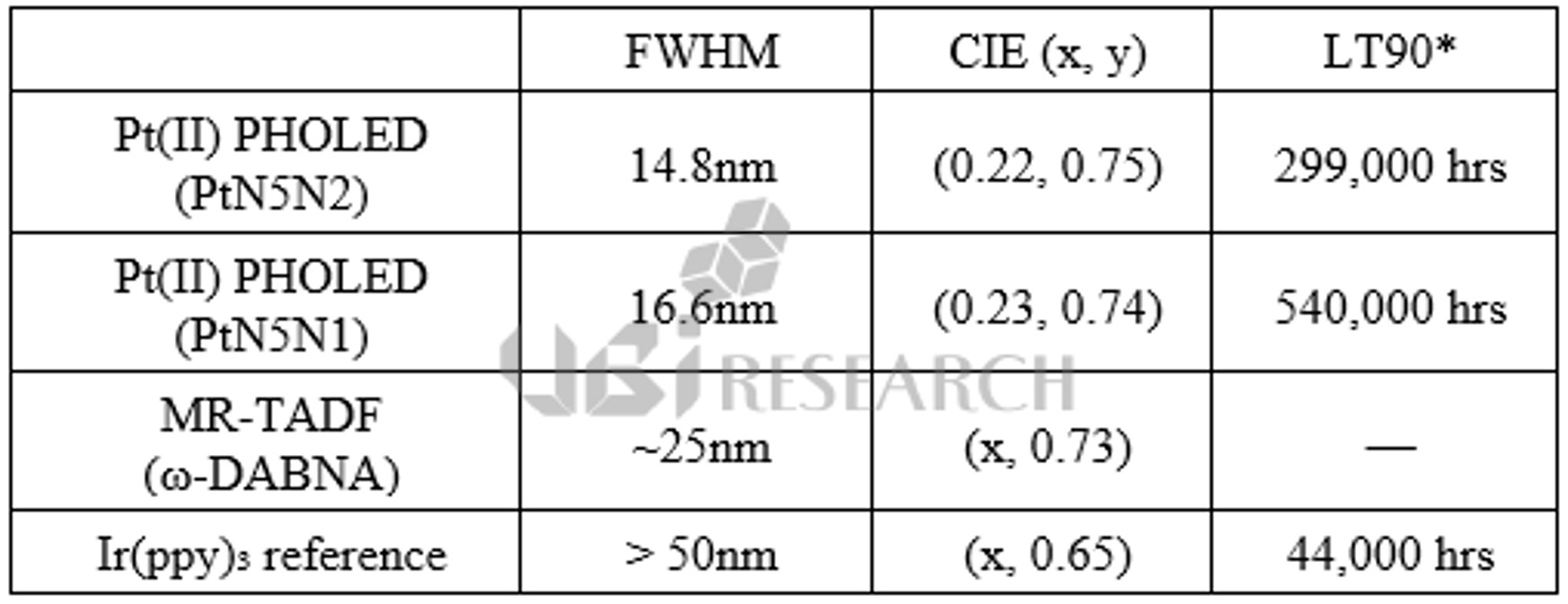
Extrapolated at 1,000 cd/m². Acceleration factor (n) of 2.14–2.17 applied.(Source: UBI Research)
Note that the lifetime figures require additional verification under actual mass-production driving conditions.
UBI Research regards this study as a signal that pathways to BT.2020 green are diversifying beyond a sole reliance on PSF structures. Panel makers and materials suppliers now have access to multiple options with differing trade-offs among color purity, lifetime, and process complexity. Furthermore, within PSF architectures where Pt(II)-based phosphors function as sensitizers, the high photoluminescence quantum yield of approximately 99% and the excellent thermal and chemical stability (466–525°C) demonstrated in this work are expected to contribute to long-lifetime device design.
This achievement was produced through an industry-academia collaboration between Zhejiang University of Technology and Zhejiang Huaxian Photoelectric Technology, and the research team has filed the associated patents (CN202510336036.5, CN202510336057.7).
Trends in next-generation OLED emitting material technologies, as well as supply chain analysis by panel maker and emitting material market forecasts, are covered in detail in UBI Research’s 2026 OLED Emitting Materials Report.
Changho Noh, Senior Analyst at UBI Research (chnoh@ubiresearch.com)
▶2026 OLED Emitting Materials Report
※ This article is produced by UBIResearchNet.
Unauthorized reproduction or citation without source attribution is prohibited.
When quoting, please clearly indicate the source (UBIResearchNet) and provide a link.