
In South Korea and China, Cannon Tokki equipment is used for the vast majority of mass-production evaporators for sizes ranging from 4.5G to 6G. However, for large evaporators of 8.5G, Sunik Systems and YAS equipment are primarily used, and Sunik Systems has a near-monopoly on small evaporators of 200mm. Since micro-OLEDs fabricated on wafers are below 200mm in size, Sunik Systems is reported to hold a market share of over 50% in this segment as well.
There are two types of micro-OLEDs used in AR and MR: white OLED + CF structures and RGB OLED structures. RGB OLEDs are the mainstream choice for high-resolution micro-OLEDs. Micro-OLEDs range in size from 0.5 to 2 inches and require a resolution of 3,000 ppi or higher, necessitating high-precision alignment specifications of ±1 μm.
Cannon Tokki has developed a 12-inch evaporator for manufacturing RGB micro-OLEDs and has challenged this market.
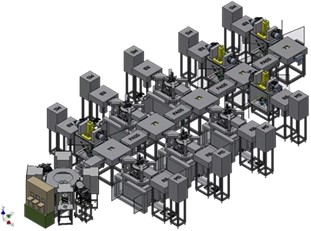
Image of production equipment
This device utilizes a magnetic levitation alignment stage and an IR camera to achieve ±1 μm alignment. The alignment marks on the back of the Si wafer are detected by the IR camera.
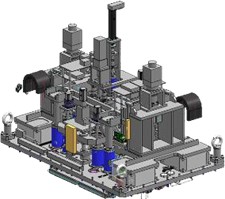
Levitation Magnetic Stage
Cannon Tokki minimized shadowing effects by reducing the gap between the wafer and the mask through the introduction of a mask tilt tracking mechanism and a light contact alignment mechanism to ensure the mask is held in close contact with the wafer.
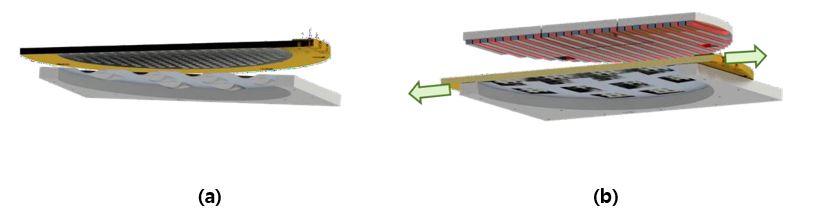
Conceptual diagrams of the mask tilt tracking mechanism (a) and the light contact alignment mechanism (b)
Cannon Tokki presented images of a 3,200 ppi micro-OLED display produced using a electroformed mask on this evaporator.
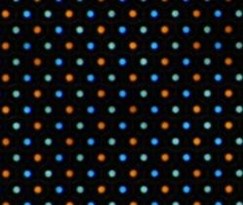
Micro-OLED emission image
Choong Hoon YI, CEO/Chief Analyst at UBI Research (choonghoon@ubiresearch.com)
▶UBI Research’s Micro Display Report
▶UBI Research’s Micro-LED Report
※ This article is produced by UBIResearchNet.
Unauthorized reproduction or citation without source attribution is prohibited.
When quoting, please clearly indicate the source (UBIResearchNet) and provide a link.