
China’s new-display policy is expanding beyond panel capacity to build an industrial ecosystem connecting materials, components, equipment and applications.
Author: Dr. Changwook Han, Executive Vice President and Principal Analyst Editor: Dr. Choonghoon YI, CEO and Chief Analyst
China’s 15th Five-Year Plan (2026-2030), which began in 2026, focuses on developing advanced manufacturing and strategic emerging industries as new engines of growth. In the display sector, the policy direction is expanding beyond panel production capacity toward an industrial ecosystem that connects core materials and components, equipment and manufacturing technologies, and application markets.
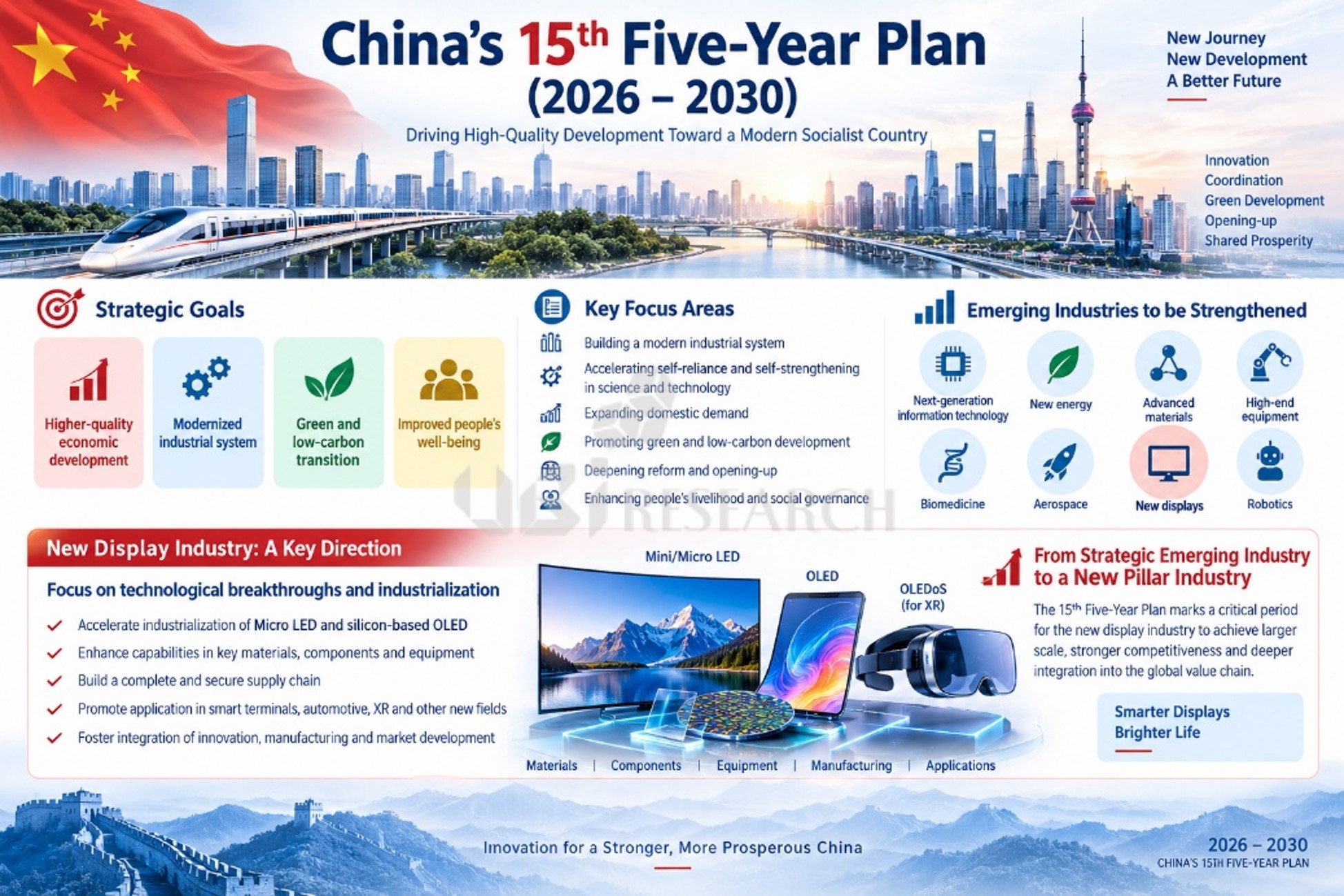
Key directions of China’s 15th Five-Year Plan (2026-2030) and its strategy to foster the new-display industry. Graphic supplied by UBI Research
China’s Ministry of Industry and Information Technology regards new displays as a core segment of the electronic information industry and supports their technological development and industrialization. Along with commercializing next-generation technologies such as Micro LED and silicon-based OLED, China is strengthening the competitiveness of upstream materials and components and promoting equipment validation. DIC 2026 described 2026 as the year when several Gen 8.6 OLED lines would enter mass production and the medium-sized OLED segment would move into a scaling phase. The simultaneous development of LCD, OLED, Mini/Micro LED, silicon-based OLED and quantum-dot technologies is another defining feature of China’s display industry.
Changwook Han, Principal Analyst, said China’s competitiveness can no longer be explained solely by low prices and large-scale investment. Panel makers are being linked with materials, components and equipment suppliers as well as research institutes, while local governments are also participating in building the industrial ecosystem. Technology development, mass production and supply-chain construction are proceeding at the same time. Han said the direction is moving beyond the localization of individual technologies to connect technology, production, cost and supply chains within a single industrial system.
Han said this change also has significant implications for the Korean display industry. Korean companies have maintained an advantage based on OLED technology and global customer relationships. However, the basis of competition could change if Chinese companies improve yields, expand local sourcing of materials and equipment, and supply products with adequate performance at lower cost. Han noted that the threat may become greater not when Chinese products surpass Korean products in performance, but when they simultaneously meet market requirements for performance and price competitiveness.
He said Korea’s response cannot rely only on maintaining an overwhelming technology lead and securing next-generation markets ahead of rivals. Korea must improve yields and material utilization while securing differentiated technologies such as Tandem OLED, low-power solutions, OLEDoS and Micro LED. Reducing manufacturing costs through simpler processes and higher equipment productivity is also important because price and supply stability, as well as performance, are becoming key competitive factors even in premium markets.
Han said there is no need for Korea to compete head-on with China in the commodity low-cost market. Price competition offers limited benefits in markets where China has advantages in scale and supply chains. A more realistic approach is to secure cost competitiveness in the mid-price segment, where customers demand adequate performance, quality and reliability. Han said Korea must retain its premium technology advantage while building production scale in the mid-price segment to sustain fab utilization, material purchasing power and the domestic ecosystem for materials, components and equipment.
He also emphasized cooperation between Korean panel makers and the domestic materials, components and equipment industries. Supply-chain strengthening should focus less on simply raising localization rates and more on improving material performance, equipment productivity, yields and costs through joint development and mass-production validation. Panel competitiveness increasingly depends not only on individual technologies but also on the strength of the supply chain supporting them.
Han said the message that China’s 15th Five-Year Plan sends to the display industry goes beyond technological catch-up. He expects the axis of competition to shift from who develops the highest-performance panel first to who can combine technology, cost and supply chains to deliver competitive products reliably.
China still faces the task of translating technological catch-up into profitability and global customer acquisition. Korea must also strengthen manufacturing-cost competitiveness, its materials-components-equipment ecosystem and its customer base while preserving its existing technology advantage. Han expects future competitiveness in the display industry to be determined less by a single breakthrough technology than by comprehensive industrial capabilities that integrate technology, cost and supply chains.
Sources: Public materials related to China’s 15th Five-Year Plan, the Ministry of Industry and Information Technology of China, and DIC 2026 materials