
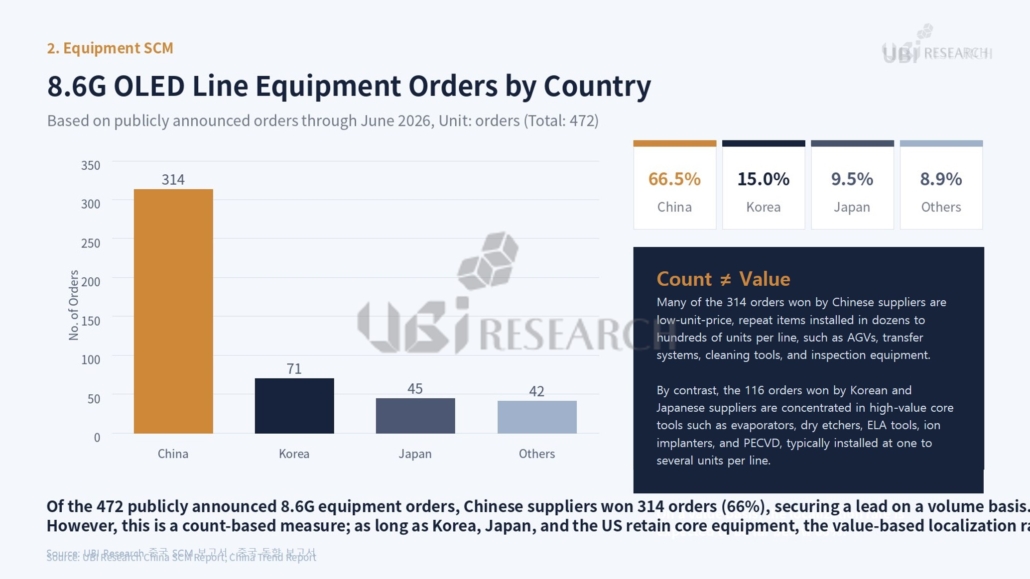
Gen 8.6 OLED equipment orders by country based on publicly announced orders through June 2026. (Source: UBI Research)
UBI Research analyst Junho Kim presented on the localization trend in China’s OLED supply chain at the “Display Next 2027: Global Supply Chain Restructuring and Key Battlegrounds for the 2027 Market” seminar held on August 12. His presentation, titled “SCM Competitiveness and Localization Strategies in China’s OLED Industry,” emphasized that new 8.6G OLED lines will become a key variable reshaping China’s equipment, component, and material supply chains.
Kim noted that “the competitive focus of China’s OLED industry is shifting from simple investment scale and capacity expansion to the localization of equipment, components, and materials.” He explained that “as new 8.6G OLED lines in China, including BOE B16, TCL CSOT T8, and Visionox V5, expand sequentially from 2026 to 2028, a supply structure different from that of 6G OLED is taking shape.”
In the equipment sector, Chinese suppliers are increasing their share in terms of order count. However, high-value core equipment such as evaporators, dry etchers, ELA systems, and PECVD tools remains largely supplied by Korean, Japanese, and US companies. One notable change in the transition to 8.6G is the weakening of the previous evaporator supply structure centered on Canon Tokki, as new equipment suppliers such as Sunic System, AVACO, YAS, and AMAT enter the market.
In components and materials, local Chinese suppliers are entering the supply chain more rapidly, particularly in TFE ink, FMM, Invar, and emitting materials. However, the pace of supplier replacement varies depending on product grade and customer qualification requirements. Adoption of Chinese suppliers is expanding quickly in general product segments, while overseas suppliers continue to retain positions in high-specification and high-reliability applications.
Kim stated that “localization in China’s OLED supply chain is progressing fastest in the initial BOMs of new lines,” while adding that “Korean suppliers still have room to respond in core equipment and high-reliability materials.” He also noted that in 2027, key points to watch will include the initial yield of new 8.6G lines, the pace of emitting material localization, and supply chain changes by patterning method, including FMM evaporation, inkjet printing, and ViP photolithography.
Junho Kim, Analyst at UBI Research (alertriot@ubiresearch.com)
▶2026 Analysis Report on China’s OLED Supply Chain Management
▶China Display Industry Trends Report
※ This article is produced by UBIResearchNet.
Unauthorized reproduction or citation without source attribution is prohibited.
When quoting, please clearly indicate the source (UBIResearchNet) and provide a link.