
As expectations grow for the AR glasses market over the next several years, Chinese companies are accelerating Micro-LED display development and production investment. INNOVISION and SAPHLUX have signed agreements for new projects worth RMB 2 billion and RMB 1 billion, respectively. Established supplier JBD is also securing funding while upgrading its manufacturing processes, broadening competition beyond product performance to mass-production costs and supply capacity.
On October 31, INNOVISION signed an agreement for an investment project totaling RMB 2 billion in Deqing, Zhejiang Province. The project targets annual production capacity of 100 million Micro-LED microdisplay devices, with annual output value projected at RMB 5 billion at full capacity. The company already began operating a line with annual capacity exceeding 10 million units in March 2025. This year, it introduced the M06, featuring 2.5 μm pixels, and the P13, a single-chip multicolor display product. The latest investment is seen as a move to substantially expand the production infrastructure needed to commercialize its existing products.
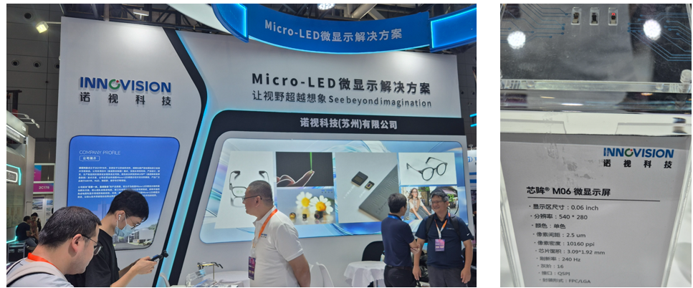
Exhibition booth and M06 product on display at CIOE 2026
On October 29, SAPHLUX confirmed an investment of RMB 1 billion in the second phase of its production base in Wuxi. Using 12-inch silicon-based gallium nitride wafers, the project aims to establish an integrated production system spanning front-end and back-end processes, with a target of 20 million Micro-LED display products for AR annually. Operations are scheduled to begin before December 2028, with target production capacity to be reached before June 2029. While the first phase, which began operating in July this year, focused on back-end processing for modules and optical engines, the second phase expands into chip manufacturing. A key objective is to reduce the cost of full-color products by combining quantum-dot color conversion with larger wafer sizes.
In April 2026, JBD was reported to have completed a Series C funding round exceeding RMB 1 billion. On the production side, construction of the second phase of its Hefei plant was confirmed to have begun in July this year, indicating that financing and manufacturing expansion are progressing in parallel. In May, JBD also unveiled a manufacturing method in which good dies from 4-inch epitaxial wafers are rearranged on a 12-inch temporary substrate and then bonded to a silicon backplane. According to the company, pilot-line validation has been completed, with wafer reconstitution yield exceeding 98%. It is now working to introduce the process into its mass-production lines. These process improvements are intended to enhance backplane utilization and manufacturing efficiency while continuing to use existing small wafers.
Investment by Chinese companies is expected to expand the component supply base needed to bring full-color displays and lower prices to AR glasses. With the market expected to grow, yield stabilization and the pace of adoption in customer products will determine investment outcomes. Over the medium to long term, the balance between capacity expansion and demand is also expected to become an important variable.