
China is proposing to require physical controls alongside virtual controls for essential vehicle safety functions and to prohibit the use of foldable and flexible displays. On October 10, four government agencies, including the Ministry of Industry and Information Technology (MIIT), released a draft Notice on Strengthening the Administration of Innovative Automotive Product Design and R&D Testing and Verification for public comment. The proposal strengthens safety assessment and verification requirements for new vehicle designs and functions. The public comment period closes on November 10.
The Technical Guidelines for Innovative Automotive Product Design, included in the draft, require physical controls when virtual controls are used for driving-safety functions such as lighting, windshield wipers, defrosting and defogging. For central infotainment screens, large-area displays and complex head-up displays (HUDs), the guidelines call for assessments of driving-safety impacts, functional reliability under extreme conditions and crash safety. The same provision states that foldable and flexible displays must not be adopted.
If these requirements are finalized, the roles of screens and design priorities in the automotive display market may change. Requiring physical controls would limit the concentration of safety-related functions on screens, while demand for navigation, vehicle information and entertainment displays would remain. The draft does not prohibit large screens themselves. Rather than causing an across-the-board decline in panel demand, it may lead to adjustments in screen size and placement and in the allocation of functions between screens and physical controls.
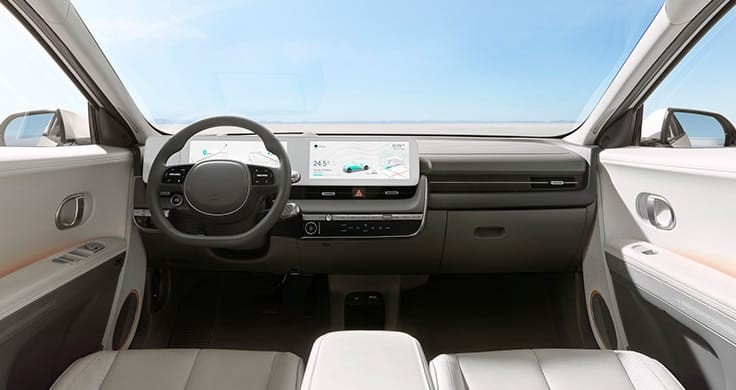
Interior of the IONIQ 5 with both a display and physical controls
A key factor determining market impact is the scope of the term “flexible.” The provision does not distinguish between screens that fold or bend during use and flexible OLEDs fixed to curved cover surfaces. If the restriction applies only to displays with changeable form factors, it could affect the timetable for automotive adoption of foldable and rollable displays. If it also covers fixed curved OLEDs, the range of eligible panel and module structures could narrow. Because the provision does not ban specific display technologies such as OLED or LCD, future definitions and the scope of application will be critical to assessing the impact on each technology market.
In competition among suppliers, the ability to demonstrate safety after installation in a vehicle is likely to become important alongside panel performance. Verification would cover not only image quality and durability but also covers, mounting structures and the mechanisms that operate movable displays. Integrating physical controls with screens also requires ease of operation and an appropriate interior design. Consequently, module suppliers and cockpit system providers capable of supporting display and control placement, module structures and safety assessment from the early stages of vehicle development will play an important role.