
China’s humanoid robot industry is rapidly entering the mass-production stage. According to China’s Ministry of Industry and Information Technology (MIIT), the country’s humanoid robot production, which stood at approximately 20,000 units in 2025, is expected to exceed 100,000 units in 2026. This would represent roughly a fivefold increase in production volume within just one year.
The rapid growth indicates that China’s humanoid robot industry is shifting from technology demonstrations toward full-scale manufacturing. In particular, the component ecosystem developed through the electric vehicle and industrial automation sectors—including motors, reducers, actuators, sensors, and batteries—is supporting the rapid expansion of production capacity.
Tesla Prepares for Mass Production, Creating Opportunities for Chinese Component Suppliers
The expansion of the global humanoid robot market is also creating new opportunities for China’s supply chain.
Tesla is establishing an Optimus production line at its Fremont factory in the United States and is preparing to begin production in the second half of 2026. In this process, Chinese suppliers of key components such as motors, reducers, and actuators are emerging as potential participants in the supply chain.
China has already established large-scale manufacturing capabilities in precision drive systems, rare-earth magnets, and batteries through the development of its electric vehicle industry. As a result, China’s humanoid robot industry has the potential to grow not only as a producer of complete robots but also as a major supplier of key components to global robotics companies.
BYD and XPENG Enter the Humanoid Robot Market
Chinese automakers are also viewing humanoid robots as a new area for business expansion.
BYD is preparing to unveil its first humanoid robot in August, while XPENG is moving forward with mass-production plans for its humanoid robot, IRON.
Automakers have an advantage because they already possess large-scale manufacturing facilities, quality-control systems, and extensive component procurement networks. Technologies accumulated through electric vehicles—including motors, sensors, batteries, and power-control systems—can also be applied to robotics. As a result, humanoid robots are emerging as a business area that allows automakers to extend their existing manufacturing capabilities into the field of Physical AI.
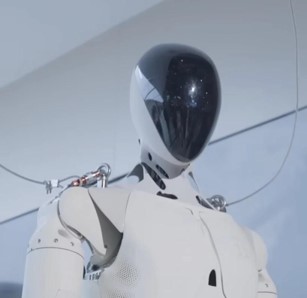
XPENG humanoid robot “IRON” (Source: XPENG)
Unitree IPO Draws Growing Capital Market Attention
The planned IPO of leading Chinese robotics company Unitree on Shanghai’s STAR Market is also raising expectations for the industry’s growth. Unitree is seeking to raise capital to expand its humanoid robot business, which is rapidly emerging as a key business alongside its existing quadruped robots.
Going forward, competitiveness is likely to depend not only on robot hardware performance but also on how effectively behavioral data collected in real-world environments can be integrated with AI models.
Humanoid Robot Expansion Could Drive New Display Demand
China’s projected production of more than 100,000 humanoid robots indicates that the industry is moving beyond emerging technology development toward competition in large-scale manufacturing and commercialization.
This shift could also create new demand for the display industry. As humanoid robots expand into service applications, OLED and LCD displays could increasingly be integrated into areas such as the face, chest, and arms for status indication, user interfaces, and emotional expression.
Displays could evolve beyond simple information output to serve as a key HMI (Human-Machine Interface) for humanoid robots. Just as displays have become an interface connecting drivers and vehicles in the automotive sector, visual interfaces could play an increasingly important role in communicating the status and intentions of AI-powered humanoid robots.
As humanoid applications expand into services, information guidance, retail, and other areas, display demand could also increase, particularly for OLED, which offers advantages in lightweight design, low power consumption, and greater design flexibility.
Changwook Han, Executive Vice President/Analyst at UBI Research (cwhan@ubiresearch.com)
▶2026 Analysis Report on China’s OLED Supply Chain Management
▶China Display Industry Trends Report
※ This article is produced by UBIResearchNet.
Unauthorized reproduction or citation without source attribution is prohibited.
When quoting, please clearly indicate the source (UBIResearchNet) and provide a link.