
China Moves to Raise LCD Prices; Korean Display Industry Responds with Premium TVs and OLED
Chinese panel makers are pushing to raise TV LCD prices, increasing the TV cost burden on Samsung Electronics and LG Electronics. In September, BOE, TCL CSOT and HKC notified customers of plans to adjust LCD panel prices, citing higher costs for components and materials such as driver ICs, printed circuit boards (PCBs) and glass substrates. TCL CSOT and HKC reportedly raised prices on some products from September, and BOE has signaled an increase in the fourth quarter.
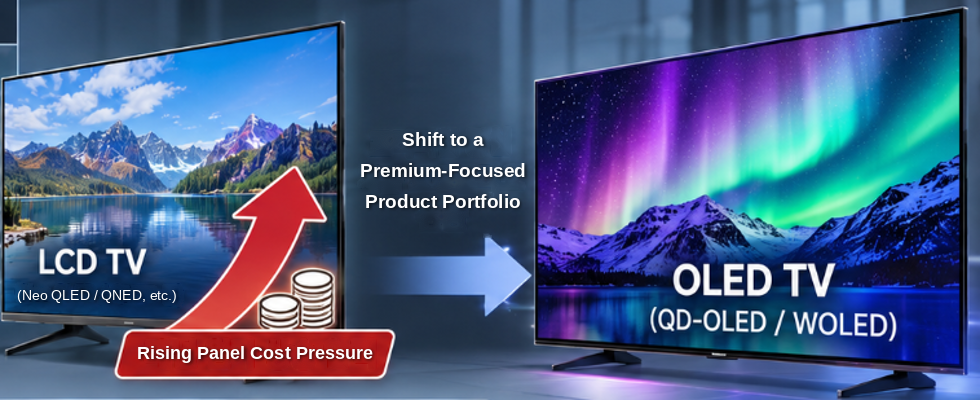
The price moves by Chinese panel makers are coinciding with production cuts. The three companies lowered utilization at some LCD lines around China's National Day holiday in October. Together they account for about 70% of global TV panel supply. In large LCD TV panels of 65 inches and above, Chinese makers hold a 70–85% share, and at 90 inches and above their share is effectively 100%.
Samsung Display ended large LCD production in 2022, and LG Display exited the TV LCD business in 2025 after selling its Guangzhou LCD fab to TCL CSOT. Samsung Electronics and LG Electronics, however, still sell LCD-based TVs such as Neo QLED and QNED as core product lines, leaving them structurally exposed to the pricing policies of Chinese panel makers. With panels accounting for 40–50% of a TV's manufacturing cost, higher LCD prices directly affect finished-product profitability.
It is not yet confirmed whether the Chinese price notices have translated into higher transaction prices overall. TV LCD panel prices fell for three straight months in the third quarter and then held flat from October through the first half of November. Global TV shipments are also expected to decline 0.8% year on year, leaving little demand-driven upward pressure on prices.
In the short term, Samsung Electronics and LG Electronics are responding by reallocating panel sourcing and managing profitability by product. Samsung Electronics has reportedly doubled its 2026 TV LCD panel purchases from BOE while cutting orders to TCL CSOT. The move can be seen as an effort to reduce dependence on any single supplier and secure purchasing leverage. However, because Chinese makers dominate the large LCD market, switching suppliers alone cannot eliminate the risk of rising costs.
Over the mid to long term, managing the profitability of low-end LCD TVs while expanding the share of high-value products is likely to become more important. Samsung Electronics has introduced a 115-inch Micro RGB TV alongside Neo QLED, and LG Electronics is expanding its premium LCD TV lineup with QNED evo and Micro RGB evo.
Micro RGB TVs, which apply RGB light sources to the backlight, can deliver a wider color gamut than conventional LCD TVs. Because they still use LCD panels, however, they are not a fundamental solution to dependence on Chinese panel makers. Chinese TV makers such as TCL and Hisense are also developing mini LED and RGB backlight technologies, so technical differentiation in the premium LCD TV market may become increasingly difficult.
This situation could open a new market expansion opportunity for Samsung Display and LG Display, which produce OLED TV panels. Rising prices for Chinese LCD panels create room to narrow the price gap between OLED and LCD TVs. It will be important for Samsung Display (QD-OLED) and LG Display (WOLED) to improve luminance and luminous efficiency while lowering panel manufacturing costs, to make OLED TVs more price-competitive.
If Samsung Electronics and LG Electronics expand OLED TV sales, they could partly reduce their dependence on Chinese LCD panels while also helping domestic panel makers improve line utilization and profitability. This would require extending the OLED TV lineup beyond the premium segment into price ranges that can compete with mini LED TVs.
As Chinese LCD panel makers strengthen their grip on supply, the competitiveness of the Korean display industry will likely depend not only on how cheaply it can procure LCD panels, but also on how far it can lower OLED panel manufacturing costs and maintain technical differentiation in finished products.
Chang-ho Noh, UBI Research