
Image source: Samsung Display
Chinese OLED metal mask makers are knocking on the doors of the capital markets one after another. Jiangsu-based Gaoguang New Material (高光新材) completed its listing-guidance registration for a Beijing Stock Exchange listing on September 28, and Zhejiang-based Zhongling Technology (众凌科技) completed its IPO listing-guidance registration on October 21. Guotai Haitong Securities (国泰海通) is serving as the guidance institution for both companies. Huancaixing (寰采星), reportedly China’s No. 1 FMM maker, has also entered the listing-guidance process after raising pre-IPO funding in July.
Behind this is investment in IT OLED. Gen 8.6 lines such as Samsung Display’s A6 and BOE’s B16 began operation in 2026, and Visionox V5 and CSOT t8 are preparing for mass production in 2027. As substrates grow larger, mask size and consumption increase, while precision requirements remain unchanged. According to Chinese industry reports, BOE placed an additional order in August for G8.6 FMMs for its IT OLED line, with deliveries scheduled through 2027.
The three companies have distinctly different business structures. Gaoguang holds the No. 1 domestic share in China in Open Masks for common layers and CVD Masks for thin-film encapsulation, posting 2025 revenue of CNY 484 million and net profit of CNY 72.17 million. However, its FMM revenue was only CNY 10.86 million, with a gross margin of -63.2%. The company says it can supply both G8.6 Half- and Full-size masks, but its Full-size product is for CSOT’s inkjet-printed OLED line (about 400 sheets per year) and differs in nature from FMMs used in the evaporation process. Revenue for 1H 2026 was CNY 241 million, down 7.9% YoY, and net profit fell 42.3%.
Zhongling is an FMM specialist with annual production capacity of 150,000–200,000 sheets, and has entered the flagship smartphone supply chain by mass-producing 20μm FMMs. On the other hand, its cumulative net losses for 2022–2024 reached about CNY 355 million. Huancaixing operates two Gen 6 lines and a Gen 8.6 FMM mass-production line, supplying China’s seven major panel makers, and its subsidiary’s Gen 8.6 line is targeting full-scale mass production by year-end.
DNP and Toppan still account for about 78% of the global FMM market, and DNP began operating a Gen 8 FMM line at its Kitakyushu plant in 2024. The raw material, Invar foil, has long been dominated by Proterial (formerly Hitachi Metals), but China’s TISCO (太钢) is pursuing localization after introducing a 25μm-thick foil for masks in 2025. DNP’s policy of not selling ultra-thin products of 20μm or less to China is both a barrier for Chinese makers and a factor accelerating the adoption of domestic products. The key is yield. Chinese makers’ mass-production frontier is around 18μm, but even the leaders’ yields are reportedly around 40%.
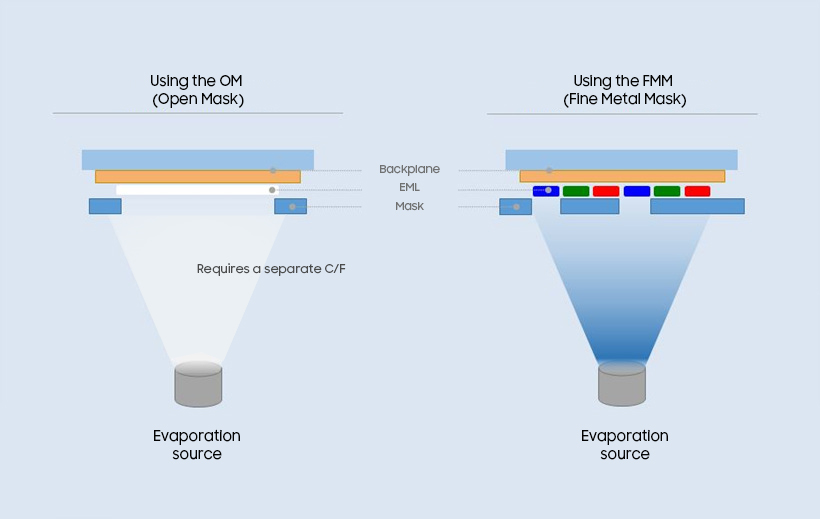
Unlike FMMs, which compete on precision, Open Masks for common-layer deposition compete more on area. Handling Gen 8.6 substrates (2,290×2,620mm) requires masks around 3m wide, and only a handful of companies worldwide own the large etching equipment needed to process them. Since the bottleneck lies in equipment rather than fine patterning, securing equipment also speeds up localization. China’s CODA expects the localization rate of Open Masks to reach 30–40% in 2026. Service businesses such as mask cleaning and refurbishment are also emerging.
The Chinese industry expects Chinese makers’ share of the mask and FMM market to rise from about 15% in 2026 to about 28% in 2027. This IPO rush is largely about ‘securing ammunition’ for that goal. The remaining question is no longer production capacity, but stable yields and consistent quality.