
On September 9, the China International Optoelectronics Expo (CIOE 2026) was held in Shenzhen, China.
As the commercialization of AR glasses accelerates, demand for lighter, smaller, and higher-brightness displays and waveguides is gradually increasing. At this exhibition, we observed through the display of newly developed products in the fields of waveguide technology and LEDoS that industrialization efforts are gaining momentum.
The Chinese company Goeroptics has unveiled a complete product lineup ranging from full-color diffractive light guides to silicon carbide (SiC) wide-field-of-view (FOV) modules. In the AR waveguide sector, Goeroptics has launched five new full-color waveguide products, enhancing various performance characteristics such as thin and lightweight design, high image quality, reduced weight, and a wide field of view. The company already operates a mass production line using DUV lithography and etching for 12-inch wafer processes, capable of producing 20 waveguides per wafer. By combining LEDoS products with SiC waveguides, the company exhibited a demo product with a thickness of 0.65 mm, a weight of 3.7 g, and a transmittance of 91%. An exhibition representative noted that waveguide efficiency had doubled compared to last year.
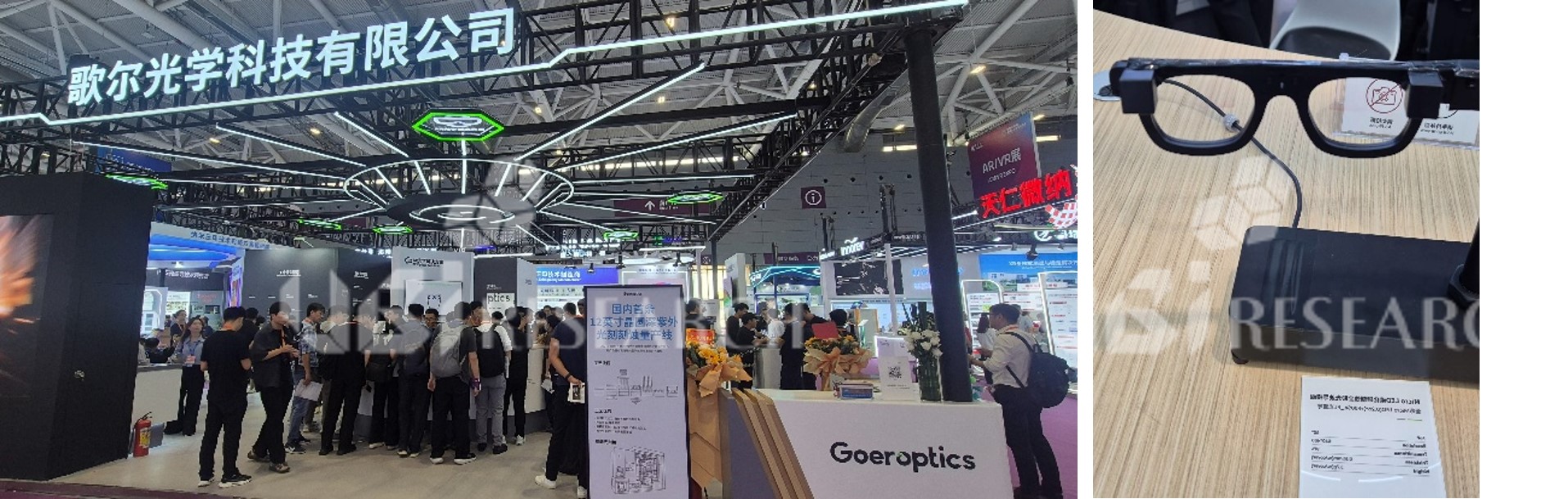
Goeroptics booth and SiC waveguide solution for AR glasses at CIOE 2026 (Source: UBI Research)
Among the exhibits, the F25Ge-DUV DUV+ etching full-color diffraction waveguide features high image quality, with MTF performance improved by 30% compared to the nanoimprint lithography (NIL) + etching method. Based on a 12-inch DUV+ etching mass production line, the company is now capable of large-scale mass production and delivery. The F25Ge-LT full-color etched waveguide adopts a completely new low-density substrate, reducing its thickness by 30% and its weight by up to 50% or more.
SEEV, a leading Chinese manufacturer of AR diffractive waveguides, exhibited its full product lineup of waveguides, including full-color silicon carbide (SiC) etched waveguides, full-color nanoimprint lithography (NIL) waveguides, and monochromatic waveguides featuring high luminous efficiency, high transmittance, and ultra-thin designs. The company has been mass-producing SiC waveguides since last year. The standout product at this exhibition was the C30CE Pro, the flagship model in the silicon carbide etched full-color series. Compared to last year’s C30CE model, its light efficiency has doubled. It is less than 0.6 mm thick, and a single lens weighs less than 3 g. The company also exhibited SiC refractive-jointed waveguides, which can be custom-manufactured to meet specific needs with a refractive range from -1.00D to -10.00D. Nikahood showcased VHG-type waveguide products designed to enhance waveguide efficiency. Compared to last year, the number of products incorporating SiC has increased, and significant progress has been made in improving optical efficiency.
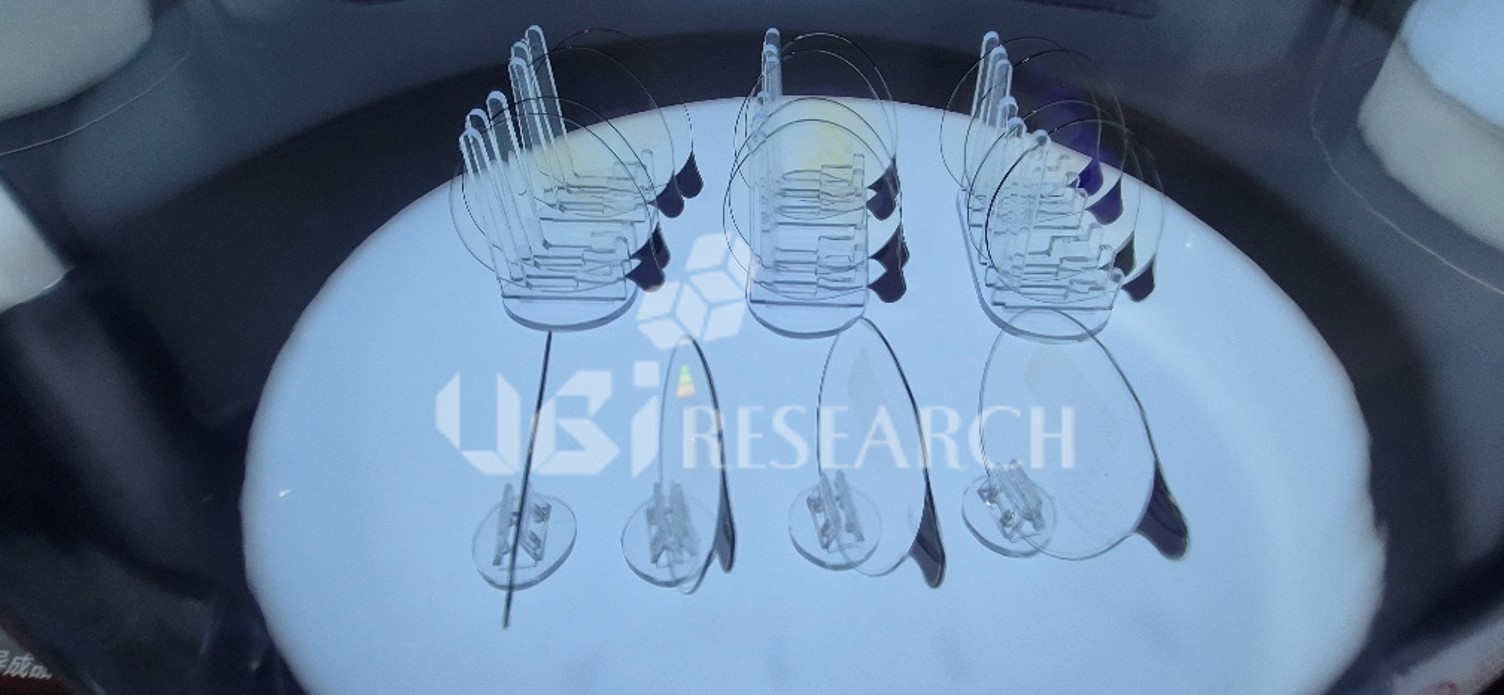
SEEV waveguide products for AR glasses at CIOE 2026 (Source: UBI Research)
Micro-LED displays are also undergoing continuous development. Hongshi Intelligent Technology has miniaturized its existing 0.12-inch module—which featured a 3.75mm pixel pitch—to 0.08 inches by incorporating a 2.4mm pixel pitch in this new product. The new XC7 light engine incorporates a module that utilizes QD color conversion technology on a single substrate, reducing its volume to 0.15 cc and its weight to 0.5 g. Raysolve is also advancing the development of single-chip full-color Micro-LED microdisplay technology and products; its PowerMatch® 1 Series full-color microdisplay adopts quantum dot lithography (QDPR) technology to achieve wafer-level integration of red, green, and blue colors into a single chip. Innovision unveiled its 0.06-inch M06 product with a 2.5-mm pixel pitch. SITAN Technology exhibited a full series of MicroLED display modules ranging from 0.13 to 0.50 inches. In China, there is a growing trend toward the development of Micro-LED microdisplay modules that utilize QD color conversion technology.
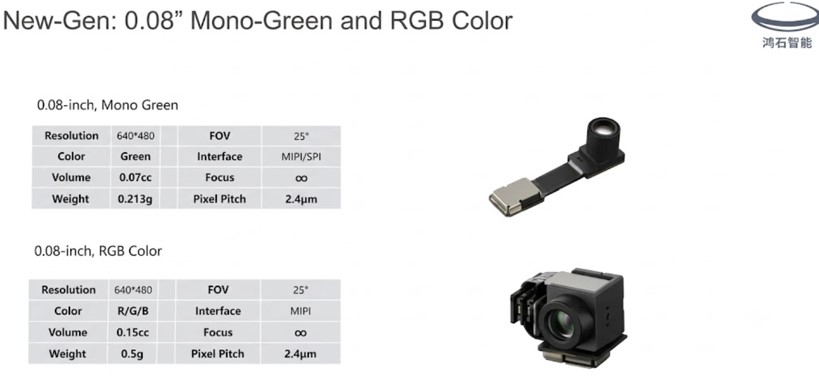
Hongshi Intelligent Technology’s new 0.08-inch mono-green and RGB Micro LED products (Source: Hongshi Intelligent Technology)
Competition to commercialize AR glasses—specifically their core components, the display and optical waveguides—is entering a new phase. The race to expand production capacity on existing mass-production lines and to commercialize products incorporating new technologies is accelerating. With nearly 3 billion people worldwide wearing glasses, and given that the number of AR glasses users is expected to continue growing in the future, I believe products featuring optical waveguides will undoubtedly become one of our core businesses.
Namdeog Kim, Senior Analyst at UBI Research (ndkim@ubiresearch.com)
▶Display Korea 2027: Where Global Display Business Connects
▶Industry Trends and Technology of Micro-LED Displays for XR Report
※ This article is produced by UBIResearchNet.
Unauthorized reproduction or citation without source attribution is prohibited.
When quoting, please clearly indicate the source (UBIResearchNet) and provide a link.