
At the silicon-based Micro LED session of the CIOE 2026 Microdisplay Industry Development Forum, held on 10 September 2026 at Shenzhen World, presentations were given by RayNeo (雷鸟创新), Goer Optics (歌尔光学), Raysolve (镭昱光电), SmartVision (芯视元), Megarobo (镁伽) and Vjio (微玖光电). There was no disagreement that Micro LED has moved beyond the laboratory stage, with AR glasses shipments surpassing 1.2 million units this year, but opinions diverged on when and how full color should be mass-produced.
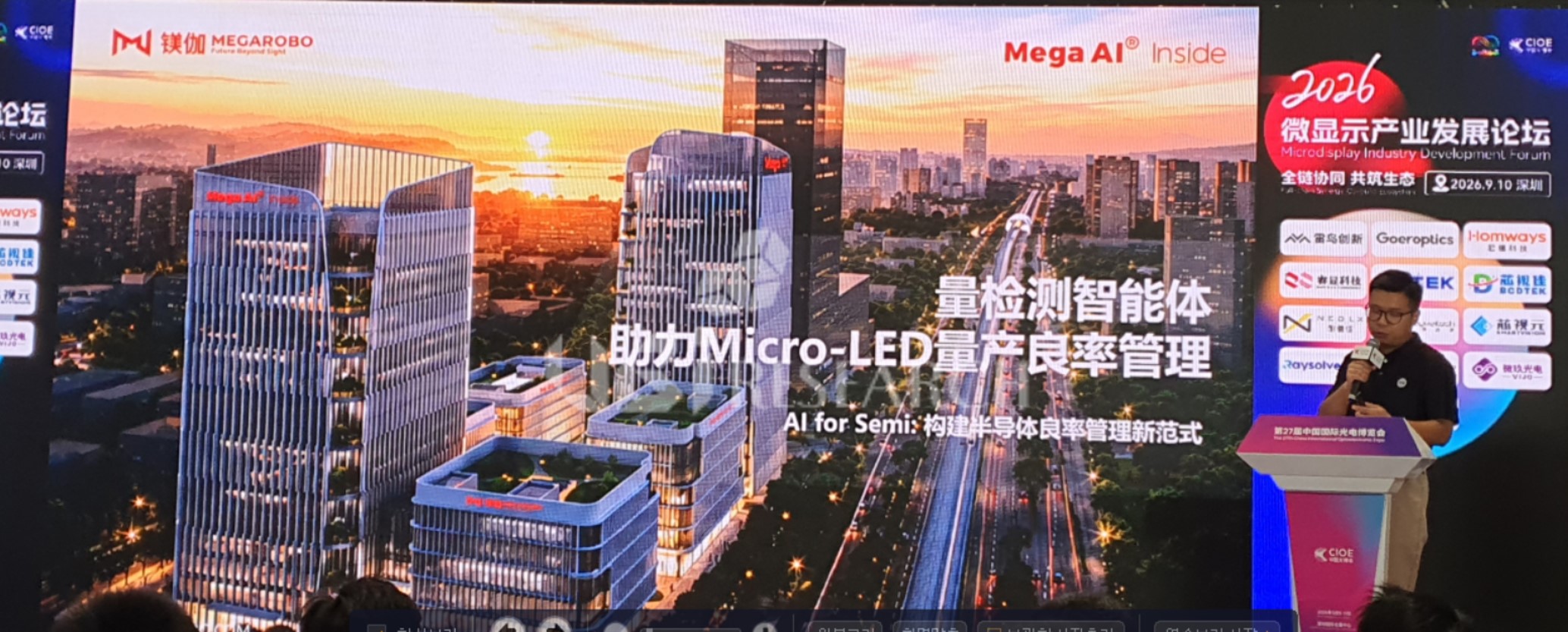
Megarobo presentation on AI-based Micro LED mass-production yield management at CIOE 2026 (Source: UBI Research)
Chen Hong (陈红) of RayNeo placed the iPhone moment for AI+AR glasses in 2027-2028. He cited supply chain maturity, panel miniaturization and falling prices as the basis, and explained that high-frequency usage scenarios such as translation, teleprompting and notifications are already taking shape. The company’s new product removes the camera to bring the weight down to 34 g and keeps the price, waveguide included, within 2,000 yuan, while achieving 93% transmittance in the grating area and 98% elsewhere. RayNeo presented its in-house structure covering everything from optical design to light engine manufacturing and device assembly as its key differentiator.
On full-color implementation, the divide between technology routes was clear. Zhao Xin (赵鑫), Deputy General Manager of the Consumer Electronics Business Unit at Goer Optics, stated that combining three panels with an X-cube will be the only practical full-color solution for the next three to five years, and that the single-chip approach will not have its opportunity until after 2029-2030. He said the light engine volume has been reduced from an initial 3 cc to 0.6 cc for monochrome and 0.17-0.18 cc for full color, with a target below 0.1 cc, and explained that alignment between the three panels, micro-deformation and color separation control are the core challenges optical companies must handle.
By contrast, Zhuang Yongzhang (庄永漳), CEO of Raysolve, which presented a full-color light engine based on quantum dot photolithography, pointed to the sharp drop in efficiency and the temperature sensitivity of red Micro LED as devices shrink as the structural weakness of the three-panel RGB approach. He also assessed the three-layer stacking approach as difficult to implement because the electrode count rises to six layers, leaving insufficient room for wiring, and because it faces limits below 3 μm, and proposed as an alternative the combination of blue devices with quantum dot color conversion, handled with a single epitaxial layer and standard processes. He further noted that the required to-the-eye brightness is rising from 100 nit to around 300 nit.
Yao Yuan (姚远), Assistant General Manager at SmartVision, introduced a monolithic approach that integrates the emissive layer and the color conversion layer on a single chip. Applying this structure can reduce light engine volume by more than 80% and raise optical efficiency more than tenfold, according to the presentation. He added the caveat that full-color single-chip devices still face technical challenges, making parallel use with existing approaches unavoidable for the time being.
Mass-production yield and inspection were also raised as shared challenges. Feng Kunlun (冯昆仑), Senior Product Manager at Megarobo, noted that a single wafer carries tens of millions of devices, which conventional semiconductor inspection methods cannot handle, and explained that color inspection with separate criteria for each RGB wavelength, combined with AI-based judgment, has lowered the over-kill rate from 0.1% to around 0.01% and cut manual review staffing by 90%. He added that transfer position error is measured down to the 0.1 μm level and that bonding alignment deviation is corrected by more than 50%. Wang Chenggong (王程功), Chairman of Vjio, founded in 2023, presented in-house development of red epitaxy as the company’s strength and said its 4-inch line in Suzhou is being expanded from 300 to 2,000 wafers per month.
On the optics side, Goer Optics assessed that the efficiency of glass-based surface relief gratings has reached a sufficient level and is no longer a bottleneck. It pointed out that silicon carbide with a refractive index of 2.6 is the ultimate solution, but that the supply chain remains immature as the price of a 12-inch transparent wafer stays in the 100,000 yuan range. For the product landscape, it proposed information-display products with a 25-30 degree field of view at 399-599 dollars and wide-field full-color products at 799-999 dollars, seeing the latter materializing around 2030.
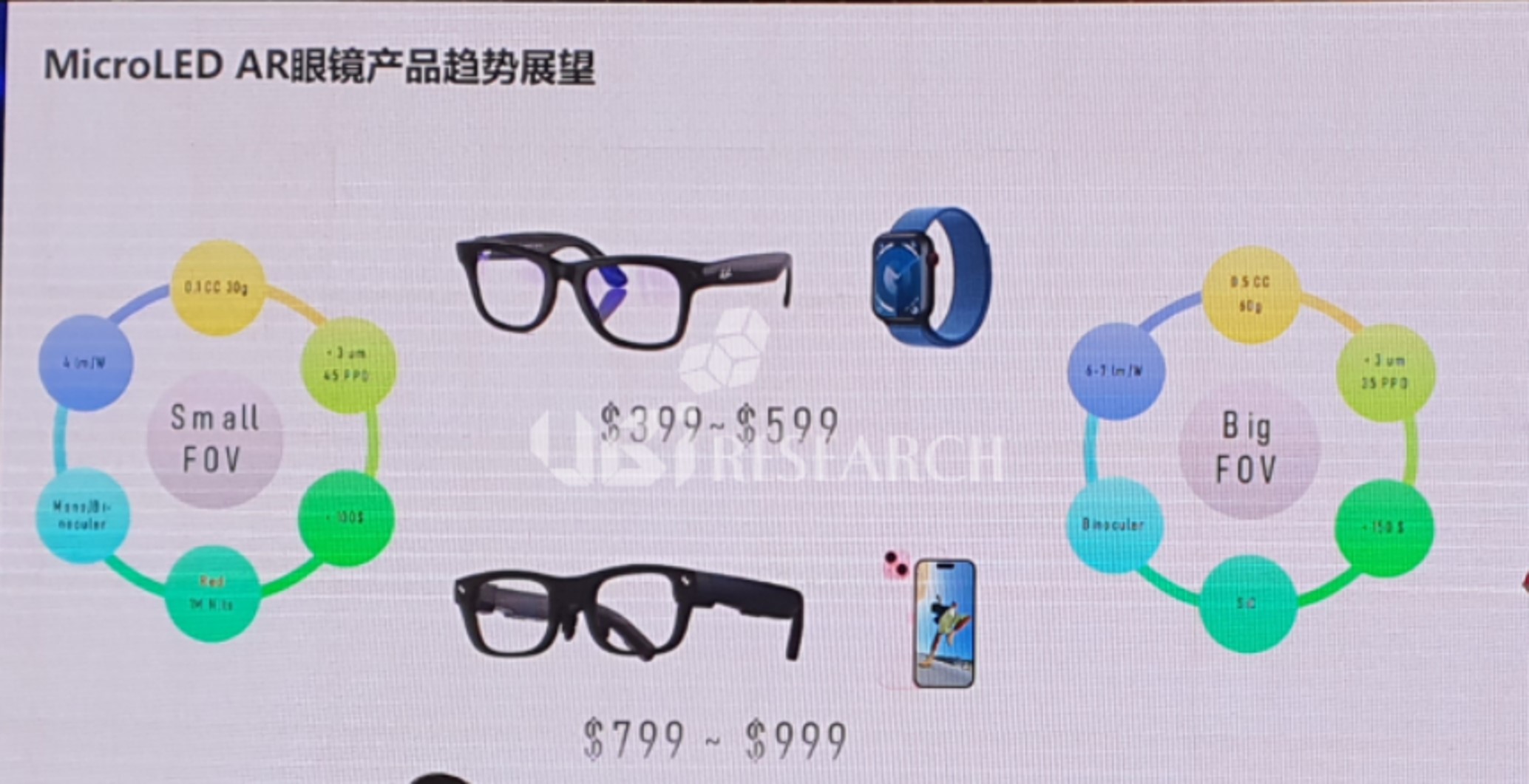
Goer Optics outlook for Micro LED AR glasses presented at CIOE 2026 (Source: UBI Research)
The session showed that the axis of competition among Micro LED players is shifting from securing brightness to the cost of full-color implementation and mass-production yield. Those who see the X-cube as the practical solution stood against those seeking to accelerate the move to a single panel, but both shared the view that how far the finished product price can be lowered will determine the pace of adoption.
Changho Noh, Senior Analyst at UBI Research (chnoh@ubiresearch.com)
▶Industry Trends and Technology of Micro-LED Displays for XR Report
▶Display Korea 2027: Where Global Display Business Connects
※ This article is produced by UBIResearchNet.
Unauthorized reproduction or citation without source attribution is prohibited.
When quoting, please clearly indicate the source (UBIResearchNet) and provide a link.