
As AI glasses are increasingly discussed as the device that will succeed the smartphone, the question of what goes inside them has become a pressing issue for China’s display industry. The Microdisplay Industry Development Forum, held on September 10, 2026 at the Shenzhen World Exhibition & Convention Center during CIOE 2026 (the 27th China International Optoelectronic Exposition), addressed that question head-on. Opened with a keynote address by Peng Jianfeng, chairman of the China Video Industry Association (CVIA), the forum’s silicon OLED (OLEDoS) session brought device makers and optics makers together to review where the technology stands and what challenges remain.
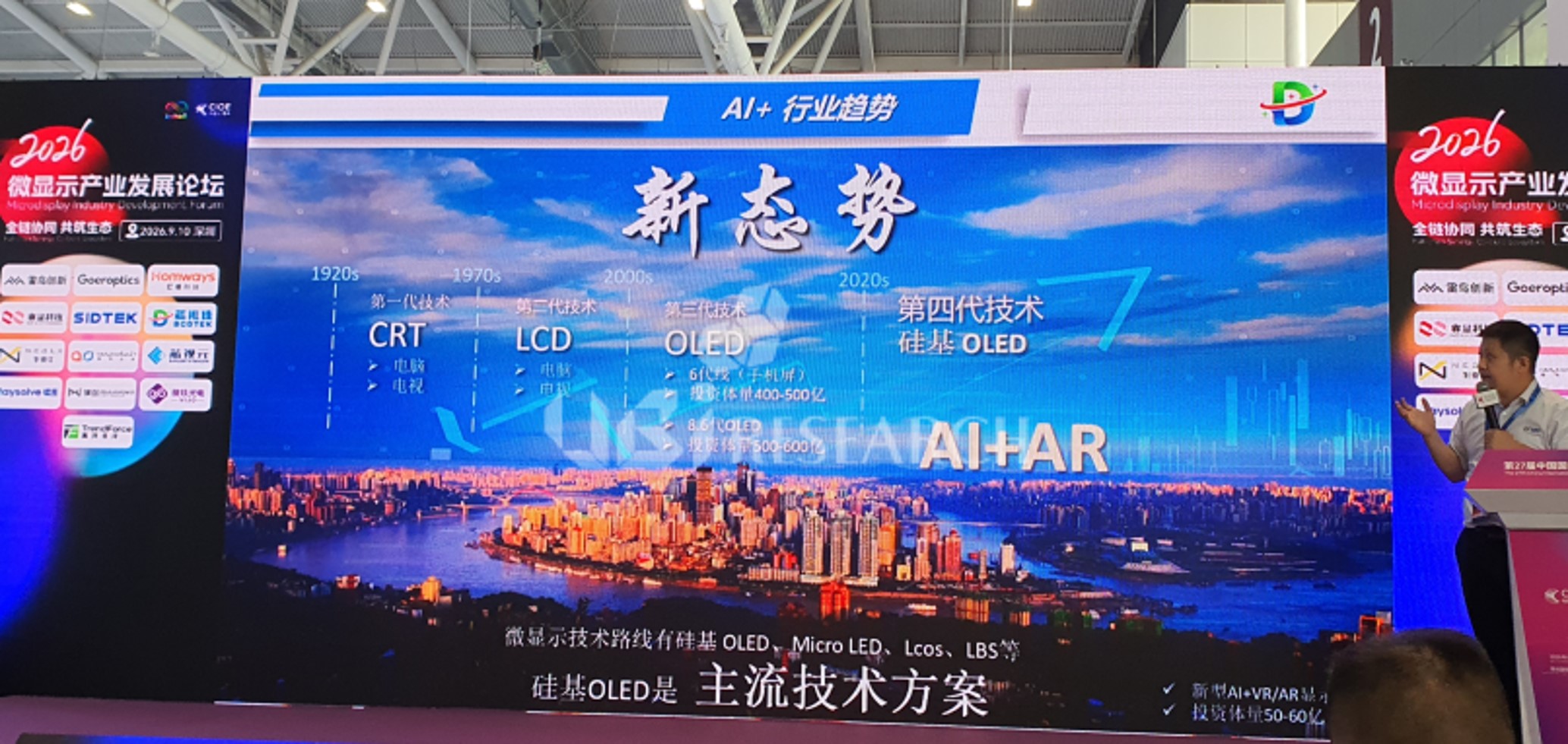
BCDtek presentation on AI, AR and OLEDoS technology trends at CIOE 2026 (Source: UBI Research)
Five companies presented in the OLEDoS session: Homway (宏禧科技), Rayvision (睿显科技), SIDTEK (熙泰智能), NED Optics (耐德佳) and BCDtek (芯视佳). The presenters shared two premises. The first was that, because voice-centric AI devices are limited in how much information they can convey, AI glasses equipped with a display will be the next entry point. The second was that, while Micro LED leads in luminance, it is not yet ready in terms of mass transfer and full-color manufacturability, which makes OLEDoS the realistic choice for the next three to five years.
The center of gravity of the discussion lay less in technical superiority than in what to build and how. Xie Junjie, CTO of Homway and the first speaker of the session, noted that 12-inch line deployment in China is already dense and particularly concentrated in Anhui Province, and judged that capacity construction is running at least one and a half to two years ahead of real demand growth. His conclusion was that differentiation in product definition is the only way to avoid low-level homogeneous competition. Rayvision, which presented next, put 2030 OLEDoS demand at 31.5 million units and argued that, because no single company can cover that volume, the industry is now in a phase of growing the market together. Two opposite diagnoses were thus delivered twenty minutes apart, which may be read as reflecting the different positions of an early mover in 12-inch production and a latecomer whose line starts up at the end of 2027.
Cost was identified as the concrete direction for differentiation. Because display area translates directly into cost, many of the presenters have shifted toward shrinking panels rather than enlarging them. The approach is to add 0.8-1.0-inch 2.5K-class products alongside the 1.3-1.4-inch 4K products that have been the mainstay for VR. SIDTEK further pointed to a practical challenge: demand for AI semiconductors has driven key material prices sharply higher, putting pressure on the cost of the remaining components as well. SIDTEK also presented its production schedule for 0.1-inch-class OLEDoS for AR.
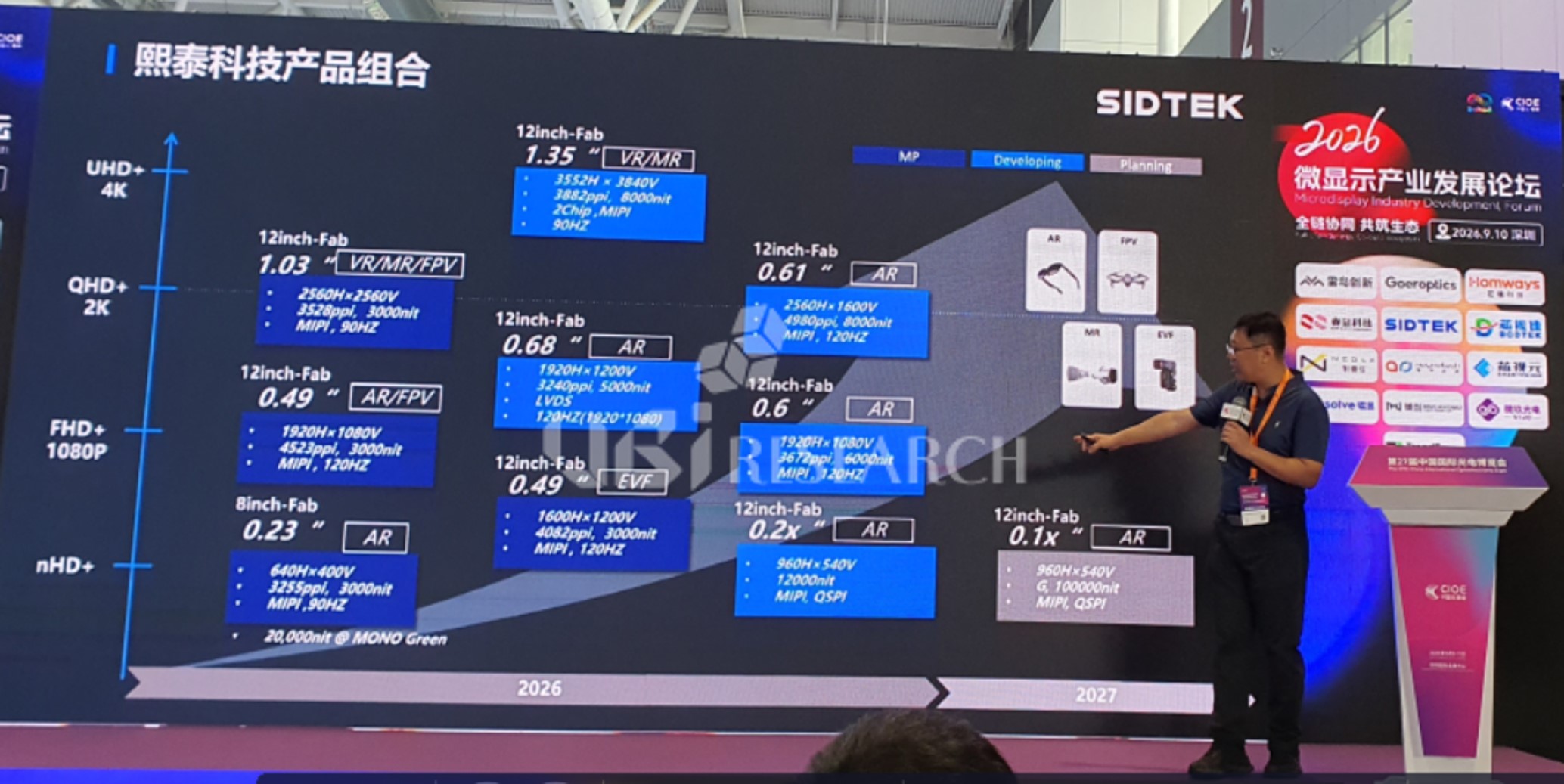
SIDTEK OLEDoS product portfolio and 2026–2027 development roadmap presented at CIOE 2026 (Source: UBI Research)
Technically, the remaining challenge converged on a single item: luminance. The presenters agreed that OLEDoS holds an advantage in color reproduction, resolution and mass-production supply capability, but falls short in brightness because optical loss is large as light passes through the waveguide. Homway forecast that moving from two-stack to three-stack tandem in 2027-2028 would make full-color 12,000 nits realistic within two to three years, and that adopting new blue emitting materials and an independent RGB approach thereafter could push past 20,000 nits within three to five years. It added, however, that the technology path beyond 30,000 nits is still being explored.
Views diverged on how to cope with luminance. Homway argued that full-color waveguides have not yet reached a balance point between cost and performance, and proposed lowering the specification to monochrome or two-color to offset the weakness. NED Optics, the only optics company in the session, countered that full color is unavoidable, citing its own research showing that monochrome green causes noticeable fatigue during long viewing. It said that combining a freeform light engine with a waveguide can bring the price of a finished full-color AI glasses product down to around 3,000 yuan.
Market forecasts differed from company to company. BCDtek expected AI glasses shipments to grow from 15 million units in 2026 to 35 million units in 2030. It singled out the fact that the display attach rate stood at only 8.4% as of 2025 as the single biggest opportunity. Homway, counting only color products equipped with a display, put 2026 shipments at approximately 1.11 million units. The differing bases make direct comparison difficult. The message the session left, however, was clear: the competitive axis of China’s OLEDoS camp is shifting from securing capacity to product definition and cost structure.
Changho Noh, Senior Analyst at UBI Research (chnoh@ubiresearch.com)
▶XR Industry Trends and OLEDoS Display Technology & Industry Analysis Report
▶Display Korea 2027: Where Global Display Business Connects
※ This article is produced by UBIResearchNet.
Unauthorized reproduction or citation without source attribution is prohibited.
When quoting, please clearly indicate the source (UBIResearchNet) and provide a link.