
AI glasses with color displays are expanding into the consumer market. On October 27, China’s Rokid and RayNeo both unveiled new products with binocular full-color displays, highlighting growing competition to deliver visual information in a form resembling ordinary glasses. Smaller optical systems are helping accelerate market entry. Could mainstream adoption of AI glasses with color displays be approaching? The pace of adoption will depend on simultaneous improvements in comfort, battery life, and practical value for money.
■ The Role and Value of Color Displays
Displays in AI glasses present information that is difficult to convey through audio alone. Monochrome screens can serve translation subtitles and calendar notifications, but color becomes more useful when distinguishing routes and nearby facilities on a map or linking AI explanations to objects identified by a camera. Photo previews and video calls would further expand the range of information users can view.
■ Smaller Optical Systems Enable More Product Launches
Rokid’s newly announced Rokid Color features a 0.16 cc full-color Micro-LED light engine and weighs 55 g excluding the nose pads. It supports 16.77 million colors, a color gamut equivalent to 167% of sRGB, and 100% sRGB coverage. Priced at CNY 4,999 (approximately KRW 950,000–1,050,000), it is scheduled to begin shipping in stages from April 2027.
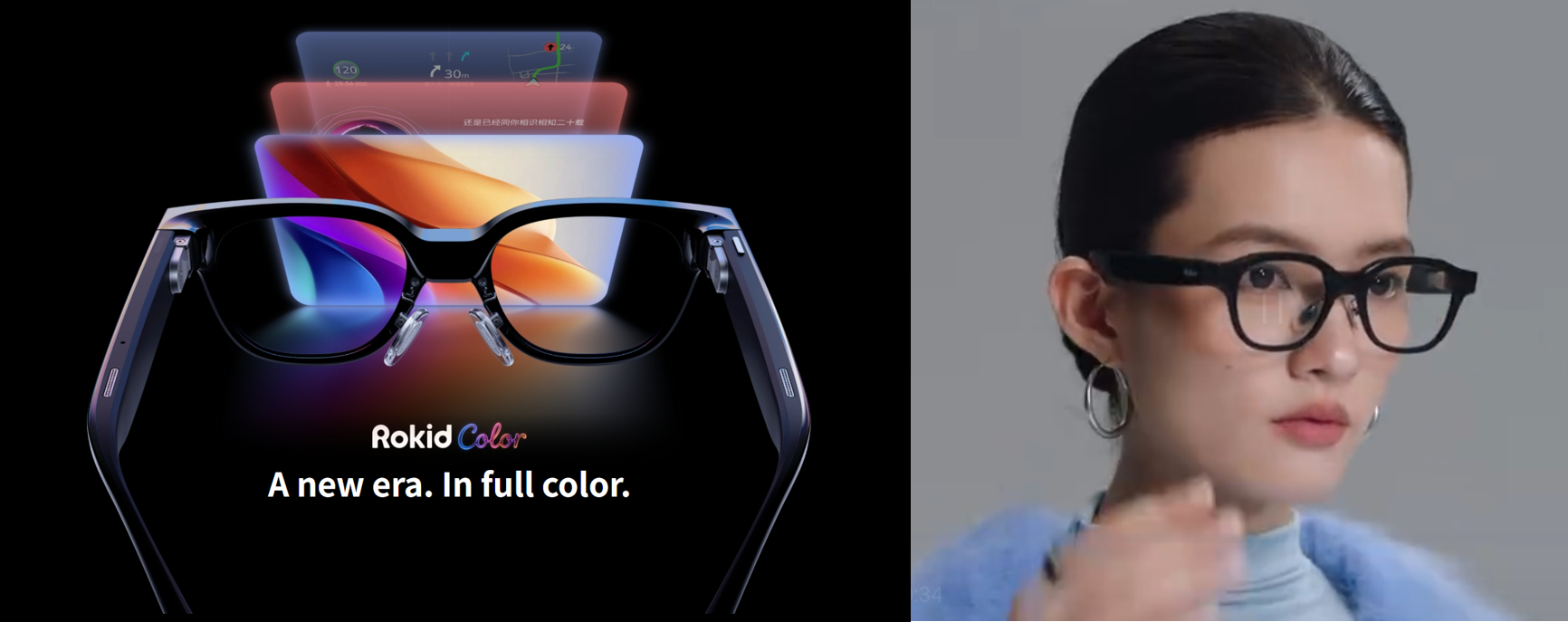
Rokid Color AI glasses / Source: Rokid and online sources
On the same day, RayNeo unveiled the iO+, featuring its fourth-generation binocular full-color Micro-LED waveguide technology. The company said the product retains the everyday eyeglass design of the existing iO while integrating a more compact optical system and reducing rainbow artifacts, light leakage, and reflections on the lens surface.
Meta had already begun selling Meta Ray-Ban Display in the United States in September 2025. It presented brief visual interactions, such as checking messages, previewing photos, and viewing translations, as the main use cases. Early consumer demand could therefore develop around checking essential information without taking out a smartphone, as well as watching video for extended periods.
■ Beyond Optical Size and Image Quality to Power and Cost
Even with a smaller light engine, a finished product still needs waveguides, a battery, processing chips, and space for heat dissipation. Outdoor readability requires sufficient brightness to reach the eye, while greater optical losses increase power consumption and heat generation. Other challenges include maintaining color uniformity and sharpness as the field of view widens, and keeping the image stable as the eye position changes.
Manufacturing complexity directly affects price. Approaches that combine separate RGB light sources require precise alignment of each color and accurate assembly of optical components. Single-chip approaches using color conversion or stacked structures depend on achieving adequate efficiency, uniformity, and manufacturing yield at small pixel sizes. As mass-production quality stabilizes for light engines and lenses and less calibration is required after assembly, there will be more scope to reduce prices while maintaining quality.
■ Could Mainstream Adoption Arrive Sooner?
These new products suggest that the consumer market for AI glasses with color displays could expand more quickly. Briefly displaying information when needed can provide practical value while limiting power consumption, particularly for functions where color offers clear benefits, such as navigation, visual search, and photo viewing. Displaying video or complex imagery for longer periods, however, increases the burden on battery life and thermal management. Initial sales growth is therefore likely to emerge first among companion devices that provide essential visual information intermittently.
With Rokid Color scheduled to ship in 2027, that year is expected to provide an opportunity to assess the comfort, outdoor readability, and charging frequency of mass-produced products in real-world use. Improvements in these areas could accelerate growth among early adopters. Subsequent expansion to a broader consumer base will likely depend on establishing functions that people use repeatedly and bringing prices down. As smaller optical systems lower the barrier to purchase, the next stage of competition will center on creating reasons to wear these glasses every day.