
BYD’s premium brand Denza is preparing to launch the new N8, equipped with a 1.1-meter PHUD. The new N8 is a five-seat, mid-to-large all-electric SUV expected to launch in China in October. A key feature of the new N8 is its departure from the conventional instrument cluster. By separating driving information from vehicle-control information across different display areas, Denza has redesigned the screen layout of the smart cockpit itself.
Author: Dr. Changwook Han, Principal Analyst
Editor: Choong Hoon Yi, CEO & Chief Analyst
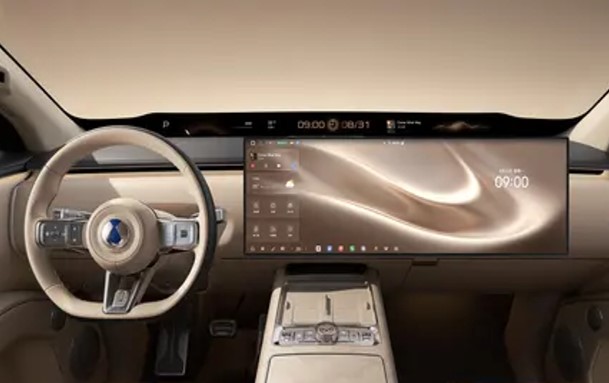
PHUD and 30-inch large integrated display in the new Denza N8 interior (Source: BYD)
The new Denza N8 features a 1.1-meter PHUD and a 30-inch large display across the front of the cockpit. The PHUD presents information that drivers need to monitor continuously, including vehicle speed, navigation, and intelligent driving alerts, while the 30-inch display handles vehicle controls and content. In this configuration, essential driving information is positioned closer to the driver’s line of sight, while more complex controls and entertainment functions are assigned to the central display. The key feature of the N8’s PHUD architecture is this redistribution of display functions, moving away from the conventional smart cockpit approach of simply adding more screens.
This trend is not limited to Denza. The Xiaomi YU7 features a panoramic display spanning the lower section of the windshield, while the ARCFOX Alpha T7 replaces the conventional instrument cluster area with a 1.1-meter ultra-wide display. The recently launched GAC Trumpchi Yue 7 also adopts a 1.1-meter panoramic display. BMW has introduced Panoramic Vision in the new iX3, using the black area along the lower windshield from A-pillar to A-pillar as an information display zone. Although the implementation differs among automakers, the overall direction is the same: removing the conventional instrument cluster from directly in front of the driver and using the lower windshield area as a new information display zone.
Several factors are driving the adoption of PHUDs. A conventional instrument cluster is visible primarily to the driver and requires dedicated installation space, whereas a PHUD can use the lower windshield area to distribute information across a much wider field. Eliminating the instrument cluster also allows the dashboard to be lowered or simplified, giving designers greater flexibility in interior design. As electric and intelligent vehicles need to continuously display vehicle status, navigation, and ADAS information, a wide horizontal information area can offer advantages over a relatively narrow instrument cluster.
PHUD should not simply be regarded as a lower-cost alternative to AR HUD, as the two technologies serve different purposes. PHUD is well suited to presenting persistent two-dimensional information, such as vehicle speed and status, across a wide display area. AR HUD, by contrast, has an advantage in displaying information that needs to be spatially aligned with specific locations in the real-world driving environment, such as lane guidance, turn directions, and hazard locations. BMW’s combination of Panoramic Vision with a separate 3D HUD illustrates this division of roles. Panoramic Vision handles basic driving information, while the 3D HUD spatially presents navigation and automated-driving information in the driver’s forward field of view.
The competitiveness of PHUD therefore lies less in replacing AR HUD than in how effectively it can eliminate the conventional instrument cluster. As cluster information migrates to the PHUD, the traditional division of functions among the instrument cluster, central display, and HUD is also being reorganized. Going forward, cockpit architectures may increasingly assign persistent driving information to the PHUD, vehicle controls and content to the central display, and, where required, road-referenced information to an AR HUD.
Several challenges remain before PHUDs can achieve broader mass-market adoption. While the display can be extended horizontally, the limited height of the lower windshield restricts expansion of the vertical display area. Distortion and double images caused by differences in windshield curvature among vehicle models must also be addressed, along with display uniformity and visibility under direct sunlight. Readability while wearing polarized sunglasses and optical stability under temperature variations are also important requirements for automotive displays. BMW, for example, applies a dedicated nano-coating to Panoramic Vision to maintain visibility when polarized sunglasses are worn.
An even more important issue is information density. Simply increasing the display width and presenting more information simultaneously could instead distract the driver. HMI design—determining which information should remain continuously visible and which should appear only when needed—will therefore be critical to the success of PHUDs. Automakers and suppliers will also need to optimize the windshield, display, optical system, and vehicle software as an integrated system while reducing vehicle-specific development costs.
The growing adoption of 1.1-meter-class panoramic displays, extending from the Denza N8 to mid-range Chinese vehicles, suggests that PHUD may develop beyond a decorative feature limited to premium vehicles. The expansion of PHUD is not simply about adding another screen to the vehicle; it represents a shift in the position and role of the conventional instrument cluster. As PHUD adoption expands across vehicle segments and price ranges, competition in the automotive display market is expected to increasingly focus not on panel size itself, but on where and how driving information is presented.