
“DIC EXPO 2026: Exhibition on Display Technology and Application Innovation,” an annual event that attracts significant attention from the global display industry, opened on August 26 at the Shanghai New International Expo Center.
Companies such as BOE, TCL CSOT, Visionox, and Tianma showcased their new products, and a separate event, the DIC FORUM 2026 Display Industry Innovation Cooperation Forum, was held under the theme “Strengthening Multidimensional Capabilities, Making a Comprehensive Leap Forward.” DIC FORUM 2026 is a forum that brings together experts from the fields of display devices, core materials, core equipment, terminal applications, and major research institutions to foster cross-industry dialogue and the exchange of ideas.
Zhang Rong, an academician of the Chinese Academy of Sciences and secretary of the Party Committee at Xiamen University, delivered a keynote speech titled “Micro-LED Technology and Its Applications in Display and Non-Display Fields.” He noted that Micro-LED technology is regarded as the ultimate display technology and is attracting widespread attention from both academia and industry, while also demonstrating tremendous potential in the fields of optical communications and optical computing, which are geared toward AI applications.
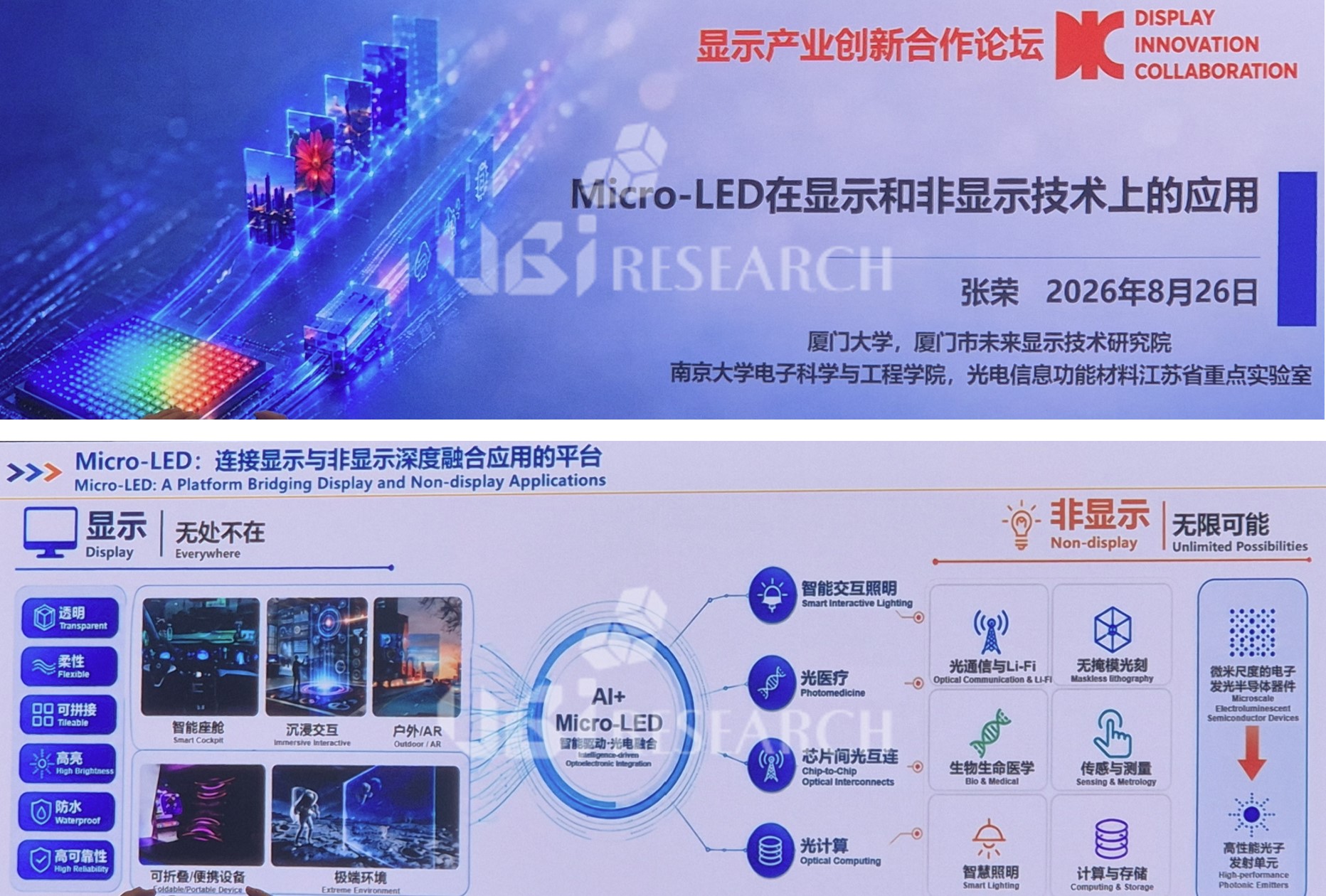
Keynote presentation on Micro LED technology and its display and non-display applications at DIC FORUM 2026 (Source: UBI Research)
The presentation provided a detailed overview of the latest advancements in the field of micro-LED epitaxy and chips. This included high-pixel-density and large-substrate micro-LED display integration technologies, as well as non-display integration technologies such as micro-LED-based optical communication and optical computing.
In the design of Micro-LED epitaxial wafers and device structures, significant technical achievements have been made with the help of AI technology, which has recently become a hot topic. From a process perspective, the IDRP (In Situ Dry Repair and Passivation) process technology has improved the edge-emitting characteristics of Micro-LED chips measuring 10 mm or less.
In the field of optical communications—a non-display application—Micro-LED technology offers low power consumption, low cost, and reliability in high-temperature environments, while delivering excellent bandwidth density and energy efficiency for links ranging from 1 cm to 1 m. In this regard, many companies around the world are racing to develop this technology.
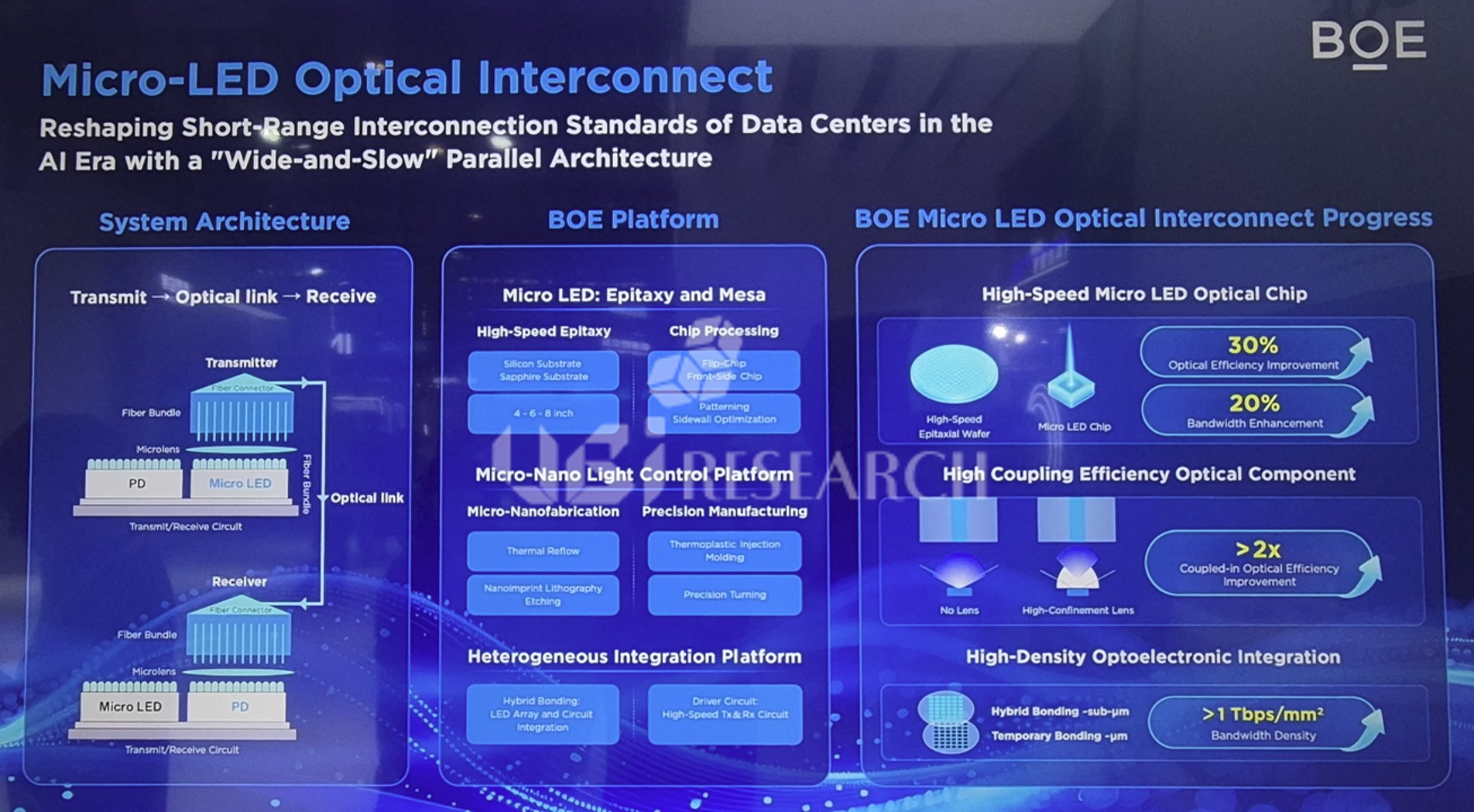
BOE Micro LED optical interconnect technology platform and development progress at DIC 2026 (Source: UBI Research)
At the exhibition, BOE showcased its new Micro-LED products, including a 1.39-inch smartwatch (326 PPI, peak brightness of 6,000 nits, power consumption of 165 mW at 350 nits) and a 27-inch module (COG P0.7, peak brightness of 3,000 nits, power consumption of 240 W, and a thickness of 7 mm) as its new Micro-LED products.
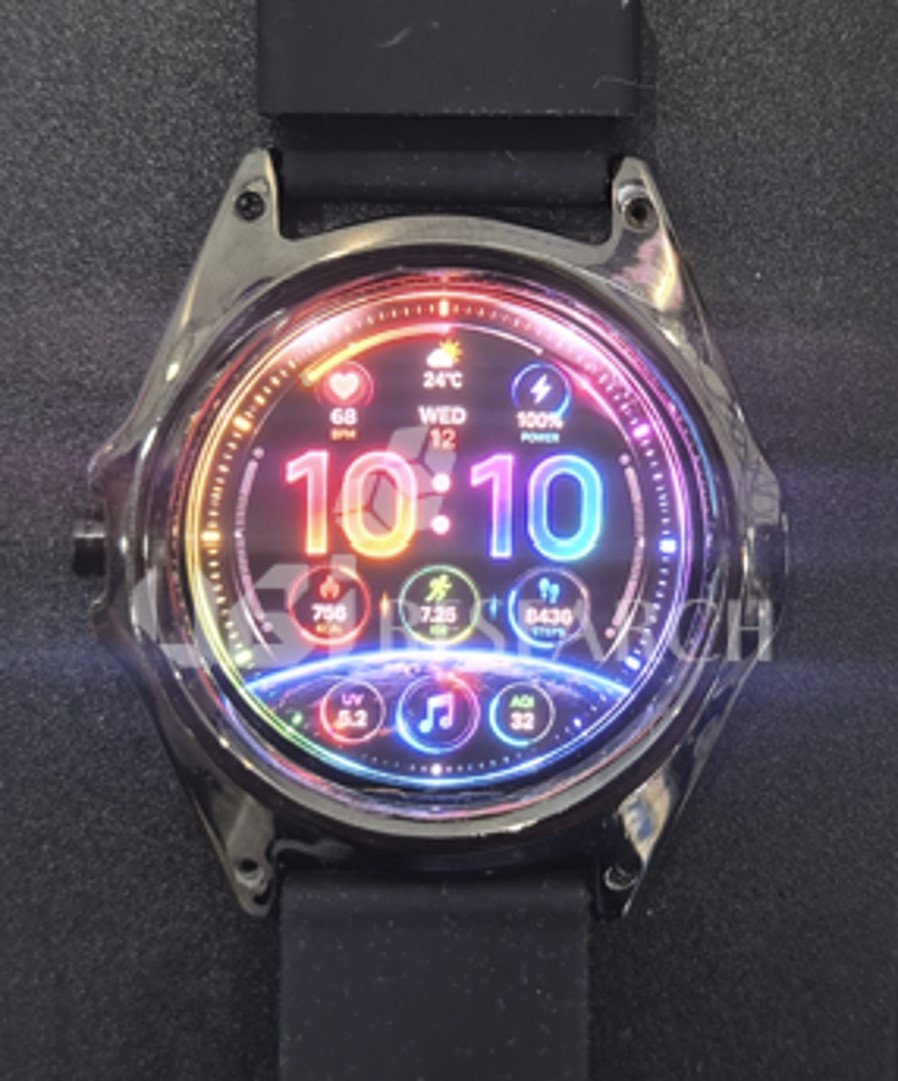
BOE 1.39-inch Micro LED smartwatch display showcased at DIC 2026 (Source: UBI Research)
Through exhibitions and forums, it has become clear that the development of Micro-LED technology applications in both the display and non-display sectors is gradually reaching a stage of maturity across the entire industry ecosystem. In particular, Chinese product developers are not only expanding the scope of applications but are also increasing production efficiency by collaborating with materials and equipment suppliers to reduce current high production costs.
Namdeog Kim, Senior Analyst at UBI Research (ndkim@ubiresearch.com)
▶Industry Trends and Technology of Micro-LED Displays for XR Report
▶Display Korea 2027: Where Global Display Business Connects
※ This article is produced by UBIResearchNet.
Unauthorized reproduction or citation without source attribution is prohibited.
When quoting, please clearly indicate the source (UBIResearchNet) and provide a link.