
At DIC EXPO 2026, TCL CSOT, Visionox, and HKC each presented differentiated technology strategies. All three companies showed a clear move beyond conventional panel specification competition, expanding their technology portfolios into OLED, Micro LED, automotive, IT, and AI-driven applications.
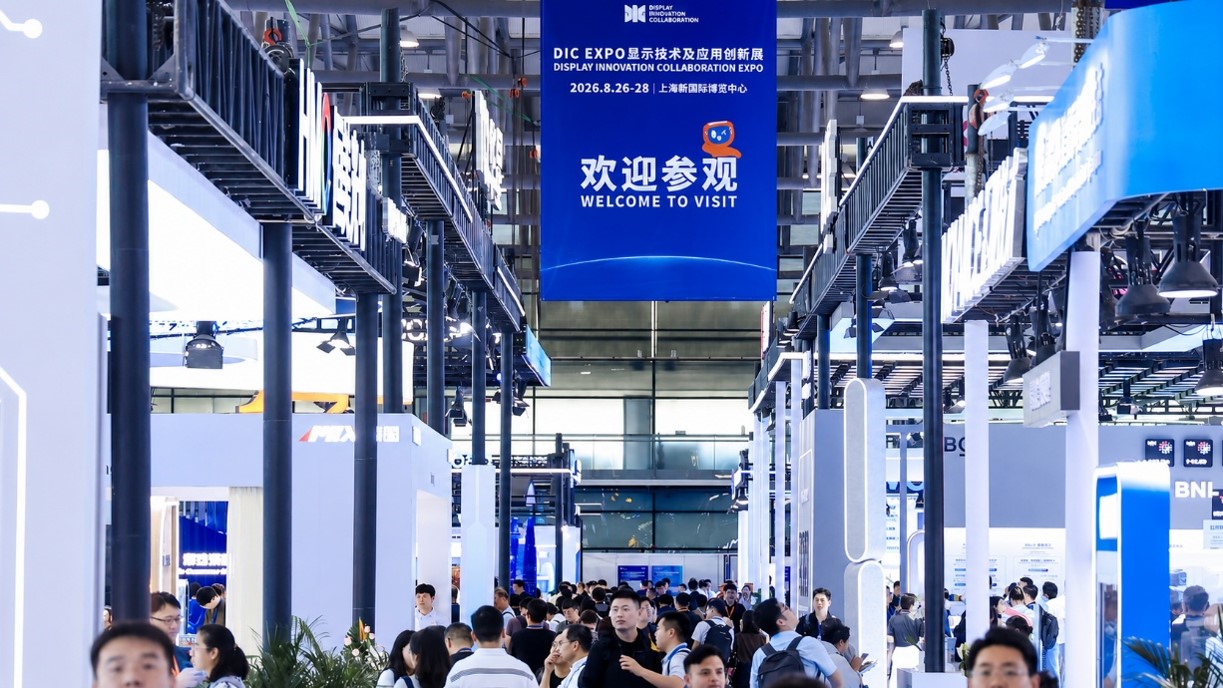
Interior view of the DIC EXPO 2026 exhibition hall (Source: DIC EXPO 2026)
TCL CSOT Advances Printed OLED Commercialization and Expands into the Mid-Sized Market
TCL CSOT presented image quality, visual health, low-carbon technologies, and next-generation form factors as key development directions under its APEX technology brand. The company also said it is applying “X-Intelligence,” an AI-based R&D framework, to display technology development.
In particular, TCL CSOT identified printed OLED as a core technology for expanding its presence in the mid-sized OLED market. The company has already begun mass production for professional display applications and is also conducting customer qualification for consumer IT products such as notebooks and monitors.
Products showcased at the exhibition included a 28-inch foldable portable printed OLED monitor, a 27-inch Oxide-based printed OLED monitor, a 6.9-inch Super Pixel OLED, a 13.2-inch low-power PLP OLED, and an 18-inch Tandem LTPO foldable notebook OLED.
The company also exhibited a 0.28-inch silicon-based Micro LED and an automotive 3-in-1 display combining 12.3-inch, 15.6-inch, and 12.3-inch panels, demonstrating its expansion beyond mobile and IT into XR and automotive applications.
Visionox Emphasizes AMOLED Manufacturing Transition Centered on ViP
Visionox presented “SENSE” as a core value framework for future displays, connecting AMOLED, QLED, and Micro LED technologies with emerging applications such as AR, automotive displays, and robotics.
At the exhibition, the company showcased a wide range of technologies, including a COE OLED with 97% BT.2020 color gamut coverage, low-reflection COE, automotive UDIR, narrow-bezel AMOLED, a transparent display with 60% transmittance, and a 3,000 PPI glass-based OLED display for AR applications.
A major focus was ViP, or Visionox intelligent Pixelization, a technology that eliminates the need for a fine metal mask (FMM). ViP is a next-generation AMOLED manufacturing platform that forms OLED pixels through photolithography and applies an independent pixel encapsulation structure. The platform is being further developed into ViP+, which integrates technologies such as Tandem, CIE, and UDIR.
Visionox also said that its Gen 8.6 AMOLED production line, which will adopt ViP technology, has entered the equipment installation and adjustment stage. In emitting materials, the company introduced pTSF, jointly developed with Tsinghua University, as a technology aimed at simultaneously improving efficiency, color reproduction, and lifetime.
HKC Focuses on Extending LCD Performance and Integrating AI
HKC showcased a broad range of products targeting consumer electronics, automotive, gaming, and commercial display applications.
Major products included a 27-inch glasses-free 3D monitor, a 21:9 5K ultra-wide TV, a 43.8-inch 6K Mini LED monitor, and a 116-inch ultra-thin Mini LED TV. The company particularly highlighted a 1,200Hz native-refresh-rate LCD gaming panel and a VA LCD with reflectance reduced to approximately 0.5%, underscoring its focus on extending the limits of LCD refresh rate and optical performance.
HKC also integrated AI directly into image processing, power control, and screen configuration through its independently developed 6K AI image-quality chip, HKTU10, and an AI Agent-based multitasking display.
In the automotive segment, the company expanded its product lineup with technologies including a 46.6-inch integrated display and a 15.6-inch privacy dual display.
One of the key takeaways from DIC EXPO 2026 is that the technology strategies of Chinese panel makers are not converging toward a single common path. Instead, each company is pursuing a different commercialization strategy based on its existing production infrastructure and technological strengths, ranging from printed OLED mass production and new AMOLED manufacturing platforms designed to replace FMM to further extending the performance limits of conventional LCD technology.
As a result, future competition is likely to be determined less by a simple comparison of whether OLED or LCD has the technological advantage, and more by how quickly each technology can be connected to growth applications such as IT, automotive, XR, and AI devices and scaled into actual mass production.
Changwook Han, Executive Vice President/Analyst at UBI Research (cwhan@ubiresearch.com)
▶2026 In-Depth Technical Report on Foldable Displays
▶Display Korea 2027: Where Global Display Business Connects
※ This article is produced by UBIResearchNet.
Unauthorized reproduction or citation without source attribution is prohibited.
When quoting, please clearly indicate the source (UBIResearchNet) and provide a link.