
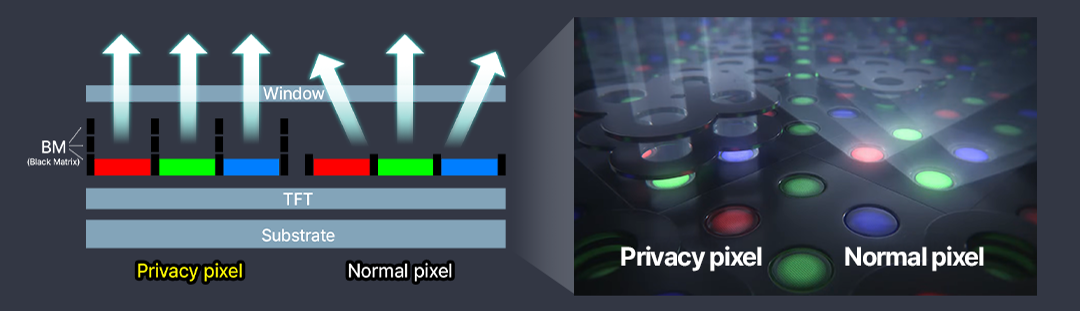
Samsung Display’s Flex Magic Pixel (FMP) structure. A multi-layer light-blocking structure controls the range over which light emitted from each pixel spreads. (Source: Samsung Display)
Samsung Display is expected to begin production of OLED panels for Samsung Electronics’ Galaxy S27 Pro in November. Initial production volume in November is estimated at approximately 700,000 units. The Galaxy S27 series, expected to launch early next year, is anticipated to consist of four models: the standard, Plus, Pro, and Ultra. With the addition of the new Pro model, the lineup featuring higher-end display specifications is expected to expand.
The two premium models, the Galaxy S27 Pro and Ultra, are expected to feature the M16 material set and a privacy display. The standard and Plus models are expected to use the previous-generation M14 material set. By differentiating both the material set and privacy features, Samsung is expected to distinguish display specifications within the same product lineup.
A privacy display controls the direction of light emitted from pixels, allowing the screen to remain clearly visible from the front while making its content difficult to identify from the side. Samsung Display’s Flex Magic Pixel (FMP) technology combines a polarizer-free OLED structure with a multi-layer light-blocking structure. Users can turn the feature on or off and selectively apply it to specific applications or notification windows, helping reduce exposure of messages and personal information in public spaces.
The broader adoption of privacy functionality shows that OLED differentiation is expanding beyond brightness and resolution toward features designed for real-world usage scenarios. Users can normally benefit from a wide viewing angle while limiting the visible range of the screen when checking personal information, making the feature a potentially tangible point of differentiation for consumers. If the technology is adopted in both the Pro and Ultra models, Samsung Display could expand the supply scope of its viewing-angle control technology, while Samsung Electronics could use advanced display functionality as an additional purchase driver for its premium models.