
At the 1st Automotive Display Industry Development Forum held on June 16, Choi Byung-yong, Principal Engineer at Harman International Korea, presented on the topic of “Display/UX Trend in SDV & Zonal E/E Architecture.” He emphasized that automotive displays are evolving from simple information display devices into core interfaces that deliver user experience (UX) as vehicles transition toward SDVs (Software Defined Vehicles).
The key to the SDV transition lies in integrating the distributed ECU architecture within vehicles into domain controllers and centralized computing structures. In conventional vehicles, approximately 100 to 150 ECUs each perform individual functions. In the SDV environment, however, this structure is shifting toward high-performance SoCs, central computing units (CCUs), and zone-controller-based architectures, making software updates and functional expansion easier. This enables OEMs to implement OTA updates, feature-on-demand (FOD) subscription services, and cloud-based development and validation systems.
These changes are also having a direct impact on display configurations and UX. While entry-level vehicles are expected to maintain basic configurations centered on the CID and cluster, premium vehicles are expanding toward multi-display architectures that include passenger displays, rear-seat entertainment displays, control displays, and displays replacing side and rearview mirrors. In SDV-based vehicles, a multi-user and multi-display environment that considers not only the driver but all occupants is becoming increasingly important.
Key UX changes presented included personalization, under-display cameras (UDC), privacy displays, AI-based interaction, entertainment functions, and the expansion of panoramic HUDs. DMS (Driver Monitoring System) cameras can be used not only to detect driver drowsiness, distraction, and condition, but also for occupant profiling. UDC structures, in which cameras are placed beneath the display, are attracting attention as a way to improve the completeness of interior design. With the spread of passenger displays, privacy mode and viewing-angle control technologies are also emerging as major technical challenges.
Harman proposed two automotive display configuration strategies. The first is a wide cockpit configuration that combines 2D/3D AR HUD, ICD, CID, and PID. The second is a configuration that combines a pillar-to-pillar panoramic HUD (PHUD) with a CID. The former integrates a wide range of functions, including cluster HMI, AI agents, navigation, media, and video streaming, across the front display area. The latter uses the PHUD to display driving information, AI agents, widgets, and other content within the forward field of view, while the CID handles the home launcher, navigation, and media functions.
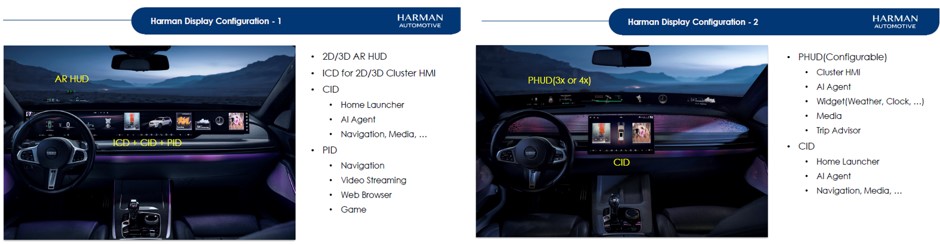
Harman’s Automotive Display Configuration Strategy (Image Source: Harman)
Panoramic HUD was mentioned as a trend that partially replaces some functions of conventional cluster displays while strengthening information delivery centered on the driver’s forward field of view. Although it may evolve into a transparent display format in the future, black film-based solutions are currently being applied first, while viewing-angle regulations, durability, and improvements in optical characteristics remain key challenges.
UBI Research believes that the transition to SDVs will serve as a key growth driver for the automotive display market. As centralized computing architectures and software-based services continue to expand, displays are expected to evolve into core HMI nodes that connect user authentication, personalization, AI interaction, entertainment, and safety functions. Accordingly, market competition is expected to intensify beyond the expansion of panel size and display count, shifting toward UDC, privacy displays, panoramic HUDs, and display architectures linked with high-performance SoCs.
Changwook Han, Executive Vice President/Analyst at UBI Research (cwhan@ubiresearch.com)
▶2025-2026 Automotive Display Technology and Industry Trends Analysis Report
※ This article is produced by UBIResearchNet.
Unauthorized reproduction or citation without source attribution is prohibited.
When quoting, please clearly indicate the source (UBIResearchNet) and provide a link.