
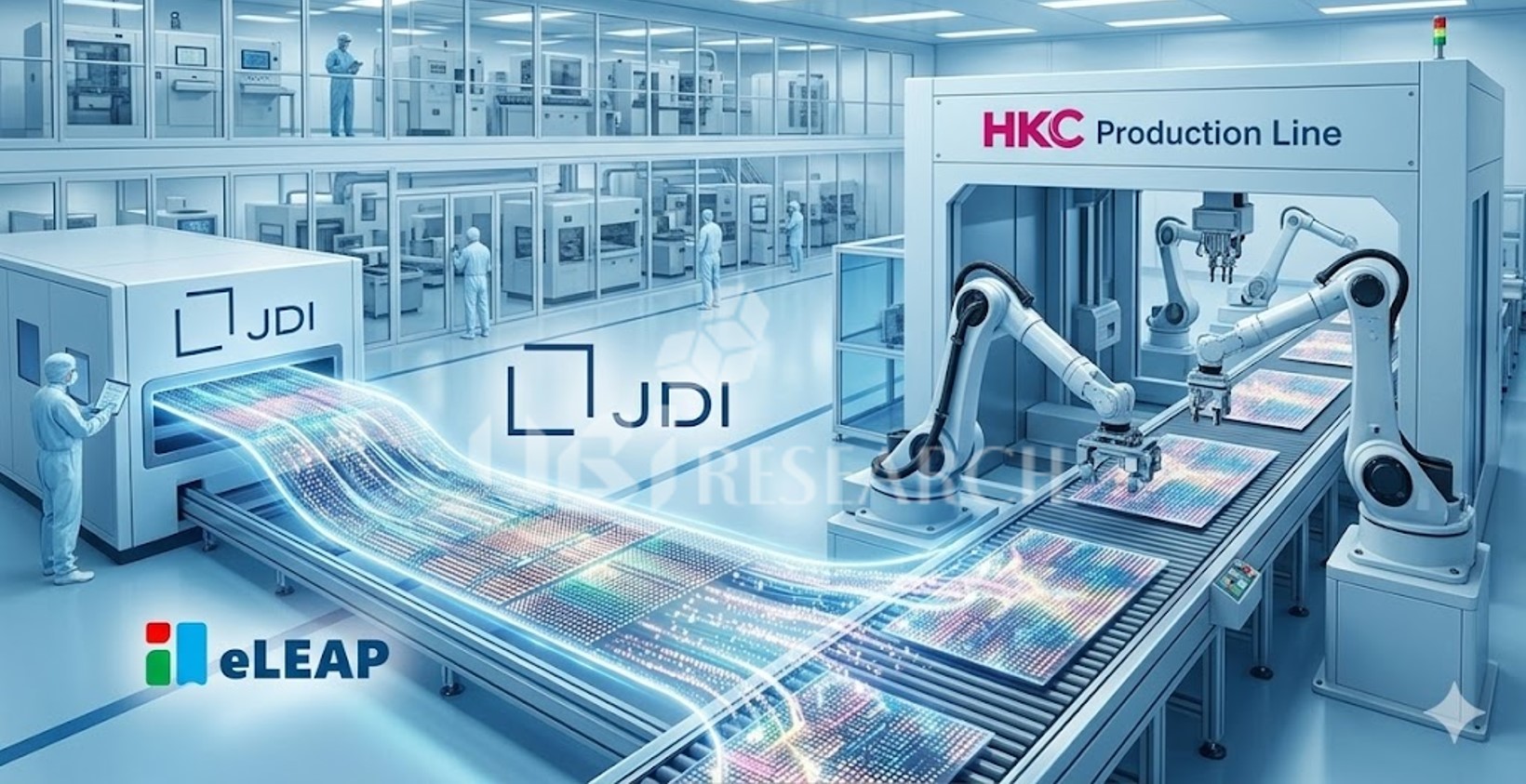
China’s HKC is considering the adoption of JDI’s eLEAP-based FMM-less OLED process through its H7 project. (Source: UBI Research)
Chinese display manufacturer HKC is moving forward with a new H7 project using a site near its H4 fab in Mianyang, Sichuan Province. The project is aimed at expanding HKC’s production portfolio by adding OLED while maintaining its LCD business.
The H7 project will be carried out in two investment phases. The first phase involves introducing used equipment from Japan Display Inc. (JDI) to establish a Gen 6-class LCD line. The purpose is to reduce the initial investment burden, reinforce LCD production capacity, and secure infrastructure that could support a future transition to OLED. The second phase is a 22.5K OLED line investment. For the OLED process, both the conventional FMM method and JDI’s eLEAP-based FMM-less approach are being reviewed.
HKC’s consideration of an FMM-less process for the H7 project reflects changes in the investment environment of China’s OLED industry. Display investments in China are closely linked to financial support from local governments. Since FMM-based OLED lines are already being used by major panel makers such as BOE, CSOT, Visionox, and Tianma, it would not be easy for HKC, as a latecomer, to attract large-scale funding with the same approach. Therefore, HKC needs to present a next-generation process technology as the centerpiece of its investment strategy, rather than simply pursuing a catch-up OLED line.
The FMM-less process forms RGB pixels through patterning processes such as photolithography without using a Fine Metal Mask. By reducing issues such as FMM sagging, limitations in scaling to larger areas, and constraints in high-resolution patterning, the technology is drawing attention as a potential solution for IT OLED and next-generation large-area OLED applications. Visionox has already moved ahead of HKC by investing in its V5 line for the ViP (Visionox intelligent Pixelization) process.
As HKC prepares the H7 project, it is also actively recruiting OLED personnel from other panel makers in China.
If the H7 project progresses successfully, HKC’s OLED investment roadmap could expand further. Industry observers suggest that after accumulating OLED production experience at the H6 Gen 5.5 line and the H7 Gen 6 line, HKC may consider a mid- to long-term investment in an H8 Gen 8.6 OLED line. Gen 8.6 OLED is a key investment area directly linked to the expansion of the IT OLED market, and major players such as Samsung Display, BOE, and Visionox have already invested in or are pursuing projects in this field.
However, whether HKC’s additional investments will actually materialize remains uncertain. Price competition in China’s OLED market has already intensified, and some companies, including Visionox, are facing financial burdens from large-scale OLED investments. In addition, Gen 8.6 IT OLED investments are already being led by major panel makers, meaning HKC would need clear technological differentiation and stable financing to enter the same market as a latecomer.
Ultimately, the key issue in HKC’s H7 project is not simply whether the company will build a new OLED line, but which process technology it will choose. The FMM method has advantages in stability and mass-production experience, but it offers limited room for differentiation for a latecomer. By contrast, the FMM-less process carries significant technical risk, but if successful, it could provide HKC with both a strong investment rationale and product competitiveness. Whether HKC can use H7 as a stepping stone to shift from an LCD-centered business structure toward OLED, and whether the FMM-less process can become a new investment strategy in China’s OLED industry, will be key points to watch.
Junho Kim, Analyst at UBI Research (alertriot@ubiresearch.com)
▶2026 Analysis Report on China’s OLED Supply Chain Management
※ This article is produced by UBIResearchNet.
Unauthorized reproduction or citation without source attribution is prohibited.
When quoting, please clearly indicate the source (UBIResearchNet) and provide a link.