
Written by Changwook Han, Principal Analyst
Huawei has adopted tandem OLED displays supporting the BT.2020 color gamut in its Mate 90 Pro Max and Mate 90 RS smartphones, expanding the use of tandem OLED technology following last year’s Mate 80 RS. BT.2020 is a color gamut standard that defines a wider range of colors than the P3 gamut commonly used in smartphones, enabling the reproduction of a broader range of highly saturated colors.
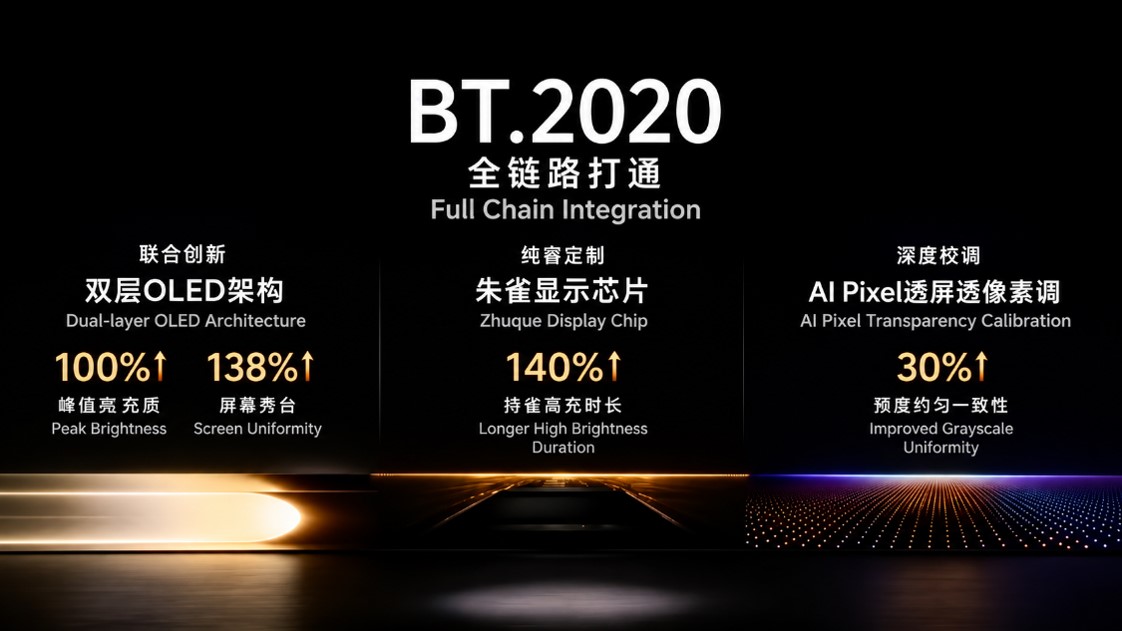
Presentation of BT.2020 color gamut technologies for smartphone OLED panels (Source: Huawei)
Commercial adoption is increasing, particularly among Chinese smartphone manufacturers. OPPO’s Find X10 and Find X10 Pro Max offer 95% BT.2020 coverage based on the CIE 1976 color space.
Display panel manufacturers are also continuing to demonstrate and announce technologies designed to achieve wider BT.2020 color coverage. In September, BOE announced that it had achieved 98.7% BT.2020 coverage using TSF-based AMOLED technology, which employs TADF materials as sensitizers. At CES 2026, Tianma showcased a smartphone OLED display exceeding 96% BT.2020 coverage, while Samsung Display introduced its Flex Chroma Pixel technology with 96% coverage at SID Display Week 2026. Both Tianma and Samsung Display utilized phosphorescence-sensitized fluorescence (PSF) technology.
Content availability remains a key factor in broader adoption. Even HDR video delivered in the BT.2020 format may contain colors that remain within the P3 gamut. Dolby recommends mastering content in P3-D65 and then converting it to BT.2020 for delivery, citing the color reproduction limitations of reference monitors. To fully utilize the wider color gamut of these panels, source content must contain color information beyond P3, and applications and operating systems must preserve that information throughout the display pipeline.
Huawei states that its devices support BT.2020 throughout the workflow, from capture and editing to display and sharing through selected third-party applications. The company has also introduced AI-HDR2020, which expands the brightness and color range of existing SDR content. User-generated content and image enhancement could therefore become initial applications of the technology. However, colors expanded through image processing should not be considered equivalent to color information originally recorded in the source content.
UBI Research expects adoption of BT.2020 OLED panels to increase, particularly in Chinese premium smartphones, but believes that widespread adoption will depend on the availability of compatible content and playback environments. Support for the BT.2020 format alone does not guarantee a perceptible improvement in image quality. Broader adoption will require more content containing actual color information beyond the P3 gamut, along with expanded application support to preserve and reproduce that information accurately.