
At its new product launch event held on August 5, Huawei unveiled new smartphones, tablets, foldable PCs, and laptops, further expanding the scope of OLED adoption. The announcement introduced the next-generation ‘MateBook Fold Ultimate Design,’ which enhances the completeness of foldable OLED PCs, and the ‘MateBook Pro S Privacy Screen Edition,’ which implements privacy functionality directly in the display itself, showing that OLED is evolving beyond image-quality competition into a differentiating factor for durability and security features. The smartphone ‘Nova 16 SE’ features an ultra-high-brightness 120Hz OLED display, demonstrating that premium OLED adoption is spreading even in mid-range smartphones. An OLED panel was also adopted for the ‘MatePad Pro 12,’ continuing the trend of expanded OLED use in the tablet market.
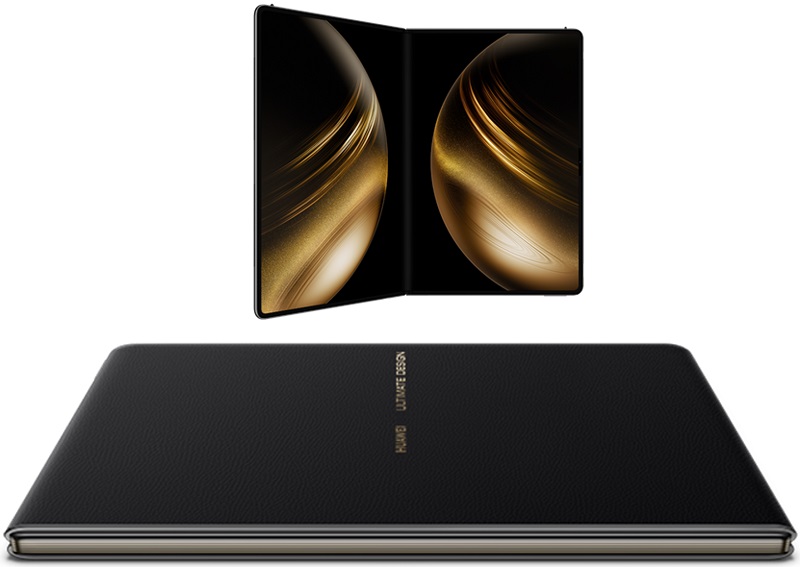
Huawei MateBook Fold Ultimate Design (Source: Huawei)
The product that drew the most attention at this event was the ‘MateBook Fold Ultimate Design.’ If the first-generation model released in 2025 presented the potential of large-screen foldable OLED as the world’s first 18-inch foldable OLED PC, this new product is regarded as a second-generation model with improved commercialization readiness. The new model is equipped with an 18-inch dual-layer (2-Stack Tandem) foldable OLED, and according to the company, it is the first in the industry to apply large-area UTG (ultra-thin glass). Huawei explained that micrometer-thick UTG is designed to secure both bending flexibility and surface hardness, increasing impact resistance by 90% and improving resistance to bending deformation by ten times compared with the previous model, allowing it to withstand frequent writing pressure as well as everyday impacts and compression. In terms of image quality, the dual-layer OLED structure achieves a peak brightness of 1,600 nits, 3.3K resolution, a 2,000,000:1 contrast ratio, and a 92% screen-to-body ratio. It also supports an LTPO-based 10–90Hz variable refresh rate, AR coating, and 1,440Hz high-frequency PWM dimming, taking power consumption and eye fatigue into account.
The newly applied ‘Waterdrop Hinge’ uses zirconium-based liquid metal as the main axis material and combines it with a three-stage damping rotating-shaft structure inspired by traditional joint mechanisms, enhancing mechanical strength and durability. At the same time, the company explained that it reduces stress on the panel, thereby minimizing creases and deformation that can occur during repeated opening and closing. The product is known to have obtained the first SGS Gold-grade five-star drop-impact certification for a foldable PC. This indicates that the competitive axis of foldable OLED technology is shifting from resolution and screen size to system engineering, including hinge design, stress control, and panel protection structures. While the first-generation product had a strong technology-demonstration character, the second generation can be seen as a product focused on securing reliability for long-term use.
In addition, system-level native handwriting input has been introduced for the first time in a foldable large-screen PC, enabling users to annotate documents, webpages, and presentations directly with the new ‘M-Pen 3’ stylus without launching a separate app. This shows that the competitiveness of foldable OLED is developing not only in hardware but also in a direction that includes the operating system and AI user experience.
Another notable product, the ‘MateBook Pro S Privacy Screen Edition,’ features a privacy display that actively controls the viewing angle within the OLED panel itself. Using dual-pixel-based optical technology, it provides a clear image when viewed from the front while limiting screen visibility from the left and right. The company highlighted that, compared with conventional privacy films, the technology increases brightness and reduces image-quality degradation. Unlike Samsung’s FMP (Flex Magic Pixel) method, which is known in the industry, Huawei emphasized that this product maintains a 100% pixel operating rate even in privacy mode, minimizing reductions in brightness and image quality.
UBI Research forecast that, along with the growth of the AI PC market, the adoption of functional OLED technologies such as foldable OLED and privacy displays will expand further. In particular, competition among panel makers is also expanding beyond image-quality improvement into system-level technology competition that includes cover materials such as UTG, durability, mechanical design, and security features. Accordingly, OLED is expected to play an increasingly important role in next-generation IT devices.
Changho Noh, Senior Analyst at UBI Research (chnoh@ubiresearch.com)
※ This article is produced by UBIResearchNet.
Unauthorized reproduction or citation without source attribution is prohibited.
When quoting, please clearly indicate the source (UBIResearchNet) and provide a link.