
IFA 2026 was held at Messe Berlin in Germany from September 4 to 8. With major global consumer electronics and IT companies participating, the display sector focused less on the emergence of entirely new panel technologies and more on how established OLED, Micro LED, and Micro-OLED technologies can be translated into differentiated products and new user experiences. This shift was particularly evident in zero-border designs, 3D Micro LED, performance improvements in IJP OLED, and the commercialization of Micro-OLED for AR devices.
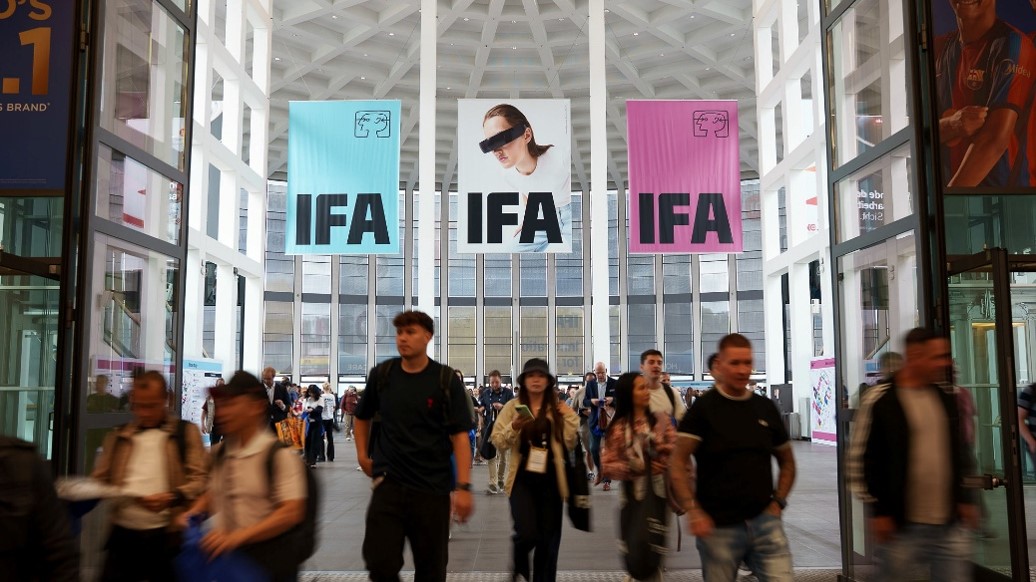
Interior entrance view of the IFA 2026 exhibition hall (Source: IFA Management GmbH)
First, the scope of display innovation is expanding from the panel itself to packaging and overall device architecture. TECNO’s Zero-border smartphone concept is notable not for a new flexible OLED panel, but for changes to the display’s internal stacking and screen packaging structure that visually eliminate the approximately 1–2 mm black border typically remaining around conventional smartphone displays. Rather than increasing resolution or brightness, the concept creates a new viewing experience by minimizing the visual boundary between the display and the device body. This suggests that future smartphone differentiation will increasingly depend not only on panel performance but also on border reduction, cover-window design, bonding, and module packaging technologies.
Second, Micro LED is beginning to translate its ultra-high brightness into new applications. Hisense showcased a 3D display that takes advantage of Micro LED’s high brightness and fast response characteristics. Active-shutter 3D systems have traditionally suffered from reduced perceived brightness because of the glasses, but high-brightness Micro LED offers an approach to mitigating this limitation. Hisense also demonstrated local processing that converts conventional 2D content into 3D in real time. This indicates that Micro LED’s competitive value is moving beyond simply achieving higher brightness than OLED toward creating new application markets, including 3D displays and ultra-large premium visual experiences that are difficult to realize with conventional display technologies.
Third, IJP OLED is moving from technology demonstration toward establishing practical product competitiveness. TCL CSOT exhibited a 27-inch 4K 120 Hz IJP OLED display with full-screen brightness increased to 500 nits. Although the product does not introduce a new form factor, TCL CSOT attributed the improvement largely to higher efficiency in the ink layer, including the emissive materials. Considering that MSI had already unveiled a 27-inch IJP OLED monitor at ChinaJoy 2026, the key question surrounding IJP OLED is no longer whether OLED panels can be manufactured using an inkjet-printing process. The focus is now on whether IJP OLED can achieve sufficient brightness, lifetime, uniformity, and cost competitiveness to compete directly with conventional FMM OLED in the commercial market. This marks a transition from proving technical feasibility to validating real-world product competitiveness.
Fourth, competition in Micro-OLED is also expanding from device-level performance to the overall completeness of AR products. The GOSIGHT P1 incorporates 0.3-inch Micro-OLED displays and full-color waveguide optics for both eyes, while targeting a weight of approximately 69 g, high optical transmittance, and a hot-swappable battery architecture. Micro-OLED itself has already appeared repeatedly at various XR exhibitions, but at IFA the emphasis was on integrating optics, power management, weight reduction, AI, and cameras into a complete consumer product. This suggests that the key competitive factors in the future AR market will not be limited to Micro-OLED brightness and resolution. Instead, competitiveness will increasingly depend on system-level integration that simultaneously delivers high optical efficiency, low power consumption, compactness, and long-term wearing comfort.
IFA 2026 can therefore be viewed as an exhibition that highlighted a broader shift in display innovation—from developing “better panels” to determining “what new experiences can be created by leveraging the characteristics of those panels.” As OLED, Micro LED, and Micro-OLED technologies continue to mature, competitive differentiation is increasingly likely to be determined less by the performance gap of the panel itself and more by the ability to combine packaging, optics, driving technologies, AI, and content at the product level.
Changwook Han, Executive Vice President/Analyst at UBI Research (cwhan@ubiresearch.com)
▶2026 In-Depth Technical Report on Foldable Displays
▶UBI Research’s Micro Display Report
▶Display Korea 2027: Where Global Display Business Connects
※ This article is produced by UBIResearchNet.
Unauthorized reproduction or citation without source attribution is prohibited.
When quoting, please clearly indicate the source (UBIResearchNet) and provide a link.