
Meta’s distribution network faces the mobile ecosystem of the Google–Samsung alliance
Competition in AI glasses is expanding into the Korean market. Meta AI glasses went on sale through Korea’s three mobile carriers in late July. Samsung Electronics’ first AI glasses are scheduled for release in November. Alibaba also unveiled its Qwen N1 series in China on October 13. Meta’s strategy is to encourage everyday use by combining EssilorLuxottica’s eyewear brands and distribution network with photography, calls, and content sharing. After improving battery life and video capabilities in its second-generation models, Meta unveiled the third-generation Ray-Ban Meta and camera-free Audio models in September. By broadening its lineup to cover both camera-focused use and extended voice interaction, Meta is seeking to establish user habits early.
Google and Samsung play different roles within the same alliance. Through Gemini, Android XR, and app integration, Google is extending access to search and task execution to glasses. Samsung combines hardware, connectivity with Galaxy devices, and designs from Gentle Monster and Warby Parker to enhance the value of its mobile ecosystem. A key feature of Samsung’s product is its ability to use the scene in front of the wearer as AI input and translate the results into actions on a smartphone. Launching a display-free model first can be interpreted as a choice to build demand for everyday voice AI while reducing the weight and power requirements of the optical system. For Samsung, this extends access to Galaxy AI from a handheld screen to the wearer’s gaze and voice. For Google, it expands the user base for Android XR and Gemini.
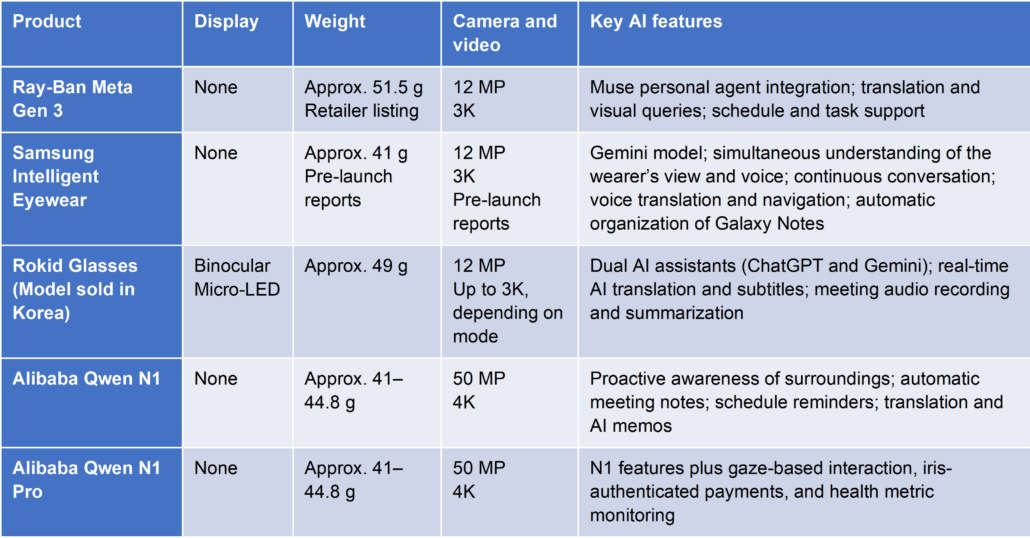
Key Specifications of Recently Announced AI Glasses
Chinese startup Rokid began its entry into Korea in July with Crevity as its official distributor. Its glasses take an open approach, connecting to multiple AI models, including ChatGPT and Gemini. Alibaba’s Qwen N1 series is currently sold only in China. Qwen is designed to support a personal agent connected to everyday services such as shopping and payments. The N1 Pro’s eye tracking and iris authentication are intended to help identify what interests the wearer. Entry into Korea is expected to require improvements in Korean-language performance, integration with local payment and mapping services, and the establishment of local sales and support operations.
The AI platform determines what information the glasses can understand and which services they can connect to, providing a foundation for becoming the starting point for everyday activities such as searching and shopping. Platform competition could therefore extend beyond device sales to control over user access and service engagement.