
Kyulux Achieves over 95% BT.2020 Coverage with RGB Hyperfluorescence, Targets Flagship Adoption in 2028
Kyulux has disclosed the latest performance of its red, green, and blue Hyperfluorescence (HF) devices along with its commercialization plan. In an invited talk at the 43rd Organic EL Symposium held in Fukuoka, Japan, on November 12–13, the company stated that its RGB HF materials cover more than 95% of the BT.2020 color gamut and that it aims for adoption in flagship products in 2028.
(Image: 43rd Organic EL Symposium presentation, Kyulux)
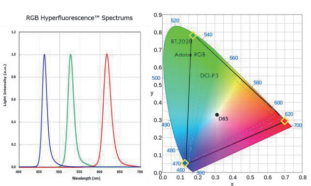
Fluorescent materials offer good color purity but limit exciton utilization to a maximum of 25%, while phosphorescent materials can use 100% of excitons but have a broad full width at half maximum (FWHM) of 60–80 nm and carry iridium price and supply risks. HF uses a TADF material as a sensitizer to harvest 100% of excitons while a fluorescent emitter determines the spectrum, delivering both high efficiency and high color purity without rare metals. Kyulux explained that its HF materials can realize a color gamut corresponding to over 95% BT.2020 coverage, 133% of the DCI-P3 area, and 152% of the Adobe RGB area on the CIE 1931 chromaticity diagram.
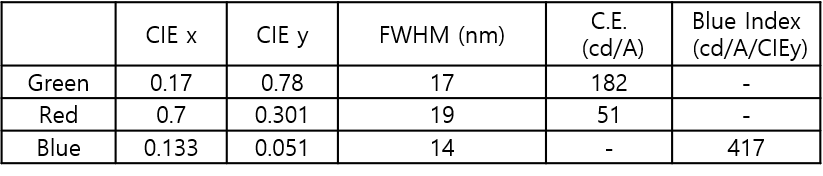
In top-emission devices, Green shows CIE (0.170, 0.780), an FWHM of 17 nm, and a current efficiency of 182 cd/A; the molecular skeletons of the TADF material and fluorescent emitter were engineered to suppress long-wavelength emission components. For Red, a fluorescent emitter with a rigid molecular skeleton reduced the second emission peak on the long-wavelength side, yielding CIE (0.700, 0.301), an FWHM of 19 nm, and 51 cd/A. For Blue, a sky-blue TADF material with high energy-transfer efficiency achieved CIE (0.133, 0.051), an FWHM of 14 nm, and a Blue Index of 417 cd/A/CIEy.
Kyulux emphasized that high efficiency widens panel design freedom. Because the required luminance can be reached at a lower current density, constraints on emission area, aperture ratio, and pixel arrangement are eased, and in tandem structures the required performance can be met with fewer stacked units, potentially reducing material usage and process steps. Narrowband emission also lowers transmission losses through color filters.
Because the HF emitting layer is a multi-component system made up of a host, a TADF material, and a fluorescent emitter, energy-level matching among the components must be optimized simultaneously. Kyulux performs more than 1,000 property calculations per day with Kyumatic, which integrates 280,000 quantum chemical calculation records accumulated over more than ten years, a library of 48 million molecules, and machine-learning models. Combined with a cumulative 38,000 thin-film and device evaluation records and a device simulator, the platform predicts device characteristics including luminous efficiency, chromaticity, roll-off, and lifetime (LT95).
On the mass-production side, the company is building a supply chain and quality assurance system with manufacturing partners including Nippon Soda. Kyulux regards quality reproducibility during scale-up, impurity control, and the stability of purification and sublimation processes as key requirements for mass-production materials. It is currently carrying out evaluations toward spec-in and mass production through joint development with major Korean panel makers.
The presentation shows that HF has become competitive as a BT.2020-ready material in terms of both color purity and efficiency.
Noh Chang-ho, UBI Research