
LG Display is taking concrete steps to address the IT OLED market by leveraging its existing large-area OLED production lines. While Samsung Display and Chinese panel makers are expanding investments in new 8.6-generation IT OLED lines, LG Display is understood to be considering a strategy that combines its existing WOLED production capacity with FLiPP technology rather than making a separate large-scale investment in a new production line.
At IMID 2026, LG Display unveiled a 27-inch OLED demo incorporating FLiPP technology. According to industry sources, LG Display is expected to finalize its FLiPP-related investment plan following an internal review in September, with equipment purchase orders potentially being placed around January 2027.
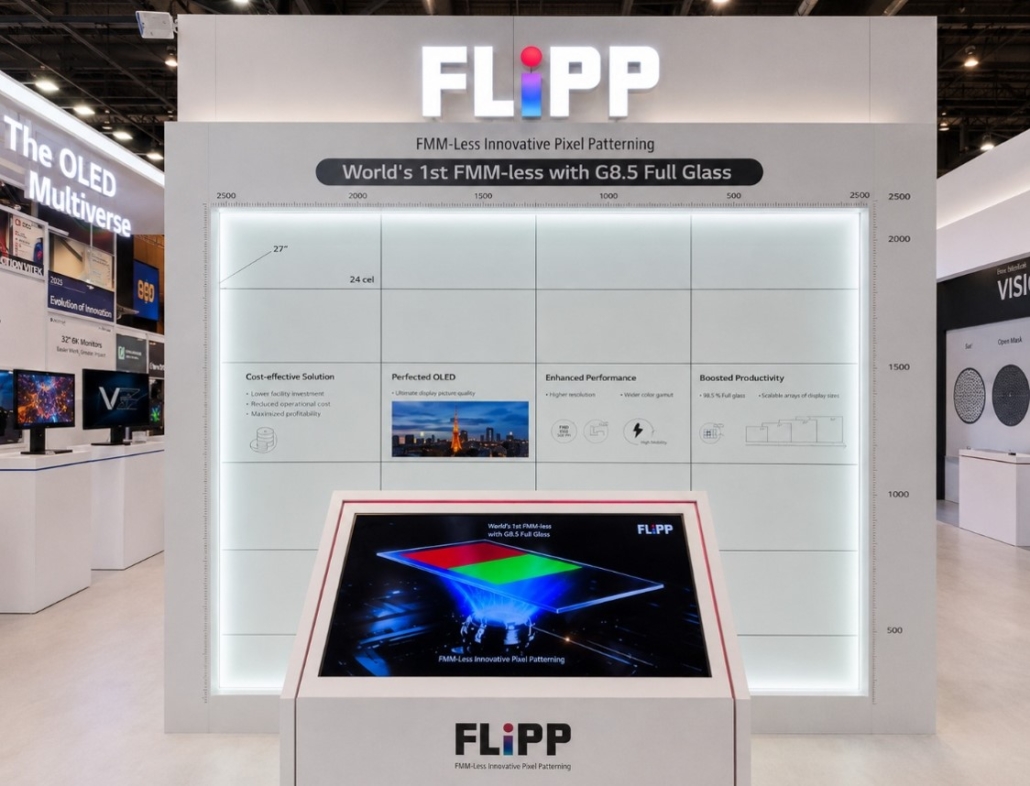
LG Display 27-inch FLiPP OLED demo showcased at IMID 2026 (Source: LG Display)
Meanwhile, LG Display has yet to make a final decision on investing in a dedicated 8.6-generation IT OLED line. Considering the scale of investment required and the pace of growth in the IT OLED market, utilizing existing production infrastructure could reduce the initial capital burden.
In this context, LG Display’s large-area OLED production capacity is drawing attention. Global OLED TV shipments reached approximately 7.3 million units in 2025, of which LG Display supplied around 6.35 million OLED TV panels. Given that LG Display’s annual large-area OLED production capacity is estimated at approximately 10 million panels, its existing production lines are considered to have a certain level of available capacity.
Of particular significance to LG Display’s IT OLED strategy is the fact that the WOLED technology currently used for OLED TVs does not require an FMM (Fine Metal Mask) deposition process. By adding exposure, patterning, and other process equipment required to implement FLiPP, while modifying deposition sources to support angled deposition, LG Display could potentially produce IT OLED panels while retaining a substantial portion of its existing OLED TV manufacturing infrastructure.
Compared with building a dedicated 8.6-generation IT OLED production line from scratch, this approach could reduce capital expenditure while improving the utilization rate of existing large-area OLED capacity.
In the IT OLED market, panel pricing and manufacturing costs are expected to become key factors determining competitiveness among suppliers. Because notebook and monitor panels have larger surface areas than smartphone panels, production yield and material utilization efficiency have a greater impact on manufacturing costs. Accordingly, the mass-production competitiveness of FLiPP will ultimately depend on whether stable production yields can be achieved.
The key to LG Display’s IT OLED strategy will therefore be securing stable FLiPP mass-production yields and efficiently utilizing its existing WOLED capacity. As Samsung Display and Chinese panel makers pursue IT OLED expansion centered on new 8.6-generation production lines, attention is focused on whether LG Display will choose a differentiated investment strategy based on its existing large-area OLED manufacturing infrastructure.
Changwook Han, Executive Vice President/Analyst at UBI Research (cwhan@ubiresearch.com)
※ This article is produced by UBIResearchNet.
Unauthorized reproduction or citation without source attribution is prohibited.
When quoting, please clearly indicate the source (UBIResearchNet) and provide a link.