
LG Display Executive Vice President (CTO) Choi Young-seok delivered a keynote speech titled “Tandem OLED: The Core Architecture Driving OLED Business Expansion and Growth in the AI Era” at the “2026” Display Business Forum held at COEX in Gangnam-gu, Seoul, on July 21.
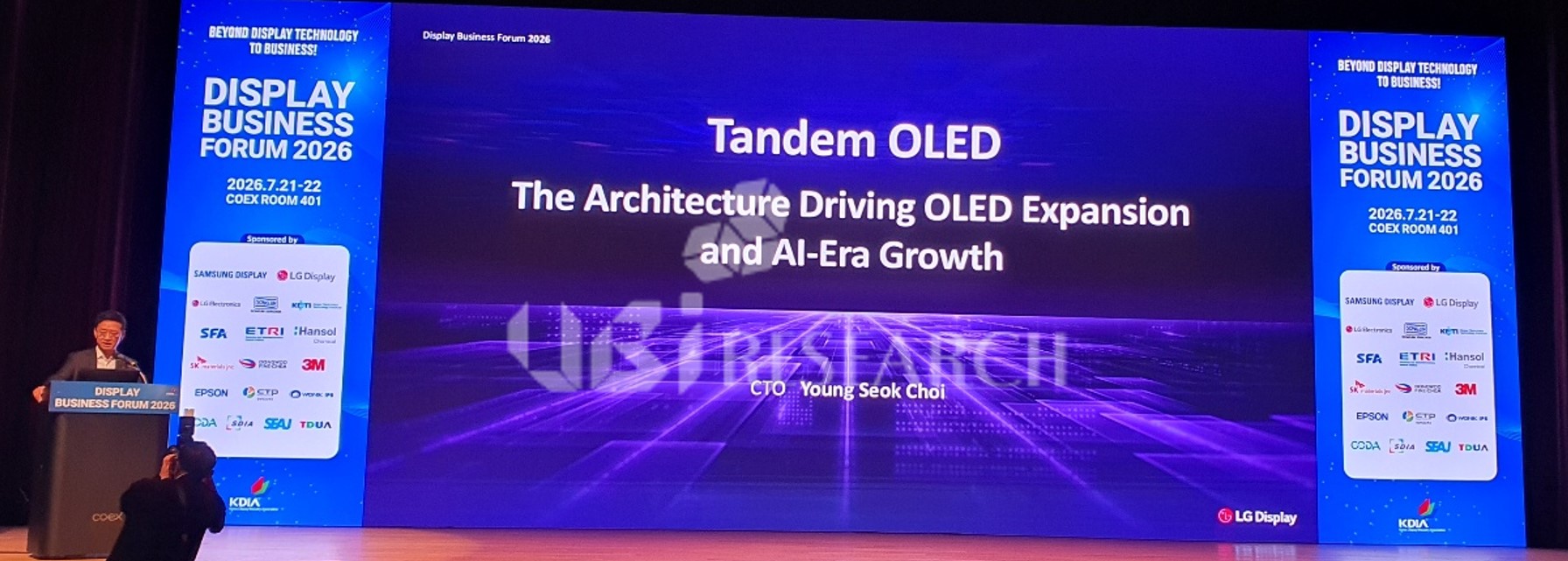
LG Display CTO Young Seok Choi delivers a keynote on tandem OLED as the architecture driving OLED expansion and AI-era growth. (Source: UBI Research)
Vice President Choi Young-seok noted that in the AI era, low power consumption and high efficiency are emerging as key factors determining display competitiveness, and he presented the tandem structure as the solution. He pointed out that the display industry—from cathode ray tubes (CRTs) and LCDs to OLEDs—has grown by overcoming the limitations of each era through innovations in architecture.
In the smartphone display market, OLED’s share of sales has grown rapidly from 10% in 2010 to 34% in 2015 and 95% in 2020, and it continues to maintain a dominant position in the 90% range today. However, the single-stack structure has faced limitations in its expansion into medium- and large-sized applications—such as TVs, IT devices, and automotive displays—where long lifespan and high brightness are required, due to issues like degradation of the emissive layer and image retention caused by high drive currents.
The tandem structure offers an alternative that overcomes these limitations. In a tandem OLED, two or more light-emitting units are connected via a charge generation layer; this approach reduces the driving current while maintaining the same brightness, thereby minimizing the electrical stress on the light-emitting layer. As a result, lifespan can be more than doubled, and power consumption can be reduced by more than 30%.
The expansion of the tandem structure is extending beyond TVs into the automotive and IT sectors. Automotive displays require stable operation even in extreme temperature environments ranging from -40°C to 85°C, and the RGB tandem structure is meeting these conditions and expanding its market share. For IT devices such as tablets and laptops, major panel manufacturers including Samsung Display and BOE are expanding their investments in 8.6-generation production lines to prepare for mass production of the tandem structure.
In a keynote speech this past July, LG Display Executive Vice President Choi Young-seok introduced the company’s advanced technology, which has evolved to a 4th-generation “Primary RGB Tandem” structure, and repeatedly emphasized the importance of expanding the application of the tandem structure across its entire product lineup, including mobile devices.
Vice President Choi Young-seok pointed out that the focal point of AI computing is shifting from centralized cloud systems to on-device processing and, further, to Ambient AI that permeates everyday life. It is reported that a single generative AI query consumes dozens of times more power than a typical search, and as a result, investor interest is also shifting from a focus on software and semiconductors toward energy infrastructure, such as power grids. As on-device AI processing increases even in personal devices such as smartphones and laptops—rapidly reducing battery life and thermal headroom—displays are identified as a key factor, accounting for approximately 40% of a device’s total power consumption.
Vice President Choi presented actual measurement data supporting the effectiveness of the tandem structure, showing that driving a 6.7-inch panel at 1,000 nits reduces power consumption by around 40% compared to the existing single-stack structure. He explained that if this saved power is reallocated to the application processor (AP) for computation, the continuous runtime of on-device AI increases by approximately 50%.
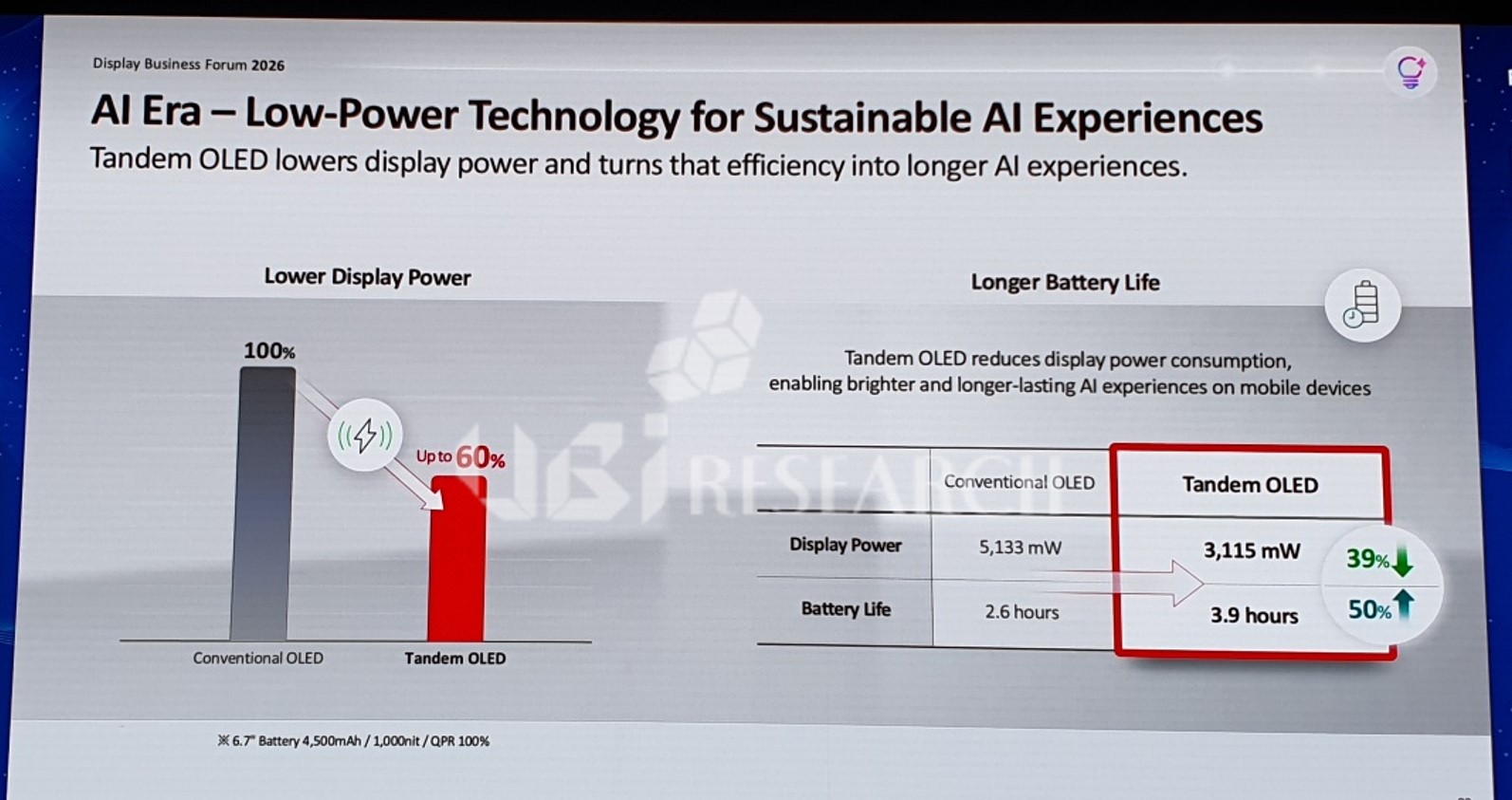
Power consumption and battery-life comparison between conventional OLED and tandem OLED on a 6.7-inch panel. (Source: UBI Research)
Executive Vice President Choi predicted that the trend of expanding the application of tandem structures beyond TVs and automotive displays to all areas of IT and mobile—coupled with growing demand for on-device computing in the AI era—will accelerate further. He also forecast that competition among major panel manufacturers to advance tandem technology will have a significant impact on the future restructuring of the display supply chain. LG Display showcased a variety of tandem OLED products at K-Display 2026, which was held during the same period.
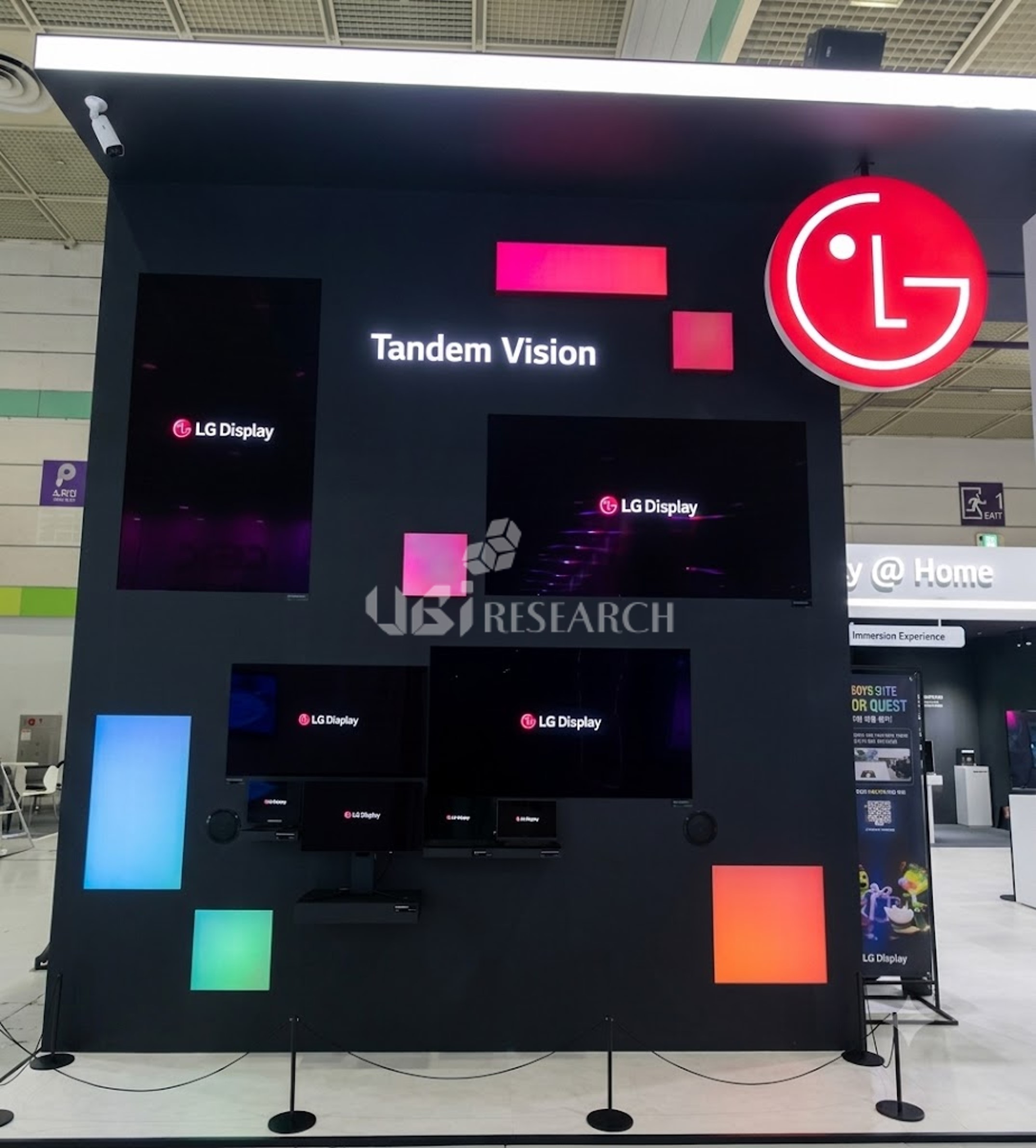
LG Display’s Tandem Vision OLED product lineup at K-Display 2026. (Source: UBI Research)
Changho Noh, Senior Analyst at UBI Research (chnoh@ubiresearch.com)
▶2026 OLED Emitting Materials Report
※ This article is produced by UBIResearchNet.
Unauthorized reproduction or citation without source attribution is prohibited.
When quoting, please clearly indicate the source (UBIResearchNet) and provide a link.