
As LTPO adoption expands from smartphones to IT devices such as tablets, technology development continues to deliver both low power consumption and high image quality. In July this year, LG Display unveiled panels incorporating LTPO technology for smartphones, watches, and 13-inch tablets. As the range of applications grows, the ability to maintain stable brightness and grayscale reproduction even at low refresh rates is becoming increasingly important.
LTPO is a technology that combines LTPS and oxide TFTs to provide driving performance and low power consumption. The low off-state leakage current of oxide TFTs helps retain the voltage written to each pixel for longer. Although their leakage current is low, small fluctuations in the stored voltage can affect image quality. As the interval between screen refreshes increases, small charge losses can accumulate, and differences in charge loss between pixels can lead to brightness variations. These variations require particularly precise control at low grayscale levels.
BOE’s patent CN122871695A, published on October 2, 2026, describes a technology for reducing luminance nonuniformity at low grayscale levels by improving the structure of oxide TFTs. A central source electrode is surrounded by ring-shaped gate and drain electrodes to suppress leakage current and improve the stability of the stored voltage.
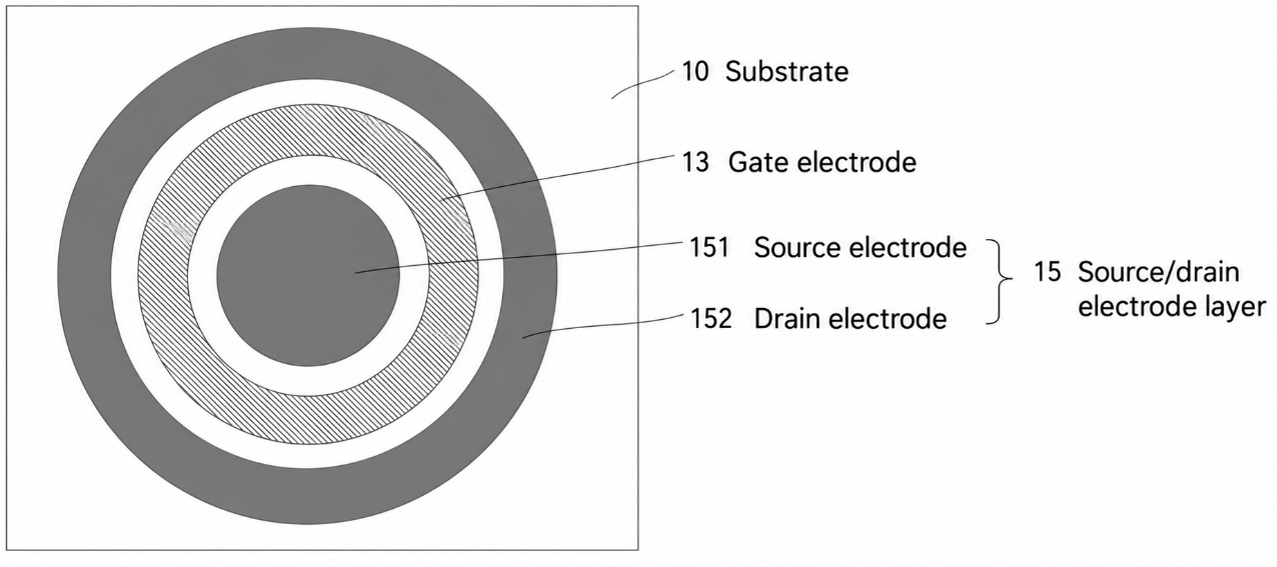
Plan View of BOE’s Ring-Shaped Oxide TFT Structure (Source: Published Patent Application CN122871695A)
The ring-shaped channel structure, applied to oxide TFTs used for initialization or compensation, can alleviate electric-field concentration at corners and eliminate overlap between electrodes. The specification explains that, compared with a conventional rectangular channel, the structure has lower leakage current and parasitic capacitance, and smaller variations in characteristics with changes in voltage, which can improve low-grayscale image quality.
Samsung Display’s patent US20210066424A1, published on March 4, 2021, describes an approach to managing leakage current in oxide TFTs through process conditions. Excessive hydrogen incorporation can cause conductive regions to extend toward the channel, shortening the effective channel length and increasing leakage current. The approach controls hydrogen through measures such as heat treatment of insulating films and ammonia-free silicon nitride deposition. While BOE changes the geometry of the electrodes and channel, Samsung Display seeks to improve the stability of channel characteristics established during fabrication.
LG Display filed a patent application, published as US20240260318A1 on August 1, 2024, to address changes in stored voltage caused by charge released from oxide TFTs. After a compensation oxide TFT turns off, trapped electrons can be released and flow into the gate of the driving TFT. The resulting changes in gate voltage and luminance can cause flicker during low-refresh-rate operation. The patent therefore proposes a circuit that connects an auxiliary capacitor to the node between two series-connected oxide TFTs and applies an inverted scan signal to suppress the effect of the released charge on the driving TFT’s gate.
The three companies’ patents improve device geometry, fabrication processes, and pixel circuits, respectively, but share the common goal of maintaining a stable driving TFT gate voltage. In addition to reducing the absolute magnitude of leakage current, it is important to minimize pixel-to-pixel variations and changes in luminance over time caused by charge movement. As LTPO becomes widely adopted in premium products, the ability to maintain stable low-grayscale reproduction and luminance uniformity even at low refresh rates will become a key factor in device manufacturers’ panel selection.