
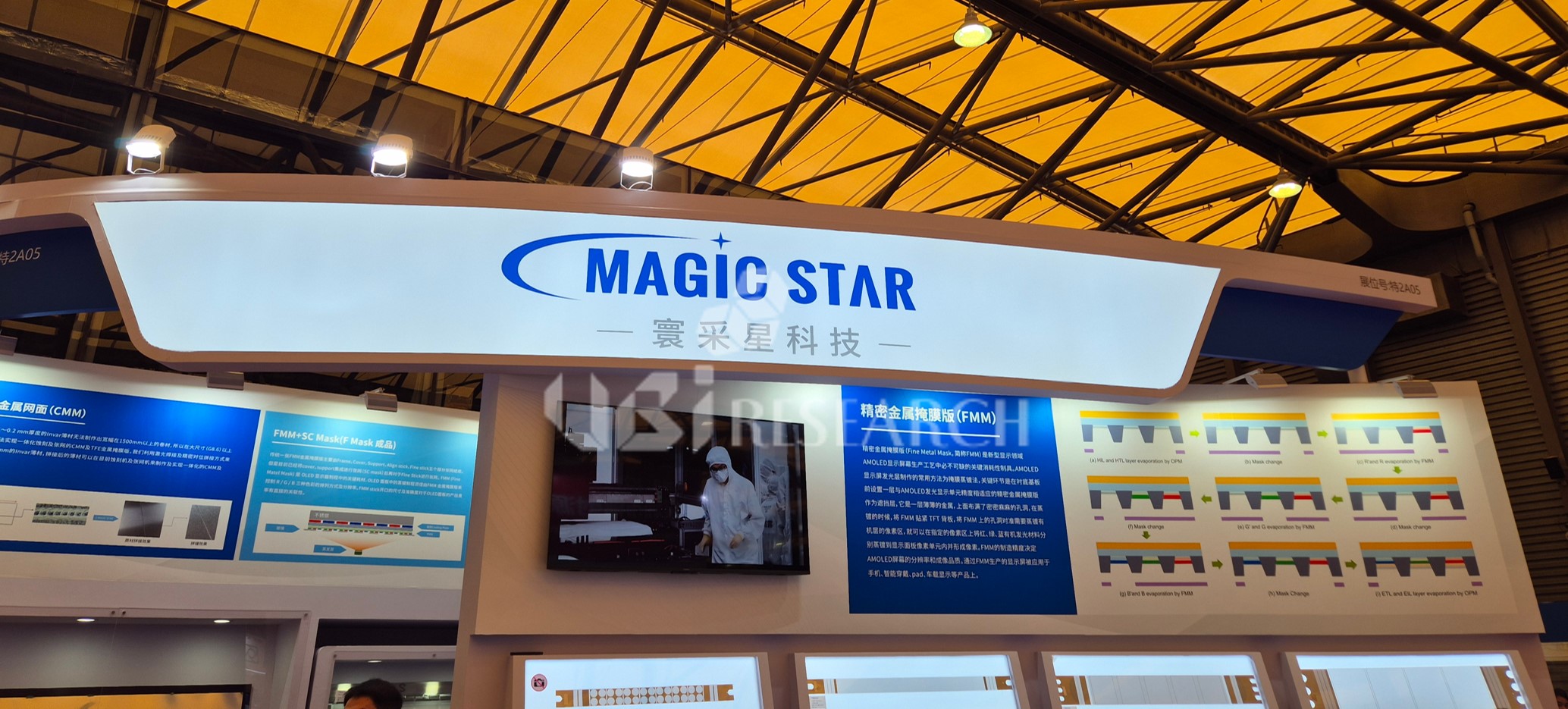
Magic Star FMM booth at DIC 2025 (Source: UBI Research)
Chinese fine metal mask (FMM) manufacturer Magic Star (寰采星) is expanding its business by simultaneously developing a Gen 8.6 FMM mass-production line and pursuing an initial public offering.
After securing a Pre-IPO investment in early July, Magic Star formally entered the listing guidance process for an A-share IPO on July 9. China Securities Co., Ltd. was appointed as the listing guidance institution, while Hefei State-Owned Capital Investment and Operation Group participated in the Pre-IPO financing through one of its affiliated funds.
Hefei State-Owned Capital Investment stated that the investment is intended to strengthen the supply chain of China’s emerging display industry and improve supply stability in key OLED materials and components, where China’s domestic sourcing rate remains relatively low. Magic Star is regarded as one of China’s leading domestic suppliers capable of mass-producing FMMs for OLED deposition.
According to industry sources, Magic Star has expanded FMM supplies across major Chinese OLED panel makers. However, shipment volumes by customer and detailed mass-production adoption of its Gen 8.6 products have not been disclosed.
Following its Gen 6 FMM products for smartphone OLEDs, Magic Star is increasing investment in Gen 8.6 FMMs to address demand from medium- and large-sized IT OLED applications, including notebooks, monitors and automotive displays. In April 2025, the company announced a plan to invest more than RMB 1 billion in Ningbo, Zhejiang Province, to build a Gen 8.6 OLED FMM mass-production line. The first-phase investment for the Gen 8.6 FMM manufacturing line amounts to approximately RMB 580 million.
Equipment installation for the line was completed in November 2025, and full-scale mass production is being pursued from 2026. The new production line is designed to process wide raw-material sheets measuring more than 700 mm in width. This capability is required to manufacture large-area FMMs that enable the efficient placement of notebook and monitor panels on Gen 8.6 OLED substrates.
The maximum dimensions supported by Magic Star’s disclosed Gen 8.6 FMM products are 1.7 meters in length and 480 mm in width. A 1.7-meter strip-type FMM provides greater flexibility in panel layout and can support a range of medium- and large-sized products, including notebook displays and wide-format automotive OLEDs.
Reducing FMM thickness helps minimize the shadow effect during the deposition process and improves aperture precision, making it advantageous for the production of high-resolution OLED panels. Magic Star has stated that it has secured an ultra-thin manufacturing process for 18–20 μm Gen 6 FMMs and technology capable of supporting resolutions above 550 ppi.
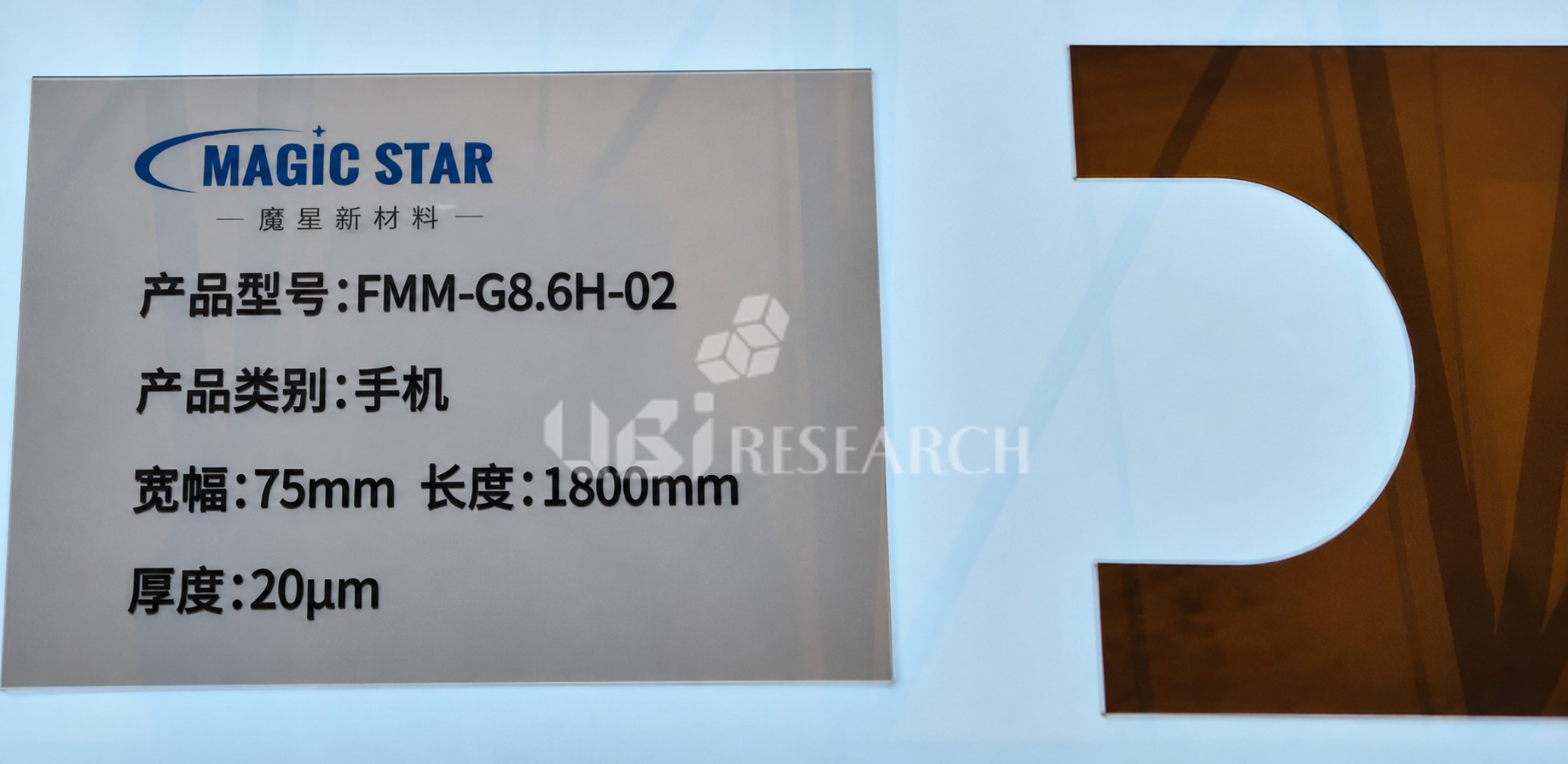
Magic Star showcased a 20μm-thick FMM product for 8.6G half-cut OLED applications at DIC 2025. (Source: UBI Research)
FMM is a critical component used to selectively deposit OLED emitting materials onto the red, green and blue subpixel locations. Aperture accuracy, flatness, thickness and tension uniformity directly affect OLED panel resolution and deposition yield.
The high-precision OLED FMM market remains heavily influenced by overseas suppliers, particularly Japan’s DNP. Gen 8.6 FMMs require more advanced process technology than Gen 6 products because their larger mask area makes it more difficult to control sagging, thermal deformation and variations in tension.
Should Magic Star achieve stable mass production of Gen 8.6 FMMs and expand qualification among Chinese OLED panel makers, the localization of China’s FMM supply chain could accelerate. Key factors determining the company’s future competitiveness will include tension uniformity across large-area masks, aperture precision, the sourcing of ultra-thin Invar materials, durability over repeated use and yield performance on actual OLED mass-production lines.
Junho Kim, Analyst at UBI Research (alertriot@ubiresearch.com)
▶2026 Analysis Report on China’s OLED Supply Chain Management
▶China Display Industry Trends Report
※ This article is produced by UBIResearchNet.
Unauthorized reproduction or citation without source attribution is prohibited.
When quoting, please clearly indicate the source (UBIResearchNet) and provide a link.