
Meta Publishes AR Waveguide Patent That Widens Field of View in Standard Glass
On November 5, 2026, Meta Platforms Technologies published a patent application (US 2026/0349260) for an AR waveguide that achieves a wide field of view (FOV) using standard glass. In AR glasses, the waveguide is the component that carries the projector's image through a thin glass plate by total internal reflection and displays it in front of the eye. The lower the glass's refractive index, the narrower the range of light angles it can guide. As a result, conventional designs that place the light-bending fine gratings parallel to the glass surface are limited to an FOV of about 27° in standard glass with a refractive index of 1.52. To achieve a 70° FOV in its Orion prototype, Meta used a SiC substrate with a refractive index of about 2.65.
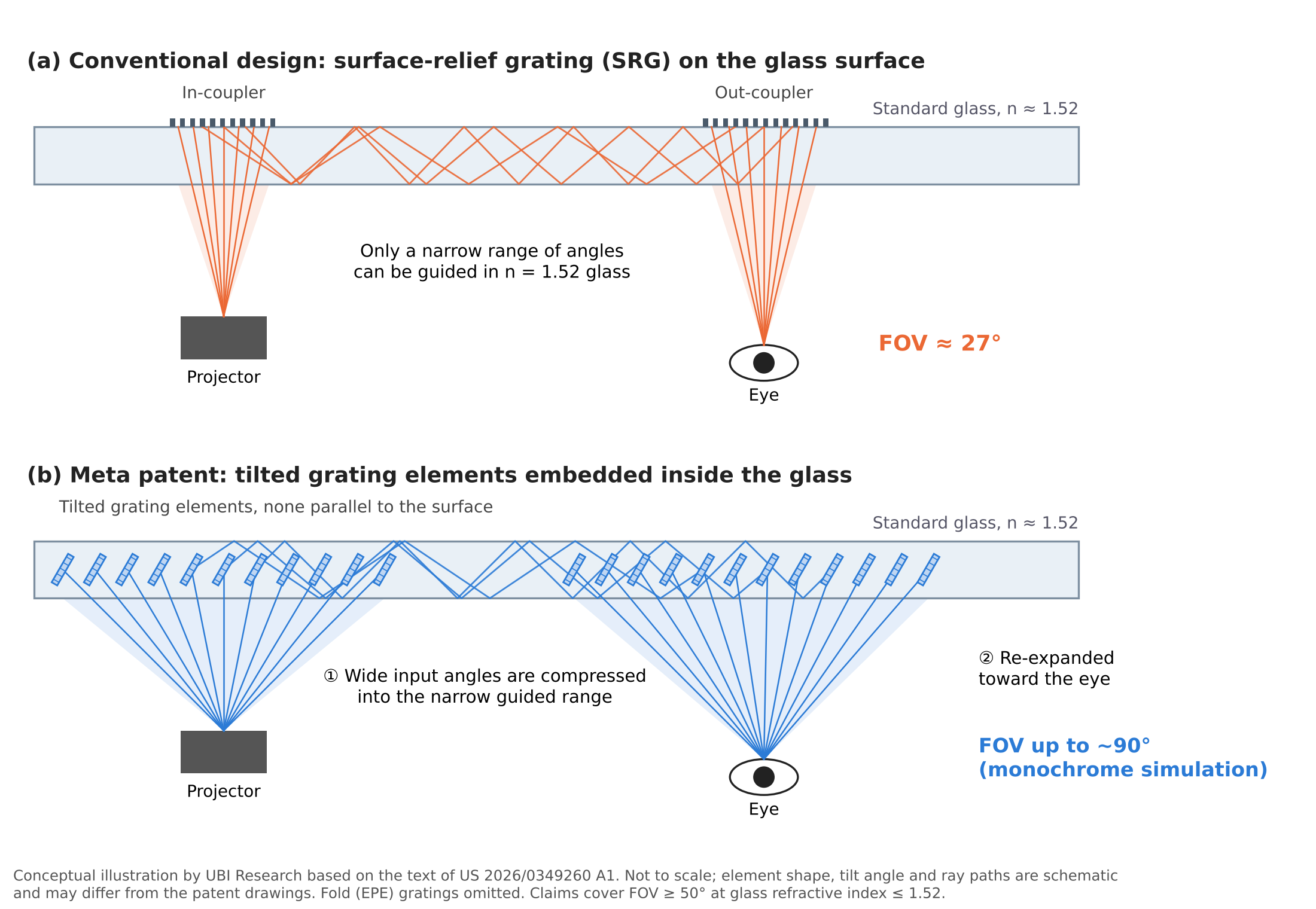
Figure 1. Planar grating vs. Meta's tilted embedded grating (conceptual)
Source: Prepared based on the description in US 2026/0349260 A1
The key to this patent is a structure in which the grating elements are tilted at set angles inside the glass. Claim 1 specifies that the grating elements are physically tilted within the waveguide medium and that none of them is parallel to the outer surfaces. The tilted gratings compress wide-angle light from the projector into the narrow angular range that standard glass can guide, then re-expand it to wide angles as the light is coupled out toward the eye (Figure 1). According to the application, a design using this structure showed an FOV of up to about 90° in a monochrome simulation on the same standard glass, about three times that of a comparable planar-grating design (about 27°). The claims cover an FOV of 50° or more in glass with a refractive index of 1.52 or less.
Among wide-FOV waveguides, approaches using high-index substrates such as SiC and reflective approaches are currently at the prototype or mass-production stage. This application differs from both in that it widens the FOV through grating structure rather than substrate material. The SiC approach achieved about 70° in Orion, but material cost and processability remain challenges. SiC waveguide mass-production lines are scheduled to start operating in 2027.
The reflective approach is in mass production in Ray-Ban Display (20° FOV), and Lumus unveiled a prototype exceeding 70° FOV in 2026. If the standard-glass approach is realized, it would ease the substrate cost burden, but forming tilted grating elements inside the glass would become a new manufacturing challenge. A wider FOV also raises the resolution and brightness required of the light source: achieving 70° at the same pixel density as current products, which use 600×600 resolution at 20°, would require about 2,100 pixels per side.
The performance figures in the application are monochrome simulation results; no data on full-color performance, optical efficiency or mass-production processes were disclosed. Commercial viability will likely become clearer through the outcome of the patent examination and full-color validation data.
Noh Chang-ho, UBI Research