
Following the unveiling of its glasses-type VR device, ‘Meta VR Glasses,’ at Meta Connect 2026 on September 23, Meta has been confirmed to have acquired 419 XR patents from Sony. As Meta shifts its focus from headsets to glasses, it appears to be strengthening its foundation on both the hardware and patent fronts.
Meta VR Glasses adopts Micro-OLED instead of LCD and cuts the weight of the face-worn unit to about 100 g. By moving the Qualcomm Snapdragon Reality Elite chip and the battery into an external puck of about 300 g, Meta reduced the head-worn weight to roughly one-fifth that of Quest 3. The design focuses less on reducing the overall weight of the device than on easing the load concentrated on the face. The device is priced at $1,299 and is scheduled for release in spring 2027.
This is Meta’s first use of OLED since the 2019 Oculus Quest. Resolution per eye is 2,412×2,288, about 20% more pixels than Quest 3, and central angular resolution is 37 PPD, about 1.5 times that of Quest 3 (25 PPD).
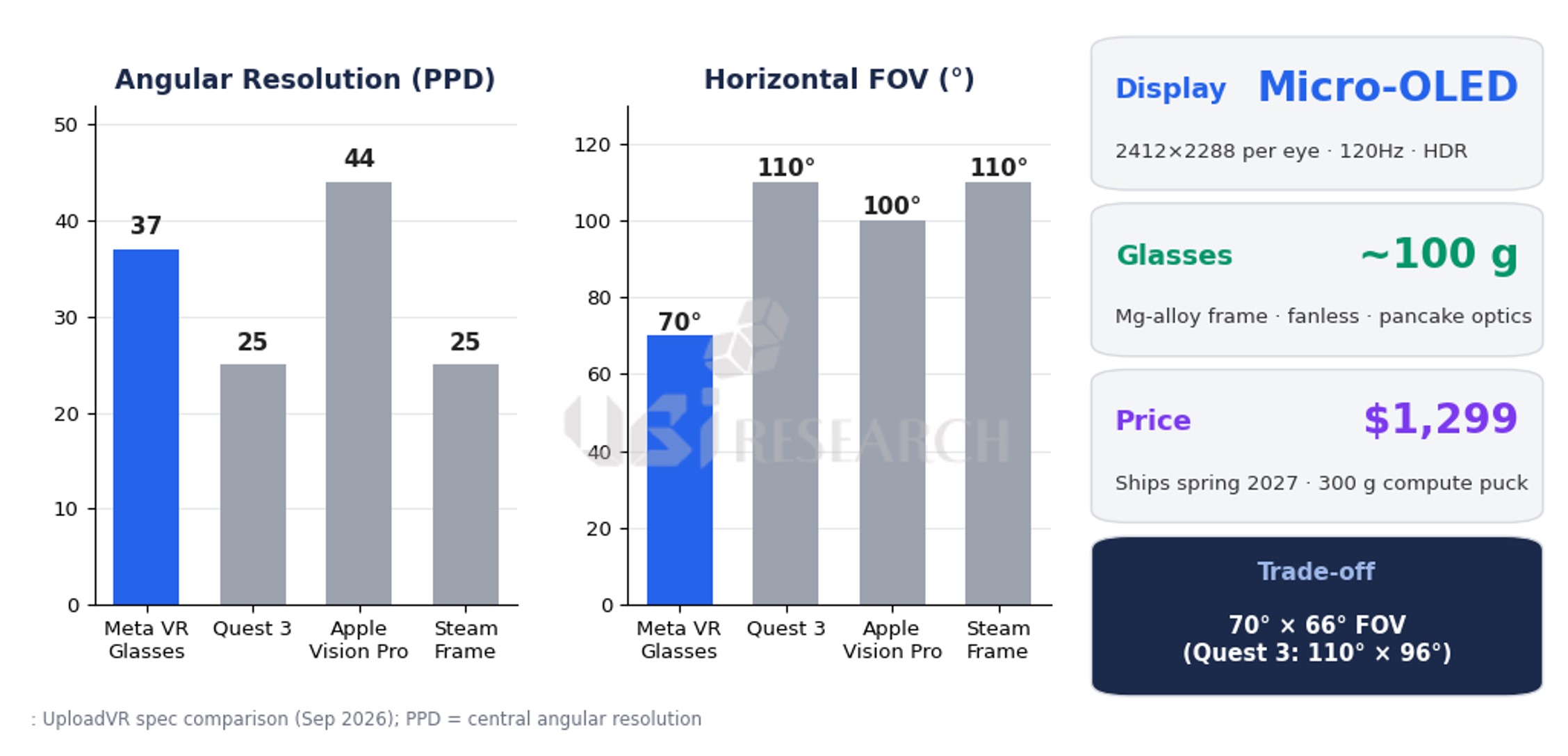
Figure. Display specification comparison of Meta VR Glasses and major XR headsets. (Source: UBI Research)
The gain in sharpness comes at the cost of field of view (FOV): 70° horizontal × 66° vertical, only about two-thirds of Quest 3 (110° × 96°). Spreading 2,412 horizontal pixels over 70° yields an average of about 34 PPD, but widening it to 110° drops this to about 22 PPD. Meta chose to narrow the field of view to raise pixel density, and introduced the device as ‘a personal cinema and multi-monitor workspace.’ This favors content placed in the center of the view, such as movies and document windows, but the narrow field of view remains a weakness for immersive VR gaming.
Movement on the patent front has also been confirmed. According to U.S. Patent and Trademark Office (USPTO) records dated October 5, the two companies signed a Confirmatory Assignment agreement in December 2025, covering 180 U.S. patents and 239 family patents filed in Japan, China, Korea, Europe and elsewhere. Of these, 43 U.S. patents related to VR, AR, MR and HMD systems completed the change of ownership between June and September. This is interpreted as a sign that Sony, which has supplied OLEDoS for Apple Vision Pro and Samsung Electronics’ Galaxy XR, is scaling back its XR hardware business, following its refusal of Apple’s request to expand capacity.
Meta’s shift to glasses is in line with market trends. Demand for VR headsets is declining, compounded by price increases driven by rising memory costs, while AI glasses shipments grew year on year in the first half of 2026, with Meta’s share reaching around 80%. Meta has also allocated about 70% of Reality Labs’ 2026 operating expenses to wearables.
Competitors are also targeting the glasses market. XREAL’s (太若科技) ‘Aura’ uses the same Snapdragon Reality Elite puck architecture as Meta, with Sony Micro-OLED and a 70° FOV, but adopts an optical see-through (OST) approach in which the real world is viewed directly through the glass; its price has been announced at under $1,500. Snap has launched ‘Specs’ ($2,195), LCoS-based AR glasses, while the AI display glasses segment is led by Chinese companies such as Rokid (灵伴科技) and Alibaba (阿里巴巴).
High-end XR devices are thus converging on Micro-OLED and a separate-puck architecture, and the Micro-OLED supply chain is expanding from Sony to Chinese companies. SeeYA Technology (视涯科技) is presumed to be supplying OLEDoS for Meta’s lightweight MR device. The entry of Meta, the largest XR device maker by shipments, is expected to cement this trend. However, with the new product slipping to 2027, a headset rebound in 2026 is also likely to be delayed, and the product’s success will depend on whether improvements in sharpness and wearability can offset its $1,299 price and narrow field of view.