
Lightweight design, high brightness, full-color capability, and low power consumption are critical hurdles that the consumer augmented reality (AR) microdisplay industry must overcome, and they have long been the primary bottlenecks constraining the industry’s large-scale development. The current mainstream approach of combining red, green, and blue monochrome micro-LEDs into cubic modules has limitations, including increased optical system volume and complex assembly processes. In this context, “monolithic full-color micro-LEDs” are gradually emerging as a leading microdisplay solution and are increasingly recognized by the industry as the ultimate direction of evolution.
1. A Roadmap Toward Single-Chip Full-Color Implementation
Currently, the industry is exploring two parallel technological approaches—namely, “vertical stacking” and “quantum dot (QD) color conversion”—to achieve full RGB color within a single chip.
- “Vertical stacking” approach: This method vertically integrates RGB light-emitting structures within a single pixel unit. Theoretically, it offers very high pixel density (PPI) and low optical crosstalk, making it suitable for displays requiring ultra-high PPI. However, it involves complex processes such as heteroepitaxy, wafer bonding, and 3D interconnects, which place extremely high demands on the manufacturing window and equipment performance, making large-scale mass production within a short timeframe a significant challenge. Chinese companies J and H are developing products based on their proprietary patented technologies.
- “Quantum dot (QD) color conversion” method: This approach involves overlaying a quantum dot color conversion layer onto a mature blue micro-LED array to generate red and green light. By avoiding the challenges associated with complex multicolor epitaxy and heterogeneous bonding, it offers significant practical advantages in terms of development time, manufacturing complexity, and mass production feasibility, thereby establishing an early foothold in the market. Numerous companies, including China’s R, S, and T, as well as Taiwanese firms, are currently developing products using this approach.
2. System-level advantages of single-chip full-color (QD color conversion) method
The system-level advantages of single-chip full-color panel technology for AR glasses can be summarized into three main points.
- Weight reduction and integration of optical modules: By implementing all RGB functions within a single chip, the complexity of the optical module structure can be significantly reduced, leading to a decrease in both size and weight. At the same time, this approach minimizes the need for multi-chip calibration, assembly, and adjustment, making it ideal for the thin, lightweight designs and extended wear times required by consumer AR devices.
- Maximizing Energy Efficiency and Battery Life: This technology overcomes the inherent efficiency limitations of Native Red micro-LEDs. By reducing power consumption while maintaining high brightness output, it effectively addresses battery life issues in lightweight AR devices.
- Mass Production and Cost Reduction: Based on a single-chip integrated architecture, this approach significantly simplifies the manufacturing process, improves yield, and substantially reduces costs during large-scale mass production.
3. Trends in Mass Production Readiness Among Leading Companies in China and Taiwan
It is China’s innovative companies that are leading the way in product validation and mass production by continuously advancing the QD color conversion pathway, which currently holds the highest potential for mass production in the global market. While challenges remain in the ongoing optimization of key metrics such as the stability, conversion efficiency, and color purity of quantum dot materials, these companies are already achieving remarkable results.
Raysolve has developed a high-resolution, single-chip, full-color micro-LED display solution based on standard semiconductor photolithography technology. The company recently completed validation of the display module’s integration through global AR optics and finished product manufacturers. This marks a significant leap from the “technology validation” stage to the “product validation” stage.
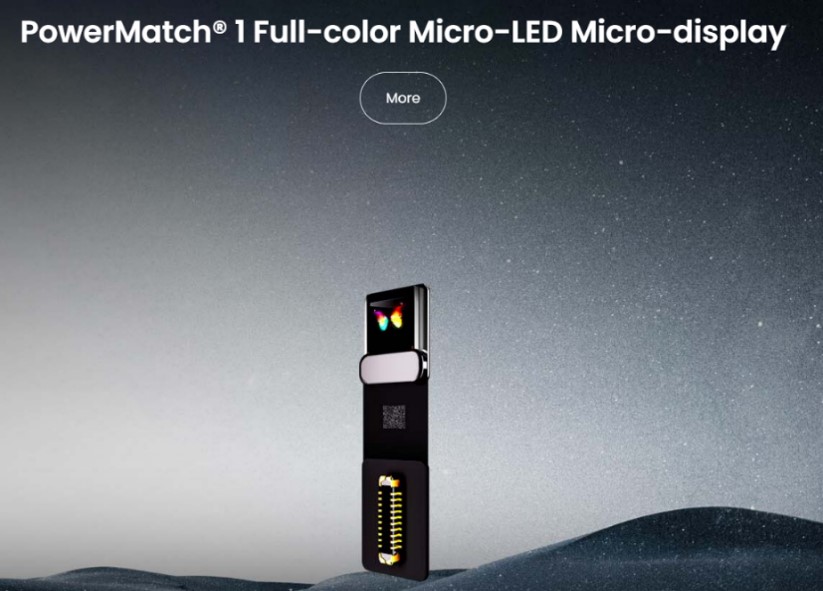
Raysolve PowerMatch 1 full-color Micro-LED Micro-display (Source: Raysolve)
Saphlux has already reached the mass production stage by leveraging its proprietary in-situ quantum dot color conversion solution. The company is currently operating a 6-inch silicon-based micro-LED production line stably and is accelerating the construction of a new 12-inch production line to support larger-scale manufacturing. At Display Week this past May, in addition to the aforementioned companies, exhibits from Taiwan’s PlayNiride (0.18-inch) and China’s TCL CSOT (0.28-inch) also incorporated QD color conversion technology.
Single-chip full-color panel technology is emerging as the ultimate direction for the evolution of AR microdisplays by addressing long-standing challenges such as complex optical modules and mass transfer processes.
According to an analysis by UBI Research, leading Chinese companies have completed integration testing with global finished-product manufacturers using their production lines, leveraging QD color-conversion technology. Compared to the existing RGB-segmented cubic method, this technology simplifies manufacturing and optical assembly processes, reducing costs to about one-third of the previous level. The dawn of the “consumer AR era,” in which AR devices will be as lightweight as ordinary glasses, is gradually drawing near.
Namdeog Kim, Senior Analyst at UBI Research (ndkim@ubiresearch.com)
▶101 inch Micro-LED Set BOM Cost Analysis For TVs
▶Industry Trends and Technology of Micro-LED Displays for XR Report
※ This article is produced by UBIResearchNet.
Unauthorized reproduction or citation without source attribution is prohibited.
When quoting, please clearly indicate the source (UBIResearchNet) and provide a link.