
OLED monitor panel shipments are forecast to rise from approximately 5.17 million units in 2026 to 16.73 million units in 2030. As gaming OLED monitors move into the mainstream consumers are taking a closer look at screen uniformity and brightness control. The debate surrounding the CPC function in the Alienware AW3926QW has emerged in this changing market environment.
Reporting and analysis: UBI Research Reviewed by: Choong Hoon Yi, CEO & Chief Analyst
OLED is becoming a core display technology for premium gaming monitors. According to UBI Research’s AMOLED Display Market Forecast DB published in July 2026 OLED monitor panel shipments are projected to increase 44% from about 5.17 million units in 2026 to 7.43 million units in 2027. Shipments are expected to reach approximately 16.73 million units in 2030 or 3.2 times the 2026 volume.
By supplier Samsung Display shipments are forecast at approximately 3.74 million units in 2026 5.08 million units in 2027 and 9.74 million units in 2030. LG Display shipments are expected to rise from about 1.43 million units to 2.35 million units and 6.99 million units over the same period. As QD-OLED and WOLED grow together gaming OLED monitors are expanding in both screen size and product range.
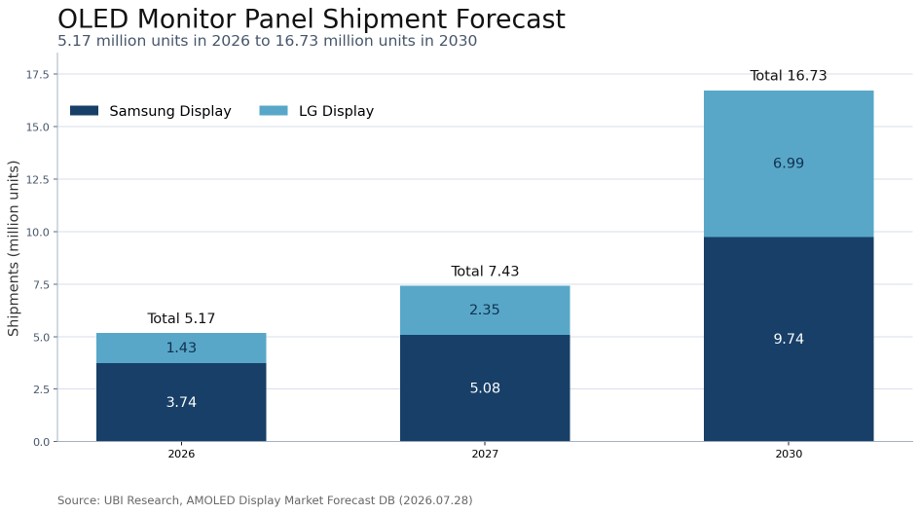
OLED monitor panel shipment forecast. Source: UBI Research, AMOLED Display Market Forecast DB (2026.07.28)
As the market expands consumers are evaluating a broader range of performance factors. Resolution refresh rate and response time remain important but screen uniformity sustained HDR brightness text clarity and image-retention management are also becoming purchasing criteria. In premium gaming OLED monitors the brightness-control algorithms applied by the monitor manufacturer can affect the actual user experience even when they are not disclosed on the specification sheet.
Against this backdrop Alienware’s 39-inch ultrawide OLED monitor AW3926QW has become the focus of a screen-uniformity debate. The monitor supports 5120 × 2160 resolution at 165 Hz and uses an RGB-stripe panel based on LG Display’s fourth-generation Tandem WOLED technology. It also offers a 330 Hz dual mode at 2560 × 1080 resolution.
According to an article published by specialist display outlet TFTCentral on September 15 2026 some users reported that the edges of the screen appeared dimmer than the center. When CPC or Convex Power Control is active luminance gradually decreases from the center toward the edges. The difference can be noticeable on solid white or gray screens and in document or web content.
TFTCentral described CPC as an OLED management function that lowers edge brightness to mitigate the risk of image retention. Alienware is testing a toggle that would allow users to adjust screen uniformity directly. The company plans to decide whether to implement the option after evaluating its effect on the overall user experience.
Choong Hoon Yi, CEO and Chief Analyst at UBI Research, said, “As the OLED monitor market expands consumer evaluation is moving beyond panel specifications to actual image quality and monitor-level control. The ability to choose between screen uniformity and panel-protection functions could become a new competitive factor in premium gaming monitors.”
The AW3926QW case shows that OLED monitor competition is extending beyond resolution and refresh rate to image quality and user-control experience. As the market grows protection algorithms and display characteristics applied by manufacturers are likely to become increasingly important points of comparison.
Sources: TFTCentral (9/15) · TFTCentral (6/1) · Dell · UBI AMOLED Display Market Forecast DB (2026-07-28)