
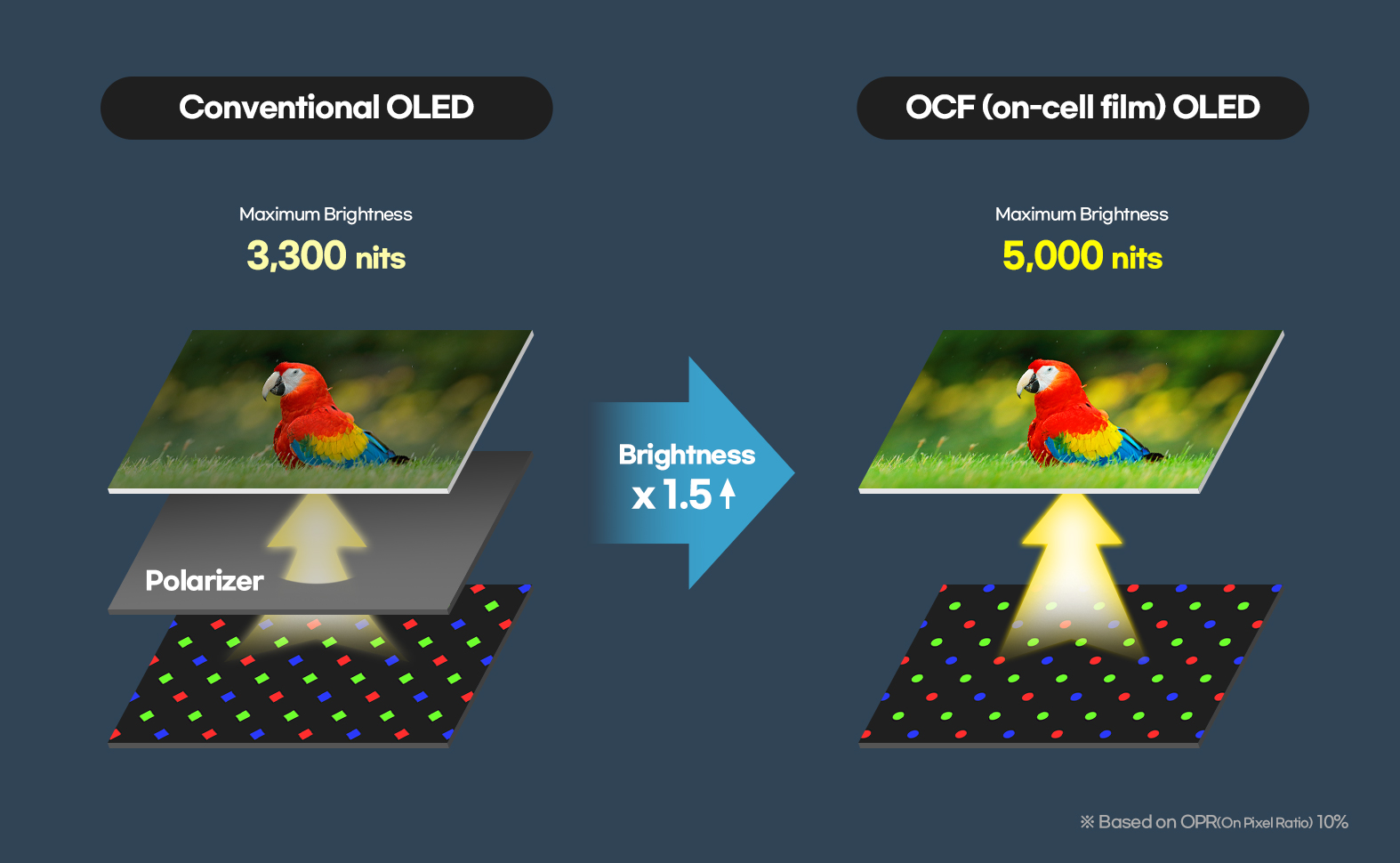
Samsung Display OCF OLED technology structure (Source: Samsung Display Newsroom)
At the 1st Automotive Display Industry Forum, Professor Young-do Kim of Kumoh National Institute of Technology introduced OLED low-power technologies and the development history of On-Cell Film (OCF). Based on his experience leading OCF development at Samsung Display, Professor Kim explained the background and technical significance of OLED’s evolution toward removing the polarizer.
OLED is prone to external light reflection due to its internal metal electrodes and wiring. Conventional OLED has used polarizers to reduce this reflection, but polarizers also lower the transmittance of OLED emission, increasing power consumption when implementing the same brightness.
OCF is a technology that reduces external light reflection by forming a color filter and black matrix on the panel instead of using a polarizer. The black matrix absorbs visible light in non-emissive areas, while the RGB color filter selectively absorbs unnecessary wavelength components in each subpixel. This suppresses external light reflection while reducing the optical loss that previously occurred in the polarizer by removing it from the OLED structure.
Samsung Display further developed OCF into its LEAD and Eco² OLED technologies. According to the presentation materials, OCF OLED can achieve 1.5 times higher brightness at the same power level compared with the conventional structure, and can operate at around 63% of the conventional power level at the same brightness. In addition, the removal of the polarizer leads to a reduction in panel thickness, contributing to slimmer foldable OLED designs and improved folding reliability.
The effect of thickness reduction is particularly significant in foldable displays. Because bending stiffness is proportional to the cube of thickness, a structure that removes the polarizer and applies a color filter array is advantageous for improving folding characteristics. During the OCF development process, key technical challenges included forming the color filter on the TFE surface, low-temperature curing to reduce EL damage, and matching EL emission with the CF spectrum.
After OCF adoption, materials capable of replacing the UV-blocking function previously performed by the polarizer also became necessary. As a result, the importance of UV-blocking adhesive and UV-blocking coatings has increased, while OCA is also emerging as a key module material that goes beyond a simple adhesive layer to secure optical reliability.
OCF technology is also expanding into viewing angle control. Samsung Display is advancing the technology through FMP (Flex Magic Pixel™), which applies a black matrix structure to distinguish between normal pixels and privacy pixels. This technology is considered capable of enhancing privacy functions and the user experience in mobile devices by limiting screen information exposure at specific viewing angles.
Ultimately, OCF is a key optical technology that simultaneously supports external light reflection reduction, low power consumption, slimmer panel design, and improved foldable reliability in OLED. Going forward, OCF-based technologies are expected to expand as a major technology axis for improving power efficiency and product design flexibility in smartphones, foldable OLED, and IT OLED.
Changwook Han, Executive Vice President/Analyst at UBI Research (cwhan@ubiresearch.com)
▶2026 Small OLED Display Annual Report
▶2026 Medium & Large Size OLED Display Annual Report
※ This article is produced by UBIResearchNet.
Unauthorized reproduction or citation without source attribution is prohibited.
When quoting, please clearly indicate the source (UBIResearchNet) and provide a link.