
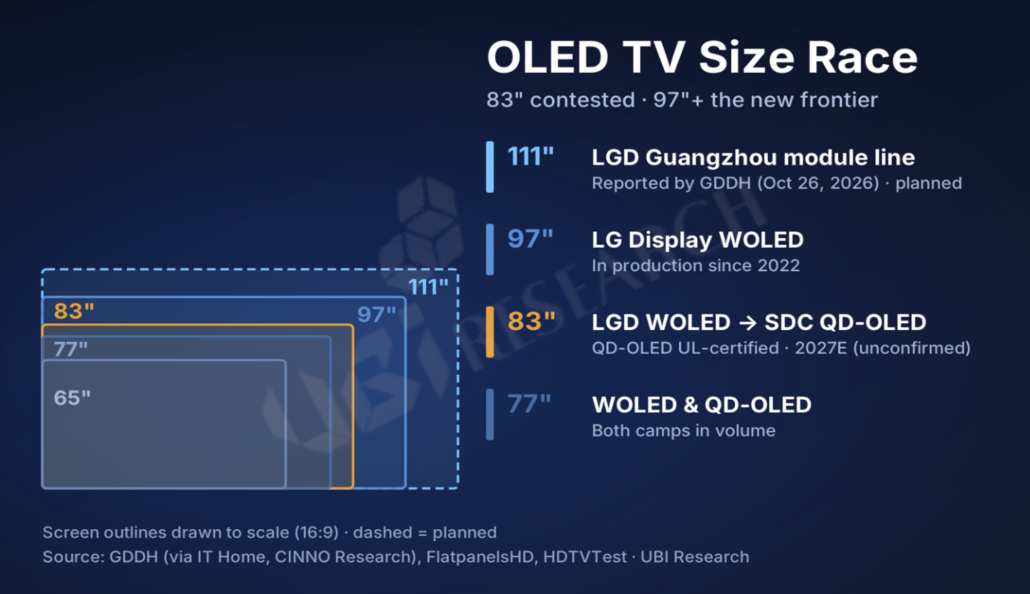
Guangzhou Development District Holding Group (广开控股, hereinafter GDDH) announced on October 26 that it will join LG Display in injecting a combined CNY 1 billion (approx. KRW 198.6 billion) into their Guangzhou OLED joint venture (LG Display 70%, GDDH 30%) in proportion to their stakes. The funds will be used to build module lines for 77-, 83-, 97- and 111-inch OLED panels, and GDDH stated that the 111-inch line will be the world’s first dedicated module line based on WOLED (as reported by CINNO Research). LG Display’s current WOLED lineup spans 42 to 97 inches; the addition of 111 inches would raise the maximum size of OLED TVs by another step.
Samsung Display is also on the move. Its QD-OLED TV panels have so far been limited to 55, 65 and 77 inches, which is why Samsung Electronics has used LG Display’s WOLED panels in its 83-inch OLED TVs. In April this year, however, Samsung Display registered an 83-inch QD-OLED panel for UL Solutions certification for the first time, and the industry sees a possibility of mass production in 2027.
Looking back, it is LG Display that has led the size expansion of OLED TVs. WOLED, which started at 55 and 65 inches, grew through 77 and 83 inches to reach 97 inches in 2022, and sizes of 83 inches and above have effectively been supplied by LG Display alone. The Guangzhou investment is not a panel capacity expansion but a technology upgrade of the module process. Its aim is to enable ultra-large panels produced at the existing Gen 8.5 OLED fab (90,000 glass substrates per month) to be finished into complete modules on site.
The first driver of OLED TV upsizing is a shift in the competitive landscape with LCD. Chinese TV makers are rapidly expanding the market for 100 inches and above with Mini LED and RGB LED backlit LCDs. If OLED fails to enter this segment, it will have no choice but to cede premium ultra-large TV demand to LCD.
Second, upsizing raises the utilization of existing equipment. A Gen 8.5 mother glass (2200×2500 mm) yields three 65-inch panels or two 77-inch panels, but theoretically only one 111-inch panel. Because glass consumption rises sharply even at the same unit volume, fab utilization and revenue per unit can be lifted together without investing in a new fab. As both companies operate Gen 8.5 lines, upsizing serves as a means of improving profitability.
Third, the zone of differentiation is moving upward. 83 inches has long been a size monopolized by LG Display, but it will turn into a contested segment once QD-OLED enters. LG Display’s move to set up 97- and 111-inch module lines at the same time can be read as a step to secure the next zone of differentiation in advance.
Because ultra-large OLEDs yield few panels per mother glass, yield translates directly into cost. The 111-inch market is expected to take shape initially around a limited number of premium home and commercial display applications.