
UBI Research’s recently published “Analysis Report on Perovskite Materials: Industry and Application Technologies” finds that perovskite materials have moved beyond the efficiency race into a new phase of competition centered on manufacturability, lifetime, and certification. Perovskites have drawn attention in both displays and solar cells because their emission color and absorption wavelength can be tuned freely simply by changing the composition, and because they offer high color purity and are well suited to low-cost processing. Efficiency has already reached commercial levels, but turning the technology into real products requires clearing three hurdles: stability, mass-production processes, and certification.
The biggest challenge is stability. Perovskites are vulnerable to moisture and heat, and when light or electrical bias is applied, ions inside the material migrate and degrade performance. However, a steady stream of recent studies has substantially extended lifetime through structural design, such as protecting nanocrystal surfaces with multiple layers. As a result, stability is shifting from an insurmountable limitation to a challenge that can be managed by design.
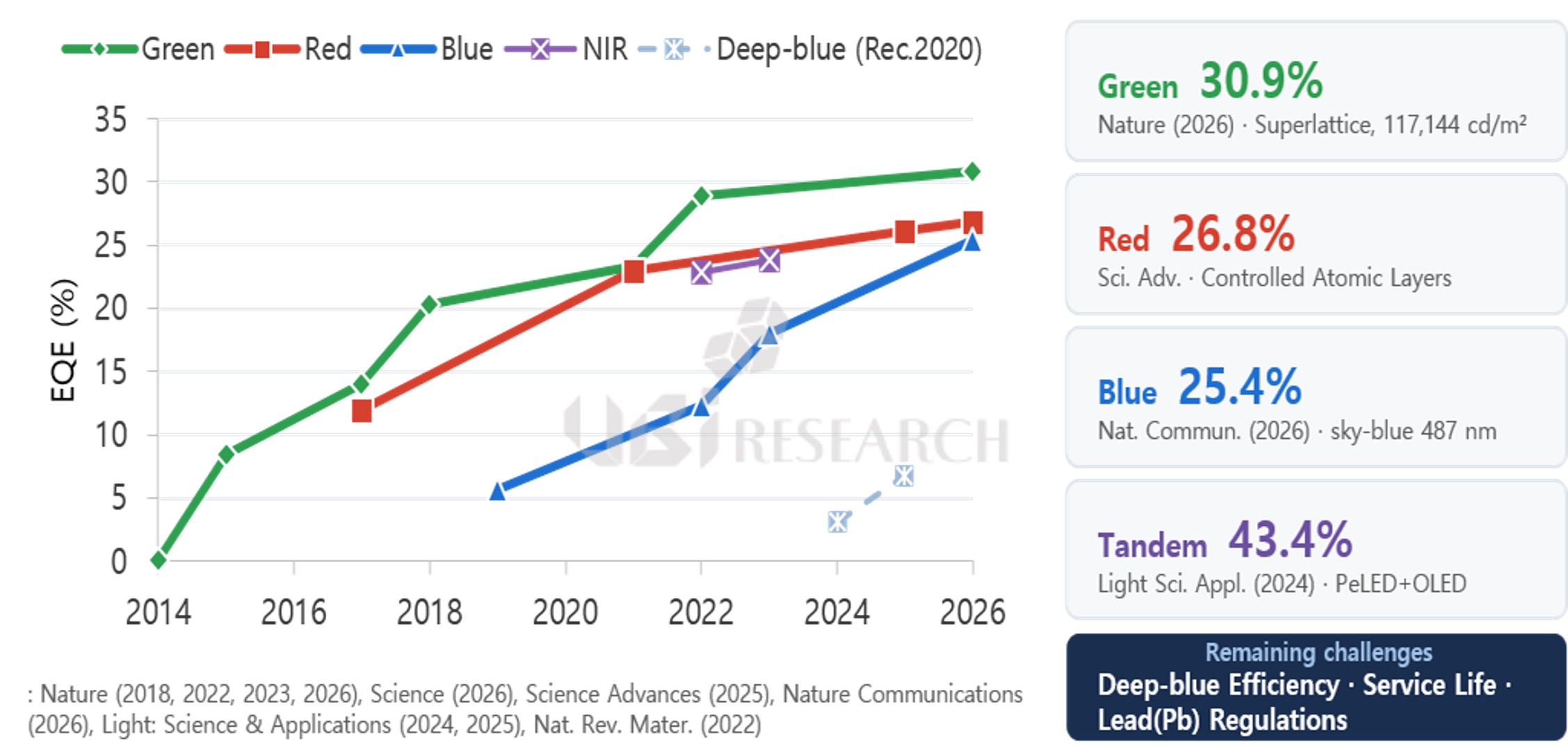
Figure. Efficiency improvements in self-emissive PeLEDs. Source: UBI Research
The application closest to commercialization is color-conversion material for Mini-LED LCDs. Because the material emits light when excited by light rather than electricity, degradation stress is low, and only the material needs to be replaced while the existing LCD architecture is retained. The mass-synthesis problem that had been a stumbling block is also being resolved. A Seoul National University research team announced a low-temperature synthesis method that maintains lab-level quality even in large-scale reactors, and SN Display, a participant in the joint research, signaled its entry into mass production after winning a CES 2026 Innovation Award for its roll-to-roll-processed color-conversion film. Yet a developer’s readiness for mass production and adoption by set makers are separate matters. Before TV and monitor makers actually adopt the material, long-term reliability, stable supply, cost competitiveness against existing QD materials, and compliance with lead regulations must first be verified. With the Mini-LED TV market growing, demand conditions are favorable, and adoption is expected to expand gradually, starting in regions where lead regulations are relatively lenient.
Self-emissive PeLEDs have reached efficiencies comparable to OLEDs in green and red. However, blue lags far behind in both efficiency and lifetime, limiting progress toward full-color displays. Hybrid structures combined with OLEDs are drawing attention as an alternative, and although ultra-high-resolution pixel patterning technologies have achieved sufficient results at the research level, validation in mass-production processes remains to be done.
In solar cells, the efficiency race is effectively over. Tandem cells combined with silicon have already surpassed the theoretical limit of conventional silicon solar cells. The key issue now is the module. Commercial module efficiency is still roughly on par with high-efficiency silicon modules, so module efficiency must be raised another notch to justify a price premium. This year also saw productization milestones, including Hanwha Qcells’ acquisition of international certification and China’s GCL (协鑫) winning its first commercial procurement bid. However, current certification standards were built around silicon and do not adequately reflect degradation phenomena unique to perovskites. Tandems are expected to enter first in markets where installation area is limited and high efficiency is required, with full-scale growth projected after 2035.
The final hurdle common to both fields is lead. Encapsulation technology can now suppress leakage during use to a considerable extent, but a recovery system for the end-of-life stage has yet to be established. Ultimately, the pace of perovskite commercialization will depend not on efficiency but on how quickly stability, mass-production processes, and certification and regulatory compliance are put in place.
UBI Research’s “Analysis Report on Perovskite Materials: Industry and Application Technologies” presents the latest development trends by application — displays, solar cells, and detectors — together with a development roadmap through 2033. It is expected to provide a practical basis for strategic planning by display and photovoltaic manufacturers, materials and equipment companies, investment institutions, and policy agencies.
Changho Noh, Senior Analyst at UBI Research (chnoh@ubiresearch.com)
▶Analysis Report on Perovskite Materials: Industry and Application Technologies
▶Display Korea 2027: Where Global Display Business Connects
※ This article is produced by UBIResearchNet.
Unauthorized reproduction or citation without source attribution is prohibited.
When quoting, please clearly indicate the source (UBIResearchNet) and provide a link.